


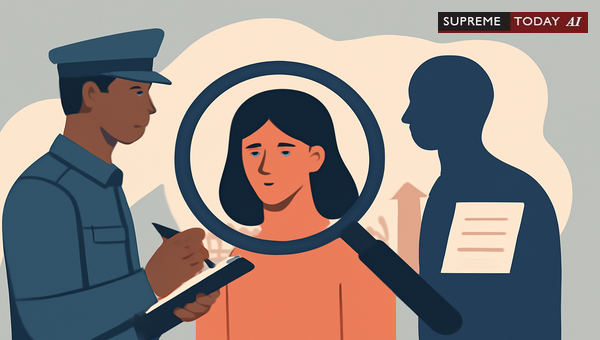
Police Probes Need Court Scrutiny for Fair Trials in India
In the Indian legal system, a fundamental question often arises: Police Investigation Cannot be Taken True at its Face Value it Needs to be Affirmed with a . This principle underscores the judiciary's vigilance in ensuring justice isn't undermined by flawed probes. While police investigations form the bedrock of criminal proceedings, courts routinely emphasize that they must be fair, impartial, and objective to protect , particularly 's guarantee of life and personal liberty. Blind acceptance of police reports can lead to , false implications, or overlooked evidence favoring the accused. This blog explores these principles, key precedents, and judicial interventions, drawing from established case law.
Core Legal Principles: Fairness in Police Investigations
Indian courts have long held that investigations must be conducted judiciously and without bias. An unfair process not only violates but erodes the trial's integrity. As noted in several rulings, courts emphasize that police investigation must be conducted in a fair, judicious, and unbiased manner to uphold the constitutional guarantee of () and ensure a 2018 0 Supreme(Raj) 160 2015 0 Supreme(Gau) 993 2019 0 Supreme(Ori) 43 2021 0 Supreme(Cal) 390 2019 0 Supreme(Guj) 143.
Unbiased probes prevent issues like or wrongful accusations. For instance, an unfair or biased investigation can lead to miscarriage of justice, , or false implications, which ultimately undermines the fairness of the trial 2012 0 Supreme(Del) 2137 2012 0 Supreme(Del) 3237.
Why Police Reports Aren't Gospel Truth
Courts are not obligated to accept investigation materials wholesale. The of police reports must be rigorously tested. The investigation's must be scrutinized; courts are not bound to accept police reports or materials collected during investigation as entirely truthful or complete 2015 0 Supreme(Gau) 993 2009 0 Supreme(SC) 1404 2017 0 Supreme(Jhk) 2035.
This scrutiny extends to all materials, including those supporting the accused's innocence. The entire corpus of investigation materials, including those supporting the innocence of an accused, must be considered to determine whether a fair and just process has been followed 2018 0 Supreme(Raj) 160 2015 0 Supreme(Gau) 993 2019 0 Supreme(Ori) 43 2017 0 Supreme(Jhk) 2035. At the , judges evaluate if facts, taken at face value, reveal an offense—yet even this requires holistic review. As one precedent states, to find out whether the facts emerging therefrom taken at their face value disclose the existence of all the ingredients constituting the alleged offence 2023 Supreme(Online)(All) 23045.
The Judiciary's Watchdog Role
When bias or influence taints an investigation, courts step in decisively. They possess inherent powers to monitor, transfer, or order fresh probes. Courts have the authority to scrutinize whether the investigation was conducted fairly and impartially, especially if there are allegations of bias or influence 2012 0 Supreme(Del) 2137 2012 0 Supreme(Del) 3237 2019 0 Supreme(Guj) 273 2021 0 Supreme(Cal) 390.
In high-stakes cases involving influential figures, transfers to agencies like the are common. For example, in a municipality recruitment scam, the court directed involvement due to the incriminating materials on record, the gravity of the offences alleged and the involvement of very influential persons including Ministers indicated proof of inability of holding fair and impartial investigation by the State police 2023 0 Supreme(Cal) 120.
Similarly, in a fatal accident case under the and , the court transferred the probe to the , holding that a fair investigation is a constitutional right, and if the police fail to perform their duty, the court must intervene to ensure justice. The right to a fair investigation was deemed fundamental, with police negligence warranting judicial action.
In cases where investigation appears biased or tainted, courts can transfer or supervise the investigation to ensure its impartiality 2014 0 Supreme(All) 3503 2010 0 Supreme(Guj) 502 2004 3 Supreme 210. This ensures the process not only is fair but appears fair, as the investigation must not only be fair but also appear to be so; any suspicion of bias or influence can undermine the entire process 2012 0 Supreme(Del) 2137 2021 0 Supreme(Cal) 390.
Consequences of Faulty Investigations
Biased or incomplete probes invite strong remedies. Courts may order re-investigations or shifts to independent bodies. A faulty or biased investigation can justify courts' intervention, including transferring investigation to an independent agency or ordering re-investigation, to restore credibility and ensure fairness 2014 0 Supreme(All) 3503 2019 0 Supreme(Guj) 273 2004 3 Supreme 210 2021 0 Supreme(Cal) 390.
Real-world examples abound. In a case of alleged fake currency possession under , the court acquitted the accused, noting, It is true that there is no such rule that police personnel have to be always disbelieved. The question of such believe or disbelieve depends upon the facts and circumstances of a particular case. Similarly, it is also true that evidence of police personnel should not be taken always at its face value 2015 0 Supreme(Cal) 571. Contradictions in witness statements and lack of independent corroboration proved fatal to the prosecution.
FIRs filed with malice can be quashed outright. In one instance, the quashed an FIR, finding it filed with and for an oblique motive to arm twist the petitioner by involving him in the FIR for the purpose of settling scores. No evidence supported the claims, highlighting how courts pierce beyond surface allegations 2018 0 Supreme(P&H) 4731.
Even in non-criminal contexts, like employment terminations, orders aren't taken at face value if they mask misconduct. Broadly stated, the face is the index to the mind and an order fair on its face may be taken at its face value. But there is more to it than that, because sometimes words are designed to conceal deeds by linguistic engineering 2020 0 Supreme(Del) 773 2020 0 Supreme(Guj) 526 2015 0 Supreme(Del) 1165.
Key Precedents
The apex court reinforces these tenets consistently. The has consistently held that the entire collection of materials, including those in favor of the accused, must be considered at the charge framing stage, and only if the materials collectively disclose an offense, can charges be framed 2018 0 Supreme(Raj) 160 2017 0 Supreme(Jhk) 2035 2019 0 Supreme(Ori) 43 2015 0 Supreme(Gau) 993.
In another ruling, the court stressed, True one can point out faults on microscopic scrutiny, but, whether it has impact on the process of investigation needs to be considered. The investigating agency cannot be permitted to conduct the investigation in a tainted and biased manner 2024 0 Supreme(Bom) 774.
These precedents affirm that fairness is non-negotiable, with judicial oversight as the ultimate safeguard.
Conclusion and Key Takeaways
Police investigations in India must embody fairness, impartiality, and completeness—principles courts rigorously enforce. They cannot be accepted at face value; instead, they demand judicial affirmation through a . Key takeaways include:- Scrutinize for Bias: Challenge probes showing partiality, incompleteness, or prejudice.- Judicial Remedies: Courts may transfer cases (e.g., to or CID) or order re-probes.- Holistic Review: All evidence, including , must be weighed.- Constitutional Anchor: mandates fair investigations as part of .
When facing such issues, consulting a legal expert is advisable to assess specifics. This overview provides general insights based on precedents and is not personalized legal advice—outcomes may vary by case facts.
Word count: Approximately 1050
#FairTrialIndia, #PoliceInvestigation, #LegalRights












