


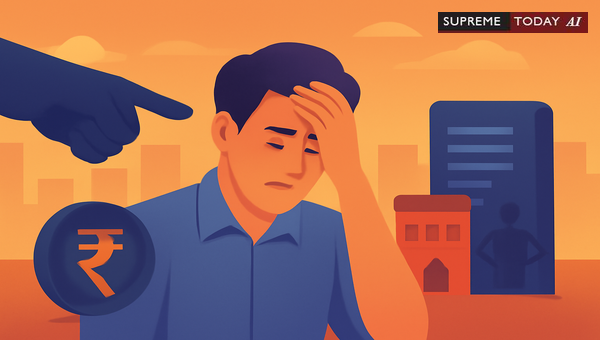
Common Man's Plight Against State Harassment: What Courts Say
In today's complex legal landscape, ordinary citizens often feel powerless against the might of public authorities or powerful builders. The poignant question arises: Unable to Match the Plight of a Common Man—how can courts bridge this gap? Indian jurisprudence consistently addresses this imbalance, emphasizing that harassment, arbitrary actions, and unlawful inaction by state instrumentalities erode public trust and violate constitutional norms. Courts have stepped in to protect the vulnerable, awarding compensation and condemning negligent officials. This post delves into key legal findings, remedies, and precedents to empower citizens.
Note: This is general information based on judicial observations and not specific legal advice. Consult a qualified lawyer for personalized guidance.
Main Legal Finding
Legal documents highlight that public authorities, as 'State' under , must act in a people-oriented manner. Harassment and arbitrary conduct by officials are impermissible, causing profound harm not just to individuals but to society at large. Courts recognize their duty to intervene, protect citizens, and award compensation to restore faith in the system. As noted, Public authorities, being , are constitutionally obliged to be people-oriented and accountable for their conduct 2023 0 Supreme(All) 981
.
This principle extends beyond direct state actions to failures in regulating private entities like builders, where the common man suffers disproportionately.
Key Points from Judicial Rulings
- Constitutional Obligation: Public bodies must avoid oppression; misuse of discretion invites judicial scrutiny 2023 0 Supreme(All) 981
.
- Harassment Impermissible: Arbitrary inaction breeds helplessness, fueling corruption and crime. Courts must provide immediate relief 2023 0 Supreme(All) 981
.
- Compensation as Remedy: Victims of unlawful acts deserve damages from public funds, recoverable from errant officials 2023 0 Supreme(All) 981.
- Judicial Condemnation: Attitudes supporting illegal acts, like regularizing unauthorized constructions, undermine the 2023 0 Supreme(All) 981.
These points underscore a proactive judicial role in balancing power dynamics.
Detailed Analysis: Responsibility of Public Authorities
Under India's constitutional framework, sovereignty vests in the people, obliging all government limbs to serve accordingly. When authorities act oppressively or capriciously, they face accountability. Courts intervene against causing harassment. For instance, The common man is ill-equipped to match the might of the State or its instrumentalities 2023 0 Supreme(All) 981. This helplessness erodes confidence, making judicial protection essential
.
Harassment and the Common Man's Vulnerability
Public officials' delays or neglect inflict social injury greater than individual harm. Harassment by public authorities is socially abhorrent and legally impermissible 2023 0 Supreme(All) 981. Similar sentiments echo in builder-related cases, where An ordinary citizen or a common man is hardly equipped to match the might and power of the builders 2022 0 Supreme(Cal) 616 2019 0 Supreme(Mad) 161 2016 0 Supreme(MP) 689 2013 0 Supreme(Pat) 671. Unauthorized constructions violate laws, yet authorities often fail to act, compounding the plight.
In a PIL, rampant high-rise violations in narrow lanes highlighted municipal failures. The court mandated surveys, demolitions, and action against officials, stressing under ( orders on illegal constructions).
Judicial Remedies and Compensation
Courts typically award compensation for proven unlawful acts, ensuring deterrence. When public authorities act unlawfully or negligently, they are liable to compensate the victims 2023 0 Supreme(All) 981. Funds come from public coffers, recovered from responsible parties. This dual approach redresses grievances and promotes accountability.
Related precedents reinforce this. In unauthorized construction disputes, courts direct builders to compensate occupiers of illegal flats, as the jurisdiction and power of courts to indemnify a citizen for injuries suffered due to such unauthorised or illegal construction... is required to be compensated by them 2022 0 Supreme(Cal) 616 2019 0 Supreme(Mad) 161 2016 0 Supreme(MP) 689. Municipal inaction invites contempt, with directions for demolition and punitive costs (e.g., cases).
Condemnation of State and Builder Attitudes
Judiciary decries support for illegal regularizations or delays. The tendency of some authorities to support illegal or irregular constructions... damages public trust 2023 0 Supreme(All) 981. In Pondicherry planning cases, appeals ignoring court decrees were quashed, upholding 2019 0 Supreme(Mad) 161.
Exceptions and Limitations
While discretion exists, it cannot be arbitrary or mala fide. Compensation requires proof and reasoned findings
. Courts balance enforcement with fairness, as in cases allowing civil suits for damages against builders while ordering demolitions 2016 0 Supreme(MP) 689.
Insights from Related Cases
- Unauthorized Constructions: Builders erect illegal structures, putting buyers in possession without redress. Courts intervene, as in cases under , directing demolitions for unapproved floors and barring future projects (specific directions post- orders).
- Municipal Failures: In Patna, the court ordered stopping high-rises on sub-20ft roads, surveys, and tribunals, citing Supreme Court precedents on planned development.
- Builder vs. Citizen: Trade disputes even note public association of marks with products, but core theme remains protecting the weak 2017 0 Supreme(Mad) 608.
These cases illustrate how judicial oversight extends to private-public nexuses harming citizens.
Recommendations for Citizens and Authorities
- For Authorities: Adhere to laws, implement transparent mechanisms, and act timely to prevent harassment.
- For Citizens: Seek writs or suits for redress; document inaction for compensation claims.
- Judicial Role: Continue awarding damages to deter misconduct
.
Public bodies should foster accountability, restoring trust.
Conclusion: Empowering the Common Man
The plight of the common man against state or builder might is real, but courts provide robust safeguards. By condemning harassment, enforcing accountability, and granting remedies like compensation, judiciary upholds constitutional ethos. Key takeaway: No authority is above the law; citizens' rights prevail. Stay informed, act promptly, and leverage these principles for justice.
References:1. 2023 0 Supreme(All) 981: Core observations on authority responsibility and harassment prevention.2.
: Principles on accountability, compensation, and citizen protection.3. Additional cases: 2022 0 Supreme(Cal) 616, 2019 0 Supreme(Mad) 161, 2016 0 Supreme(MP) 689, 2013 0 Supreme(Pat) 671, and municipal PILs.
(Word count approx. 1050. General insights only.)
#CommonManRights #StateHarassment #JudicialRemedy















