


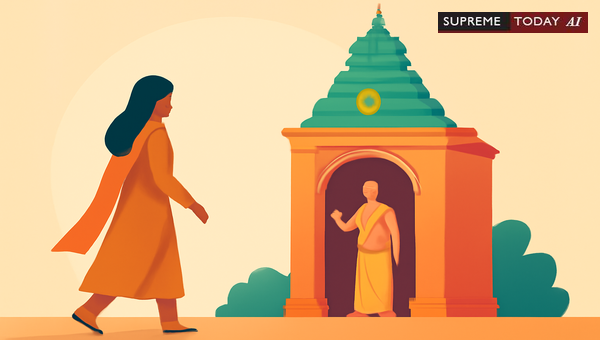
Right of Entry to Religious Places in India: A Comprehensive Legal Guide
In a diverse nation like India, where faith plays a central role in daily life, questions about who can enter religious places often spark debates. From age-old customs to modern constitutional mandates, the 'right of entry to any religious place' balances individual freedoms with community practices. This blog delves into the relevant sections of Indian law governing access to temples, mosques, churches, and other sites of worship, drawing from constitutional provisions, key statutes, and landmark judgments.
Whether you're a devotee seeking clarity or curious about legal boundaries, understanding these principles is crucial—especially amid evolving social reforms.
Constitutional Foundation:
The Indian Constitution enshrines the right to primarily through 1982 0 Supreme(SC) 190 2002 8 Supreme 359.
- guarantees 'freedom of conscience and the right to freely profess, practice, and propagate religion,' subject to public order, morality, and health 1982 0 Supreme(SC) 190. This implies a general right for individuals to enter and worship at religious sites without undue barriers.
- empowers every or section to 'establish and maintain institutions for religious and charitable purposes,' 'manage its own affairs in matters of religion,' and own/administer property 2002 8 Supreme 359.
These rights form the bedrock, but they are not absolute. Courts have consistently interpreted them to promote equality while respecting .
Restrictions and State Interventions
Religious freedoms under are tempered by reasonable restrictions:
- Subject to public order, morality, and health1982 0 Supreme(SC) 190 2002 8 Supreme 359.
- The State may regulate economic, financial, political, or secular activities linked to religious practice 1982 0 Supreme(SC) 190.
- Laws for social welfare and reform can open Hindu public religious institutions to all classes and sections of Hindus 1982 0 Supreme(SC) 190.
For instance, in cases involving temple administration, courts have upheld state oversight to prevent mismanagement. In a ruling on the 's duties, the court emphasized compliance with the and , noting the Board's obligation to 'manage temple properties, perform traditional rites, and ensure compliance with statutory duties' 2023 0 Supreme(Ker) 918. Permission for non-religious events like 'Nava Kerala Sadas' was set aside due to violations.
Defining ''
A key concept under is ',' defined as 'a collection of individuals having a common faith, a common organization, and a distinct name' 2016 2 Supreme 50 2017 7 Supreme 461. Not every group qualifies—mere devotees of a deity do not form a separate denomination.
In the iconic Sabarimala case, the ruled that 'devotees of Lord Ayyappa do not constitute a distinct , as they are simply Hindus and not a separate religious group' 2018 0 Supreme(SC) 959. The temple was deemed a ' without any exclusive identified followers.' This opened doors for broader access.
Relatedly, in a Tamil Nadu case on denomination temples under the , the court clarified that classifying a temple as such requires a full suit, not summary proceedings, highlighting limits on exclusive entry claims 2022 0 Supreme(Mad) 3604.
This pivotal Kerala law aims to 'throw open all Hindu places of public worship to all sections and classes of Hindus' 2017 7 Supreme 461.
- bars preventing, obstructing, or discouraging any Hindu from entering, worshipping, or performing services in public worship places 2017 7 Supreme 461.
- A proviso exempts temples for specific denominations, respecting their management rights under 2017 7 Supreme 461.
defines 'place of public worship' broadly as any site 'dedicated to, or for the benefit of, or used generally by, Hindus or any section or class thereof' 2023 0 Supreme(Ker) 918.
Landmark: Sabarimala Temple Entry Verdict
The exclusion of women aged 10-50 from Sabarimala was struck down as unconstitutional, violating (equality), (non-discrimination), 25, and 262018 0 Supreme(SC) 959.
- The custom was not an 'essential religious practice' protected under 2018 0 Supreme(SC) 959.
- Rule 3(b) of the 1965 Rules, enabling exclusion, was declared 2018 0 Supreme(SC) 959.
This ruling reinforced inclusive access, influencing similar debates nationwide.
Broader Judicial Insights from Related Cases
Courts have addressed entry and management in varied contexts:
Inviting non-Hindus to state-sponsored Hindu events does not violate Articles 25/26: 'No right of any or any section thereon has been curtailed' 2025 0 Supreme(Kar) 1049. Participation in public functions transcends faith boundaries.
Archaka appointments in Agama-based temples must follow Agamas, not state rules alone 2022 0 Supreme(Mad) 2608. A committee headed by a retired judge was directed to identify such temples.
Challenges to acts like highlighted discrimination issues under Article 14, striking down provisions interfering with rights 2015 0 Supreme(Kar) 662 2006 0 Supreme(Kar) 1073.
Economic regulations, like common pool funds, must not infringe core religious administration 2006 0 Supreme(Kar) 684.
These cases illustrate courts' nuanced balancing act.
Key Takeaways and Recommendations
- Constitutional rights to religion are robust but restricted for public good and equality.
- Public Hindu temples generally allow entry to all Hindus, barring essential practices proven in court.
- Denominations enjoy autonomy, but customs must align with constitutional morality.
- Acts like Kerala's 1965 law promote inclusion; violations invite judicial scrutiny.
In summary, while traditions hold value, India's legal framework prioritizes equal access. Temple boards must ensure facilities and rites without discrimination, as seen in Devaswom Board duties 2023 0 Supreme(Ker) 918.
Disclaimer: This post provides general information based on legal principles and judgments. It is not legal advice. Consult a qualified lawyer for specific cases, as interpretations may vary.
#TempleEntry #ReligiousFreedomIndia #SabarimalaVerdict












