


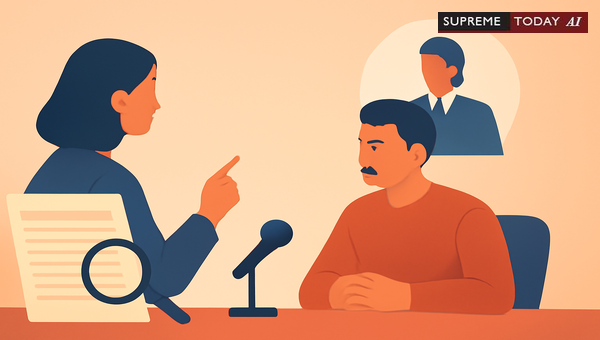
Lawyer's Right to Confront Witnesses in
In the heat of a criminal trial, the ability of a lawyer to rigorously test witness testimony can make or break a case. But how far does this right extend? A key question arises: Sufficiency of Trial Judges Reasoning Finding of Facts in evaluating practices. Courts must adequately reason their findings on facts, particularly when assessing the impact of on witness credibility. This blog delves into the lawyer's unwavering right to confront witnesses, the role of suggestions during , statutory safeguards, and judicial limits, drawing from pivotal legal precedents.
Whether you're a legal professional, defendant, or simply interested in courtroom dynamics, understanding these principles ensures appreciation of adversarial justice in India.
The Essence of in Adversarial Justice
stands as a cornerstone of the , designed 'to discover the truth, weaken false testimony, and test the credibility of witnesses' 2023 3 Supreme 105. It's not merely a procedural step but a fundamental right that allows lawyers to put questions, make suggestions, and challenge credibility 2023 3 Supreme 105. The aptly noted that 'is a duty, a lawyer owes to his clients' and that 'justice must not be defeated by improper ' 2023 3 Supreme 105.
This right is implied in a lawyer's authority during trials, enabling them to clarify testimony or expose inconsistencies. Importantly, suggestions made—though generally not evidence themselves—can elevate to evidentiary value if they elicit 'incriminating admissions or support the case of the prosecution or defense' 2023 3 Supreme 105. For instance, in sensitive cases like rape, a suggestion about consent doesn't imply admission unless it directly implicates the accused 2023 3 Supreme 105.
Statutory Foundations Protecting Confrontation Rights
Indian law robustly safeguards this right through key provisions:- Sections 162 and 145 of the : These empower the accused with an 'undefeasible right to confront witnesses and to put questions to them' 1986 0 Supreme(Raj) 246.- : Reinforces procedural fairness by upholding 1986 0 Supreme(Raj) 246.
Failure to confront a witness with prior contradictory statements can undermine trial fairness. In one case, conviction based on a sole witness's testimony was set aside because the witness wasn't confronted with inconsistencies between his police statement under Section 161 and court testimony, violating . The court remanded for fresh examination, stressing: 'the importance of confronting witnesses with their previous statements to ensure a fair trial' 2024 0 Supreme(Chh) 373.
Trial judges must sufficiently reason their , considering such procedural lapses, as inadequate reasoning can lead to appeals or remands.
Court's Role: Balancing Control and Fundamental Rights
While lawyers enjoy broad latitude, courts retain oversight to prevent abuse. Judges can curtail 'harassment or undue length' in , yet they 'cannot deny the fundamental right of the lawyer to confront witnesses' 2023 3 Supreme 105.
Recalling witnesses post full examination is tightly restricted. 'Once a witness has been fully examined and cross-examined, recalling them solely to re-examine or re-cross without exceptional circumstances is generally impermissible' 2008 7 Supreme 231. Under , recall requires 'concrete foundation' and belief it's 'essential for a just decision' 2023 0 Supreme(P&H) 2263. Petitions lacking valid reasons, especially after ample prior opportunities, are rightly dismissed 2023 0 Supreme(P&H) 2263.
In civil contexts, similar principles apply. Documents not produced earlier may be used to confront opposing witnesses during , per . Courts have clarified typographical errors in , directing it be read as allowing confrontation of 'defendant’s witnesses' 2019 0 Supreme(J&K) 222 2014 0 Supreme(Bom) 1822.
Testing Witness Veracity: 's Power
The true test of a witness lies in their responses. 'The veracity of the witness is to be tested with reference to answer given in ' 2011 0 Supreme(Ori) 436. outline its objectives: testing credibility, truthfulness, putting the defense version to the witness, and uncovering additional facts 2011 0 Supreme(Ori) 436.
Courts must scrutinize the entire testimony, including damaging statements, which 'cannot be ignored' 2011 0 Supreme(Ori) 436. In a rape case under , reliance on the prosecutrix's sole testimony faltered due to unaddressed inconsistencies revealed in , lacking ' to establish ' 2011 0 Supreme(Ori) 436.
Even in disputes over land or eviction, failure to confront witnesses with prior statements or documents erodes reliability 2024 0 Supreme(Chh) 373 2019 0 Supreme(Bom) 1277.
Exceptions, Limitations, and Judicial Discretion
While robust, rights have bounds:- Suggestions amounting to 'admissions against the accused's interest are binding and can be considered as evidence' 2023 3 Supreme 105.- Recalling for re-argument or filling case gaps is disallowed; only for 'clarify ambiguities' 2025 4 Supreme 741.- Improper, irrelevant suggestions aimed at 'harass or humiliate' are curbed 2023 3 Supreme 105.
In civil suits, belated documents require 'valid and sufficient reasons'; courts exercise discretion sparingly to avoid surprise or delay 2019 0 Supreme(Bom) 1277.
Trial judges' reasoning on facts must reflect these nuances, ensuring sufficiency in evaluating 's impact.
Practical Recommendations for Lawyers and Courts
To uphold justice:- Lawyers: Pose 'relevant, pointed questions and make suggestions that challenge the credibility or reliability of testimony.'- Courts: Safeguard confrontation rights while enforcing procedural bounds.- Limit recalls to exceptional cases for ambiguity removal, not re-examination.- Note: Suggestions with incriminating admissions can sway outcomes.
Conclusion: Safeguarding Fair Trials
A lawyer’s right to confront witnesses during remains a 'fundamental aspect of criminal trial procedure, protected by statutory law and judicial principles' 2023 3 Supreme 105. Suggestions are vital for testing credibility, with courts balancing fairness. Adequate judicial reasoning on facts, incorporating evidence, is crucial for robust findings.
This post provides general insights based on legal precedents and is not specific legal advice. Consult a qualified lawyer for your situation.
Key Takeaways
- is essential for truth-finding 2023 3 Supreme 105.
- Statutory protections under and are non-negotiable 1986 0 Supreme(Raj) 246.
- Confront prior statements to avoid fair trial violations 2024 0 Supreme(Chh) 373.
- Recalls demand exceptional justification 2025 4 Supreme 741 2023 0 Supreme(P&H) 2263.
References:1. 2023 3 Supreme 105: Principles on suggestions and confrontation.2. 1986 0 Supreme(Raj) 246: Statutory rights to cross-examine.3. 2008 7 Supreme 231: Limits on recalling witnesses.4. 2024 0 Supreme(Chh) 373: Confronting contradictions under Section 145.5. 2023 0 Supreme(P&H) 2263: recall petitions.6. 2011 0 Supreme(Ori) 436: Testing veracity in cross-exam.7. 2025 4 Supreme 741: Court's power on ambiguities.
#CrossExamination, #LegalRightsIndia, #EvidenceAct












