


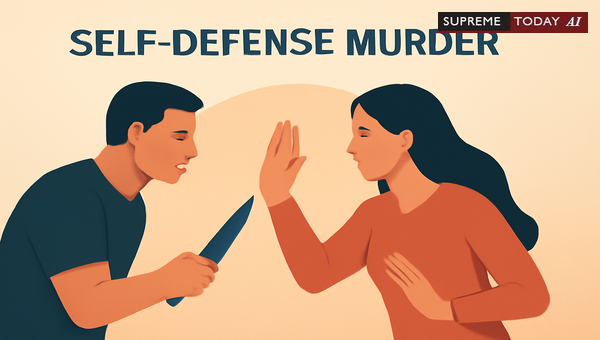
Self-Defense Limits in Murder Cases: Key Legal Boundaries
Imagine a heated confrontation where you fear for your life—do you have the right to fight back, even if it leads to a death? The question To what Level can Self Defence be Used in a Murder Case arises frequently in criminal law discussions. Self-defense, often called under laws like , can be a powerful shield in murder prosecutions, but it's not unlimited. This post breaks down the conditions, burdens, exceptions, and judicial perspectives to help you understand its scope.
We'll draw from established legal principles, emphasizing that self-defense must be reasonable, necessary, and proportionate. Note: This is general information, not legal advice. Consult a qualified attorney for your specific situation.
Conditions for Claiming Self-Defense
For self-defense to apply in a murder case, several strict conditions must be met. Primarily, it is a defensive right, not a right of aggression or reprisal 1974 0 Supreme(SC) 187. The accused must face an apprehension of imminent danger and must not have provoked the conflict 1974 0 Supreme(SC) 187 2011 0 Supreme(SC) 817.
Key requirements include:- : The threat must be immediate and real.- No provocation by the accused: Entering a situation with intent to kill or start a fight disqualifies the claim 2011 0 Supreme(SC) 817.- : The force used in self-defense must be reasonable and proportionate to the threat faced 2008 0 Supreme(SC) 133. Lethal force, for instance, may not be justified solely to protect property 2008 0 Supreme(SC) 133.- Opportunity to retreat: If safe retreat was possible, using force might not be justified 2008 0 Supreme(SC) 133.
Self-defense can serve as a , potentially leading to acquittal if proven
. However, it must be exercised in good faith and within the bounds of necessity
.
Burden of Proof in Self-Defense Claims
The accused does not bear an impossible burden. They need only show a , not 2010 5 Supreme 241(c)). Once raised, the prosecution must explain any unexplained injuries on the accused's body 2009 0 Supreme(SC) 1750 and bears the ultimate burden of disproving the accused's claim of self-defense 2008 0 Supreme(SC) 24.
In special defenses like self-defense in murder prosecutions, the is upon the defendant to prove his defence 2022 0 Supreme(All) 554 2020 0 Supreme(All) 469 2020 0 Supreme(All) 78 2018 0 Supreme(All) 18 2017 0 Supreme(All) 1862. This shifts focus to probabilities rather than absolute proof.
Exceptions and Limitations to Self-Defense
Self-defense has clear boundaries. It cannot be claimed if:- The accused intended to kill or provoke a fight upon entering the situation 2011 0 Supreme(SC) 817.- Force exceeds what's necessary, turning a potential acquittal into a murder conviction
.- initiates the attack, such as firing a weapon first, which courts view skeptically for proportionality 2024 Supreme(US)(ca8) 299.- Weapons were brought to escalate violence, undermining the defensive nature 2025 Supreme(SRI)(CA) 189
.
Additionally, provocation alone doesn't equate to self-defense. For it to reduce murder to , it must be grave and sudden, depriving a reasonable person of self-control 2024 5 Supreme 275
. Mere fighting without these elements won't suffice.
Courts instruct juries that exceeding necessary bounds negates the defense, requiring a verdict reflecting the true nature of the act
.
Judicial Approach to Self-Defense Pleas
Courts adopt a balanced view: Courts should not construe the right of self-defense narrowly, as it is a valuable right with a social purpose 2010 5 Supreme 241(c)). They examine the probabilities of the self-defense plea, rather than demanding 1993 0 Supreme(SC) 105. If probable, it can challenge a conviction, even via review petitions 1993 0 Supreme(SC) 105.
This approach ensures self-defense isn't unduly restricted but rigorously tested against facts. Judges emphasize necessity, good faith, and proportionality in evaluating claims.
Real-World Implications and Case Insights
In practice, self-defense succeeds when evidence shows imminent threat and measured response. For example, unexplained injuries on the accused bolster the plea, forcing prosecutors to rebut 2009 0 Supreme(SC) 1750. Conversely, initiating or lacking retreat options often fails 2024 Supreme(US)(ca8) 299 2008 0 Supreme(SC) 133.
Bringing weapons or escalating beyond protection indicates misuse, dooming the defense 2025 Supreme(SRI)(CA) 189. Courts scrutinize contexts like property defense, where non-lethal options typically prevail 2008 0 Supreme(SC) 133.
Key Takeaways
- Self-defense can fully acquit in murder cases if proportionate and necessary
.
- Accused shows probabilities; prosecution disproves 2010 5 Supreme 241(c)) 2008 0 Supreme(SC) 24.
- No claim if provoked or excessive2011 0 Supreme(SC) 817 2008 0 Supreme(SC) 133.
- Courts favor social purpose but demand facts 1993 0 Supreme(SC) 105.
In summary, while self-defense offers robust protection against murder charges, its application hinges on imminent danger, proportionality, and no aggression. Exceeding limits risks conviction. Always seek professional legal counsel, as outcomes depend on specific circumstances.
Word count: 1028. This overview draws from legal precedents for educational purposes only.
#SelfDefenseLaw, #MurderCaseDefense, #LegalRights















