


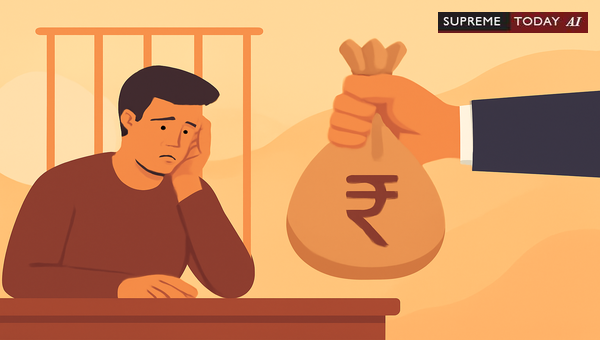
Jail for Paying Maintenance in Bits and Pieces? Understanding Case Law on Wilful Defaults
In family law disputes, maintenance payments are crucial for supporting dependents like spouses or children. But what happens when payments are made sporadically or in bits and pieces? A common question arises: Is there any case law on imprisonment for deliberately paying maintenance in bits and pieces? This issue touches on enforcement under (CrPC), where courts balance compliance with genuine financial hardship.
While no case directly addresses imprisonment solely for piecemeal payments, judicial principles emphasize that imprisonment for default is justified only if non-payment is deliberate and wilful2023 0 Supreme(Mad) 3305 2021 0 Supreme(Raj) 1891. This blog post breaks down the legal landscape, key cases, and practical insights to help you navigate this complex area. Note: This is general information, not specific legal advice—consult a qualified lawyer for your situation.
The Legal Framework: Maintenance Orders and Enforcement
Under Section 125 CrPC, courts can order maintenance to prevent and ensure financial support. Non-compliance doesn't automatically lead to punishment; instead, imprisonment serves as a mode of enforcement, not a penalty for the debt2023 0 Supreme(Mad) 3305.
Courts issue warrants for recovery, and if arrears accumulate due to default, the defaulter may face up to one month per month's arrears (). However, the key determinant is intent: Was the default wilful?
- : Intentional evasion justifies and jail 2021 0 Supreme(Raj) 1891.
- Genuine inability: No imprisonment if proven with evidence, as it's not 2024 0 Supreme(Del) 240.
Core Case Law: Deliberate Default and Imprisonment
No Direct Precedent on Bits and Pieces
The provided judicial documents reveal no specific case law directly condemning imprisonment solely for deliberately paying maintenance in bits and pieces. Courts scrutinize overall conduct rather than payment method alone 2023 0 Supreme(Mad) 3305. For instance:
Imprisonment for default in payment of maintenance is a mode of enforcement, not a penalty for the underlying obligation 2023 0 Supreme(Mad) 3305.
This case upheld enforcement measures, noting that deliberate non-payment amounts to contempt, but genuine efforts mitigate risks.
Wilful vs. Unavoidable Default
In 2021 0 Supreme(Raj) 1891, the court analyzed:
If the non-payment is not or not due to deliberate neglect, then and imprisonment may not be justified.
Repeated defaults, if intentional, invite jail, but courts probe finances and efforts. Similarly, 2024 0 Supreme(Del) 240 stresses:
Inability to pay, if genuine and not , may not warrant contempt or imprisonment.
Judges reduce sentences if default isn't () 2021 0 Supreme(Raj) 1891.
Insights from Related Cases: Wilful Non-Compliance
Broader jurisprudence reinforces this. In a domestic violence maintenance dispute under the , the court refused to strike off the respondent's defense despite payment delays, ruling:
The defense can only be struck off for non-payment of maintenance when the default is shown to be wilful and , ensuring no party benefits from their own wrongdoing 2025 0 Supreme(Ori) 534.
Here, partial compliance negated gross default, with future payments directed from . This highlights courts' reluctance to penalize without proven intent.
Another maintenance case under Section 125 CrPC dismissed challenges to a Rs.70,000 monthly award, emphasizing:
The right to maintenance under cannot be denied based on a wife's qualifications or potential earnings, especially when she has sacrificed her career for matrimonial duties 2024 0 Supreme(P&H) 1236.
The husband's unsubstantiated expense claims (e.g., rent) were rejected, underscoring evidence's role in default defenses.
Unrelated cases, like those on currency notes or UGC regulations, mention bits and pieces metaphorically (e.g., piecemeal adoption of rules 2022 0 Supreme(Ker) 826) but offer no direct analogy to maintenance.
Paying in Bits and Pieces: Court Scrutiny
Sporadic payments might signal evasion if:- Arrears build deliberately.- No credible financial proof exists.- Full lump sums are avoided without reason.
Conversely, documented partial payments due to hardship (e.g., job loss) often avoid jail. Courts view consistent, genuine efforts favorably, distinguishing them from calculated delays 2023 0 Supreme(Mad) 3305.
In 2021 0 Supreme(Raj) 1891, judicial discretion modified sentences for non-wilful defaults, cautioning:
Imprisonment should not be used as a punitive measure but as an enforcement tool.
Exceptions and Limitations
Courts exercise caution:- Genuine inability: Protected if evidenced (bank statements, job loss proof) 2024 0 Supreme(Del) 240.- Reduced sentences: For partial compliance or changed circumstances 2021 0 Supreme(Raj) 1891.- No extinguishment of debt: Jail doesn't erase arrears 2023 0 Supreme(Mad) 3305.
Litigants can't exploit their wrongs, per Supreme Court precedents cited in 2025 0 Supreme(Ori) 517, like .
Practical Recommendations
To avoid risks:- Document everything: Receipts, financial statements, job applications.- Seek modifications: File for reduced maintenance if circumstances change.- Communicate: Inform courts of payment plans proactively.- Legal aid: Lawyers can argue inability or negotiate instalments.
Defendants claiming inability should produce credible evidence, as courts may be reluctant to imprison for default caused by genuine financial hardship.
Key Takeaways
- No direct case law jails for piecemeal payments alone—focus is on wilful intent 2023 0 Supreme(Mad) 3305 2021 0 Supreme(Raj) 1891.
- Prove genuine efforts to dodge contempt 2024 0 Supreme(Del) 240.
- Partial compliance helps, as in defense-strike refusals 2025 0 Supreme(Ori) 517.
- Always prioritize evidence; courts prioritize equity.
Maintenance enforcement aims at compliance, not punishment. If facing defaults, act swiftly with professional guidance. Stay informed on evolving family law—justice hinges on facts and fairness.
References: Analysis based on cited documents. For full judgments, refer to official repositories.
#MaintenanceLaw #FamilyLawIndia #CrPC125















