


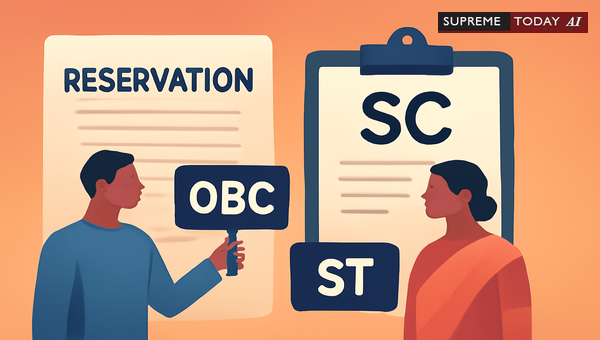
Must Reserved Posts Be Advertised Separately in India?
In the realm of in India, play a pivotal role in promoting social justice. But a common question arises: Whether in Advertisements of Recruitment of any Post Reserved Category Post should Advertise Separately? This issue touches on constitutional mandates, judicial precedents, and practical recruitment strategies. Understanding it is crucial for employers, aspirants, and policymakers to ensure compliance and fairness.
This post delves into the legal analysis, drawing from established court rulings and guidelines. While it provides general insights, consult a legal expert for specific advice.
Constitutional Foundation of Reservations
India's reservation system stems from Article 16(4) of the Constitution, empowering the state to make provisions for reserved posts for Scheduled Castes (SC), Scheduled Tribes (ST), and Other Backward Classes (OBC) in public employment. The goal is to address historical inequalities without compromising merit.
Courts have emphasized that reserved category candidates must typically be considered against their designated quotas. Mixing them with general category vacancies can undermine this. As noted in key judgments, reserved category candidates should be considered for their respective posts and not be mixed with general category candidates unless specified otherwise 2012 0 Supreme(SC) 834 2010 0 Supreme(Raj) 172.
The Case for Separate Advertisements
Legal precedents strongly favor separate advertisements for . This practice ensures transparency, prevents confusion, and upholds . For instance, in recruitment for Safai Karamcharis, courts ruled that reserved candidates apply only to their posts, not general ones unless vacancies remain unfilled 2019 0 Supreme(Raj) 786 2018 0 Supreme(Raj) 1088.
Separate ads clarify eligibility, relaxations (like age limits or qualifications), and prevent issues. Reserved candidates qualifying on general merit may migrate, but only without availing category-specific concessions 2019 0 Supreme(SC) 719 2022 0 Supreme(Raj) 822.
Insights from Additional Rulings
Several cases reinforce this:- In a case under the Employees of Private Schools Regulations, courts stressed mandatory procedures, including permission to advertise reserved posts and ascertaining surplus staff before filling. Failure invites rejection of appointments
. The judgment highlights, the management must adhere to the rules and regulations for the appointment of staff in private schools, including the obligation to ascertain...- For sub-inspector recruitment, advertisements were effectively combined despite numbering, but reservations were applied post-advertisement, underscoring clarity needs
.- Government resolutions often mandate advertising reserved teaching posts for up to three years before . The said Government Resolution also provided that if reserved category candidate is not available then candidate could be appointed temporarily 2022 0 Supreme(Bom) 1230. Continuous separate ads are key to eligibility.
If no suitable reserved candidates emerge after efforts, posts may convert to 1994 0 Supreme(SC) 881 2019 0 Supreme(Raj) 318. However, initial separate advertising remains essential for records and compliance.
Challenges and Judicial Safeguards
Recruitment bans complicate matters. In one instance, a SC candidate's appointment on a duly advertised reserved post was approved despite a ban, as resolutions don't apply retrospectively 2022 0 Supreme(Bom) 1232. As per the advertisement, the said reserved category post was duly advertised.
requires proof of exhaustive advertising. A lecturer's post, advertised six times without reserved applicants, led to regularization for an open candidate 2018 0 Supreme(Bom) 201. Conversely, illegal without procedure was struck down in Tripura, where posts weren't segregated subject-wise, violating transparency 2016 0 Supreme(Tri) 50. The court noted, Provided that in case of non-availability of Scheduled Caste/Scheduled Tribe candidates unfilled reserved posts may be filled by exchange...
In Himachal Pradesh, relaxing eligibility mid-process without re-advertising breached . Eligibility criteria/conditions, unless provided otherwise in extant rules or advertisement, must be fulfilled by candidate by last date for receipt of applications specified in advertisement 2023 7 Supreme 468. Wide publicity for changes is mandatory.
Roster maintenance is vital: To have a record of such reserved post, every institution has to maintain the Roster
.
Best Practices for Compliant Recruitment
To navigate these rules:- Issue Separate Ads: Clearly delineate reserved vs. general posts, specifying quotas, relaxations, and qualifications.- Follow Multi-Advertisement Protocol: For unfilled reserved posts, re-advertise 2-3 times before , notifying employment exchanges 2013 0 Supreme(Bom) 1710.- Maintain Records: Keep rosters, ad proofs, and applicant data for audits.- Monitor Compliance: Conduct reviews to preempt challenges; exceptions like bans require permissions.- Ensure Transparency: Group posts judiciously but avoid over-reservation per department to preserve efficiency.
These steps align with circulars like 's GR, allowing open candidates on reserved posts post-advertising, with reversion upon retirement 2013 0 Supreme(Bom) 1710.
Key Takeaways and Recommendations
Generally, yes, should be advertised separately to comply with constitutional intent and judicial directives. This fosters equality, reduces litigation, and maintains process integrity. Recruitment bodies should:- Draft clear, roster-compliant ads.- Seek approvals pre-advertising where required.- Audit for relaxations and migrations.
Failure risks quashed selections, as seen in multiple High Court rulings. For instance, Tripura's TPSC faced directives for UGC-compliant processes after flawed reservations 2016 0 Supreme(Tri) 50.
Disclaimer: This analysis is for informational purposes, based on general principles and cited precedents. Laws evolve, and outcomes depend on facts. Always seek professional legal counsel for your situation.
References:2012 0 Supreme(SC) 834 2010 0 Supreme(Raj) 172 2019 0 Supreme(Raj) 786 2018 0 Supreme(Raj) 1088 2019 0 Supreme(SC) 719 2022 0 Supreme(Raj) 822 1994 0 Supreme(SC) 881 2019 0 Supreme(Raj) 318
2023 7 Supreme 468 2022 0 Supreme(Bom) 1232 2022 0 Supreme(Bom) 1230 2018 0 Supreme(Bom) 201 2016 0 Supreme(Tri) 50 2013 0 Supreme(Bom) 1710
Stay informed on evolving reservation jurisprudence to build equitable workplaces.
#ReservationLaw, #RecruitmentIndia, #LegalHiring












