


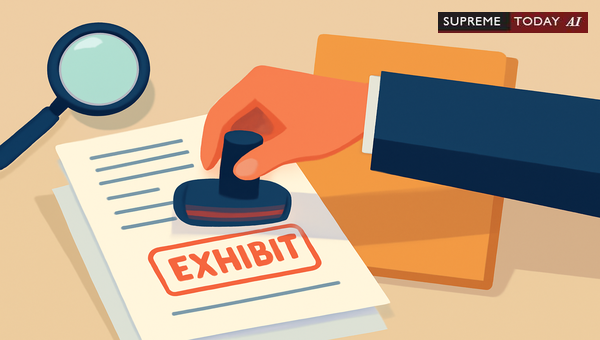
Understanding the Purpose of Marking Documents in Court Cases
In legal proceedings, documents play a pivotal role as evidence. But what exactly is the purpose of marking a document? Many litigants assume that once a document is marked as an exhibit, its contents are automatically proven and admissible. However, this is a common misconception. Generally, marking a document serves only as an initial step to place it on record, not to establish its truth or without further scrutiny. This article explores the legal nuances, drawing from judgments and other precedents, to clarify this essential concept.
Disclaimer: This content provides general information based on legal precedents and is not intended as specific legal advice. Consult a qualified attorney for your case.
The Main Legal Finding: Marking ≠ Proof
The core principle, as established by the , is that the marking of documents in court proceedings does not automatically establish their proof or . Documents require proper and proof of their contents. Merely , without a judicial determination of its and , does not dispense with the need for proper evidence to establish the document’s veracity. 1971 0 Supreme(SC) 255
This distinction is crucial. determines if the document can be received in evidence, while proof involves verifying its contents through admissible evidence. Courts have repeatedly emphasized that is not equivalent to proving its contents. 1971 0 Supreme(SC) 255
Key Points from Judicial Precedents
- Marking does not prove contents: Simply labeling a document as an exhibit does not authenticate its truth. 1971 0 Supreme(SC) 255
- requires judicial determination: Especially for issues like stamp duty or registration, courts must scrutinize at the time of tender. 2021 6 Supreme 577 2024 6 Supreme 482
- No revisiting admitted documents without scrutiny: Once admitted without proper review, later challenges are limited, but initial proof remains essential. 1971 0 Supreme(SC) 255
- Failure to prove leads to rejection: Unproven marked documents can be disregarded. 2024 6 Supreme 482
Detailed Analysis: Significance of Marking Documents
Does Not Dispense with Proof
The legal position is clear: of a document as an exhibit does not dispense with . Courts differentiate between (can it be considered?) and proof (is it true?). For instance, in , it was held that even if a marked document is used in examination and , it does not prove its contents. This was reiterated in , stating that mere production and marking of a document as exhibit by the court cannot be held to be a due . 1971 0 Supreme(SC) 255
Judicial Obligation on
Presiding officers have a statutory duty to judicially determine , particularly when objections arise on validity, registration, or stamp duty. Under the and , courts must verify compliance before admission. Merely allowing a document to be marked does not establish its proof. 2021 6 Supreme 577
Objections to stamp duty or registration must be raised at the time of tender or , not after marking. 2024 6 Supreme 482 If admitted without scrutiny, it is accepted subject to later proof, but contents still need evidence like witness testimony or expert deposition.
Proving and Contents
To prove a document, the relying party must establish and contents through admissible evidence. An expert’s letter marked as an exhibit does not suffice unless the expert testifies. 2024 0 Supreme(SC) 554 Courts stress that an order admitting a document does not automatically prove its contents; proof must be established through evidence. 1971 0 Supreme(SC) 255
Insights from Additional Case Law: Marking in Context
Lower courts and high courts have reinforced these principles in varied scenarios, providing practical guidance.
Objections and on
In one case, pleas on and genuineness of documents were raised during of PW-1, inferring that on marking, defendants can cross-examine on and genuineness, such as for sale deeds. 2025 0 Supreme(Telangana) 90 However, trial courts cannot revisit document issues already determined by a higher court, emphasizing adherence to prior judgments. The court held that refusing unregistered sale deeds contradicted a prior ruling allowing marking for collateral purposes. 2025 0 Supreme(Telangana) 90
Marking at Interlocutory Stages
Marking may not always be necessary during interlocutory applications. In a civil miscellaneous appeal, the court noted whether marking of documents is necessary at the stage of enquiry in interlocutory applications. Decisions often rely on affidavits, absent specific rules for marking. 2022 0 Supreme(AP) 343 Similarly, documents relied on by petitioners are to be adjudicated by marking before the trial court in the course of trial, following Code procedures. 2022 0 Supreme(AP) 451
Practical Marking Through Witnesses
Trial courts often accept witnesses like PW1 for marking, but respondents may raise objections about . Private documents must be marked through authors, while public ones have flexibility. Marking through PW1 does not amount to proof, and relevance can be challenged later. 2019 0 Supreme(Bom) 1174
Marking is an intermediary step and does not authenticate contents; it's merely . Public documents can be marked through parties, but private ones need originators. 2019 0 Supreme(Bom) 2562
Recalling Witnesses for Marking
In some instances, recalling respondents is sought for marking documents, especially if linked to prior cases, to avoid hardship. However, applications post-arguments may be scrutinized for delays. 2019 0 Supreme(Mad) 2831
These cases illustrate that while marking facilitates proceedings, it never substitutes proof. Higher courts urge adherence to procedures without abuse.
Impact of Improper and Final Considerations
If admitted without scrutiny, challengers may seek reconsideration, but proof remains key. This upholds evidence integrity, preventing reliance on .
Key Takeaways
- Marking identifies documents but does not prove them.
- Always raise objections timely on stamp duty/registration.
- Prove contents via witnesses/experts.
- Respect prior higher court rulings on .
- Follow trial procedures strictly.
In summary, is not equivalent to proving its contents. Proper , checks, and evidentiary proof are essential. This principle, rooted in wisdom, safeguards justice. Stay informed, but seek professional advice for your matters.
#DocumentMarking, #CourtEvidence, #LegalProof












