


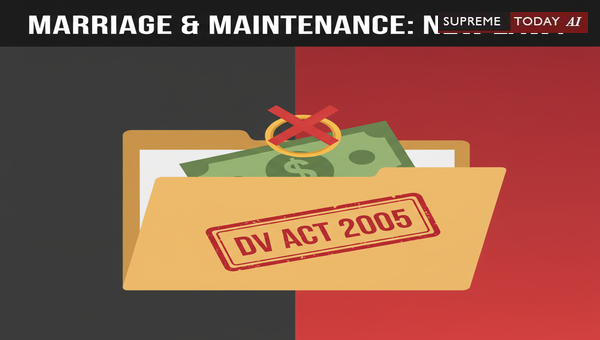
Can a Married Woman Living with Another Man Claim Maintenance Under the ?
In today's complex family dynamics, questions about legal protections under the () often arise. A common query is: In Wife can Get Maintenance – particularly when a married woman is living with another man. This blog post delves into the legal nuances, interpretations, and key precedents to clarify whether such scenarios qualify for relief under the .
While the offers robust protections against domestic violence, its scope is precisely defined. Generally, a married woman in such a situation cannot claim maintenance or other reliefs under this Act. Let's break it down step by step.
Understanding the and Its Scope
The , 2005, aims to protect women from domestic violence in domestic relationships. defines an as any woman in a with the respondent who alleges violence. However, the Act's applicability hinges on specific definitions.
defines to include relationships where persons live or have lived together in a , related by consanguinity, marriage, , adoption, or joint family. Crucially, is restricted to opposite-sex partners who hold themselves out as spouses, are of legal age, and have cohabited voluntarily for a significant period 2021 0 Supreme(Del) 1372.
Main Legal Finding: No Relief for Married Women in New Relationships
A married woman living with another man cannot claim relief under the . The Act explicitly recognizes only relationships between opposite-sex individuals and does not extend to a woman already legally married to another man 2021 0 Supreme(Del) 1372.
Key reasons include:- The woman's existing marriage is valid and subsisting 2010 0 Supreme(SC) 961.- Any subsequent marriage or relationship while a spouse is alive is void, denying her the status of a wife in the new setup 1998 0 Supreme(AP) 477.- The does not recognize same-sex relationships or those involving an already married woman 2021 0 Supreme(Del) 1372.
The has clarified that such a relationship must mirror the , including social recognition as spouses – absent when the woman remains legally married elsewhere 2021 0 Supreme(Del) 1372.
Detailed Analysis: Definitions and Criteria
Under Sections 2(f) and 2(s), this term applies to opposite-sex partners in a . Criteria include:- Holding themselves out as husband and wife.- Legal age and voluntary cohabitation for a significant period.- Mutual support and social acknowledgment 2021 0 Supreme(Del) 1372.
Mere long-standing cohabitation does not qualify if the woman is married to someone else 2010 0 Supreme(SC) 961 2013 8 Supreme 122.
Marital Status Barrier
If a woman is legally married, her new relationship lacks validity. As noted, a marriage contracted while a spouse is living is void and does not confer the status of a wife, thus denying maintenance rights and, by extension, protection under the 1998 0 Supreme(AP) 477. In one case, a woman already married to another person could not claim protections, as her prior marriage invalidated subsequent claims
.
Judicial Precedents Reinforcing the Position
The has consistently ruled against extending protections in such cases:- Relationships must be akin to marriage; a married woman's liaison with another man fails this test 2021 0 Supreme(Del) 1372.- Only women (wives or those in qualifying relationships) can seek relief; courts cannot grant under DV appeals, as seen where an appellate order was set aside for exceeding scope: it is the wife or the woman alone can seek any relief under the 2021 0 Supreme(Kar) 23.
In broader contexts, courts distinguish . For instance, the concept of i.e. of a married man living consensually with another woman or a woman living and having sexual intercourse with a married man draws from outdated adultery laws but underscores moral and legal limits 2019 0 Supreme(Raj) 2703. Even pre- ethos rejected live-in relationships outside marriage 2016 0 Supreme(Ker) 81.
A married woman having connection with another man may be viewed as immoral but not criminal for her 2015 0 Supreme(Mad) 202. However, this does not grant rights.
Exceptions and Limitations
- No Protections for Already Married Women: The excludes relationships where the woman has a 2021 0 Supreme(Del) 1372.
- Same-Sex Relationships: Not recognized 2021 0 Supreme(Del) 1372.
- Mere Cohabitation: Insufficient without marriage-like traits.
Long-term relationships might warrant consideration elsewhere, but not under if marriage persists 2021 0 Supreme(Del) 1372. explicitly limits scope: requires qualifying ties 2021 0 Supreme(All) 215.
Alternative Legal Remedies for Maintenance
While relief is unavailable, other avenues exist:- : Maintenance for wives, including deserted ones, regardless of fault (but void relationships may not qualify).- () Section 24/25: Interim/permanent maintenance in matrimonial proceedings. Notably, grant of maintenance under the would not be a bar to seek maintenance under 2021 0 Supreme(All) 215. Courts assess financial status, lifestyle, and needs realistically.
Factors for quantum: parties' ages, employment, marriage duration, children, health 2021 0 Supreme(All) 215.
Recommendations for Navigating Such Cases
- Verify marital status and relationship nature before filing under .
- Explore 125 or for maintenance if eligible.
- Courts scrutinize claims rigorously; adulterous or illicit setups typically fail DV tests.
Seek advice from a family law expert, as outcomes depend on facts.
Conclusion and Key Takeaways
In summary, a married woman living with another man generally cannot claim maintenance or protections under the due to strict definitions and precedents 2021 0 Supreme(Del) 1372. The law prioritizes valid domestic relationships, excluding subsisting marriages' complications.
Key Takeaways:- limited to opposite-sex, marriage-like relationships without prior marriages.- Void subsequent unions bar relief 2010 0 Supreme(SC) 961 1998 0 Supreme(AP) 477.- Alternatives like 125 or Section 24 offer options 2021 0 Supreme(All) 215.- Always consult a lawyer; this is general information, not specific legal advice.
Stay informed on evolving family laws to protect your rights effectively.
#DVAct, #DomesticViolenceLaw, #MaintenanceRights















