


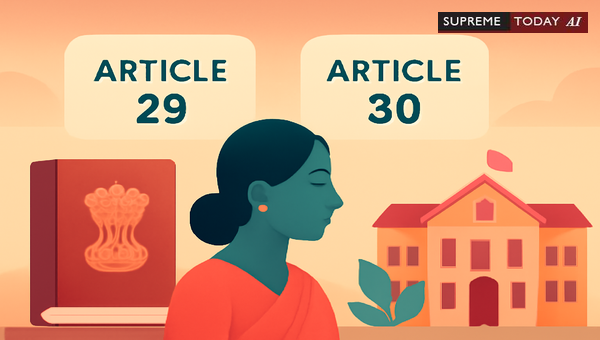
Articles 29 & 30: Minority Rights in Indian Constitution
In India's diverse society, safeguarding the rights of minorities—particularly in education, language, and culture—is paramount. The enshrines these protections through Articles 29 and 30, which often spark discussions among students, educators, and legal scholars. A common query arises: Write a Comprehensive Essay on and 30 and how they are Related in . This blog delves into their provisions, interplay, judicial interpretations, and practical implications, drawing from constitutional text and landmark cases.
These articles form the bedrock of minority protections, ensuring that can preserve their identity while accessing quality education. While they overlap, subtle distinctions make their relationship nuanced. Let's break it down.
Understanding : Conservation of Language, Script, and Culture
is a available to any section of citizens residing in India or any part thereof. It emphasizes cultural preservation:
- (1): Any section of the citizens residing in the territory of India or any part thereof having a distinct language, script or culture of its own shall have the right to conserve the same. 2002 8 Supreme 359
- (2): Prohibits denial of admission to state-maintained or state-aided on grounds of religion, race, caste, caste, or language, ensuring .
00100093908
2002 8 Supreme 359
This provision extends to majorities too, promoting India's pluralistic fabric. For instance, in cases involving language use, courts have upheld expressions tied to cultural themes. In a judgment on essay evaluations, remarks like 'Jai Hind, Let us live united with nature' were deemed relevant to conservation topics, reflecting emotional ties to culture without breaching rules. 2023 Supreme(Online)(Mad) 80626
thus acts as a broad shield for identity preservation, applicable beyond minorities.
: Special Rights for Minorities to Establish
offers targeted empowerment to religious and linguistic minorities:
- (1): Grants minorities the right to establish and administer of their choice. 2014 4 Supreme 494
This is more specific and robust than . It allows minorities to create institutions reflecting their ethos, medium of instruction, and administration. As noted, (1) is considered a more specific and absolute right compared to the general protections in (2). 2002 7 Supreme 359 2014 4 Supreme 518
Judicial precedents reinforce this. In a Meghalaya case involving a Bengali linguistic minority school, the court held: The Bengali community being the linguistic minority community in the State of Meghalaya has the fundamental rights guaranteed under Articles 29(1) and 30(1) of the . The reservation policy could not extend to such institutions, limiting state interference to maintaining standards. 2014 0 Supreme(Megh) 145
The Interplay Between Articles 29 and 30
Articles 29 and 30 complement each other, with providing general safeguards and offering special minority privileges. Key relationships include:
- Overlap in Scope: Both protect educational access and , but (1) applies universally, while focuses on minority administration. 2002 8 Supreme 359 2013 3 Supreme 161
- Non-Override Principle: (2)'s anti-discrimination does not supersede (1)'s rights. Minorities retain autonomy in admissions and management. 2014 4 Supreme 518
- Cultural-Linguistic Nexus: Language cases highlight synergy. For example, permitting Urdu on municipal signboards alongside Marathi was upheld, as language is a medium for communication and should not divide communities. This aligns with (1)'s conservation mandate. 2025 0 Supreme(SC) 631
In essence, they work in tandem: conserves identity broadly, while operationalizes it through institutions. 2002 8 Supreme 359 2013 3 Supreme 161
Limitations and State Regulations
These rights are not unfettered. The state can impose :
- Ensure educational standards, prevent maladministration, and promote efficiency. 2002 7 Supreme 359 2013 3 Supreme 161
- Aided vs. Unaided Institutions: Aided minority schools face more oversight than unaided ones. 2012 3 Supreme 305
- Impact: Special provisions for backward classes may apply, but not erode core minority rights. 2014 4 Supreme 494
Courts balance this. In minority teacher appointments, state control is limited if standards are met. The Meghalaya ruling directed approval of appointments sans reservation quotas. 2014 0 Supreme(Megh) 145
Relatedly, exam contexts underscore fairness. Challenges to answer paper invalidations for cultural remarks (e.g., on nature conservation) emphasize contextual evaluation, indirectly supporting 's cultural expression. 2023 Supreme(Online)(Mad) 80626 2024 0 Supreme(SC) 1377
Judicial Interpretations and Case Insights
Indian courts have clarified these articles extensively:
- T.M.A. Pai Foundation v. State of Karnataka (implied in sources): Affirmed administration rights subject to regulations.
- Meghalaya Minority School Case: The State Government cannot interfere with the administration of the school, so long as the school maintained the standards prescribed by the Government regulations. 2014 0 Supreme(Megh) 145
- Language disputes, like Urdu usage, reinforce : Urdu and Marathi are both recognized languages under the Constitution and should coexist. 2025 0 Supreme(SC) 631
These rulings prevent arbitrary state overreach while upholding excellence.
Practical Implications for Minorities and Institutions
- Linguistic Minorities: Can choose native mediums, as in Bengali schools. 2014 0 Supreme(Megh) 145
- Admissions: Preferential for community members, balanced with merit.
- Challenges: Navigating aid conditions or reservation pressures.
Educators and minorities should note evolving jurisprudence, like tribunal appointments ensuring judicial independence, indirectly aiding fair oversight. 2023 0 Supreme(Bom) 2161
Conclusion and Key Takeaways
Articles 29 and 30 are pillars of India's secular, multicultural ethos, interrelated in fostering minority empowerment. broadly conserves culture, while specifically enables educational autonomy—together, they prevent assimilation forces.
Key Takeaways:- (1) for all; (1) for minorities. 2002 8 Supreme 359- Rights subject to reasonable state regulations. 2002 7 Supreme 359- Courts protect against undue interference. 2014 0 Supreme(Megh) 145
This post provides general insights based on constitutional provisions and judgments. It is not legal advice; consult a qualified lawyer for specific cases.
For deeper reading, explore full texts of cited cases.
#IndianConstitution, #MinorityRights, #Articles29_30















