


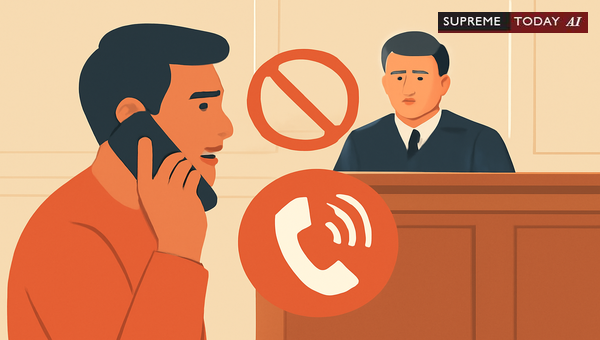
Can You Talk on Your Phone in an Indian Court Hall? Key Rules Explained
Visiting an Indian courtroom can be intimidating, especially with strict protocols to maintain order. A common question arises: can talk phone inside the court hall? In today's smartphone-driven world, it's tempting to check messages or take a quick call, but doing so risks serious consequences like charges. This guide breaks down the legal landscape based on judicial rulings, helping you understand what's permitted, what's not, and how to avoid trouble.
Note: This is general information based on precedents and not specific legal advice. Always consult a lawyer for your situation.
Main Legal Finding: Generally Prohibited, But Nuances Exist
Talking on a phone inside a court hall is generally not permitted in Indian courts. Such actions can disrupt proceedings and amount to if they cause interference or disturbance. Courts prioritize maintaining decorum and sanctity, viewing disruptions as obstructions to justice. However, mere possession of a mobile phone in silent mode or non-disruptive activities—like checking messages without hindering the court—may not constitute contempt, subject to the presiding judge's discretion. 2014 2 Supreme 134
Key principles include:- Ringing or active use: Constitutes contempt by distracting judges and lawyers. 2014 2 Supreme 134- Judge's authority: Ultimate say on whether disturbance is 'intolerable'. 2023 0 Supreme(P&H) 1848- Security guidelines: Often prohibit phones entirely to preserve sanctity. 2010 0 Supreme(AP) 1214
Prohibition on Mobile Phones: Why Courts Ban Talking and Ringing
Indian courts treat their halls as sacrosanct spaces. The has ruled that allowing a phone to ring or using it leisurely obstructs justice: when a mobile phone starts ringing in the Court and it goes on ringing continuously, then, person having the phone cannot be exempted, because, his act is causing interference in the hearing of the judicial proceedings, and is obstructing the administration of justice. 2014 2 Supreme 134
Security directives reinforce this: Cameras and mobile phones shall not be allowed inside the courtrooms. 2010 0 Supreme(AP) 1214 These measures ensure a calm atmosphere, backed by alarms and police for violations.
Talking on the phone amplifies risks, as it inherently creates noise and diverts attention—far beyond silent possession.
When Phone Use Might Not Lead to Contempt: Silent Mode and Discretion
Not every phone-related action triggers contempt; the crux is disruption. The clarified: carrying a mobile phone inside the court hall or keep it in a silent mode or the occasional alerts or looking at the short messages received through mobile phone or forwarding messages in reply without disturbing the court proceedings cannot be said to be an obstructing the course of administration of justice attracting proceedings. 2023 0 Supreme(P&H) 1848
This recognizes phones' utility for lawyers, like receiving cause lists via SMS: the technology so advanced that it is unthinkable that the counsel can be without the aid of mobile phone. 2012 0 Supreme(Mad) 1329 Still, the judge decides if use crosses into 'intolerable disturbance'.
Parallels from Other Contexts: Possession vs. Use
Similar logic appears in examination hall cases, where mere possession doesn't equate to misconduct if unused. For instance, courts have held that possession of a mobile phone during an exam does not equate to cheating if not used. In one case, a student who inadvertently carried a phone and informed the invigilator avoided severe penalties due to honest intent and lack of use. This underscores procedural fairness and intent, mirroring court contempt thresholds. (CBSE Unfair Means Guidelines reference in exam rulings)
Likewise, What the aforesaid clause prohibits is the 'use' of any electronic gadget such as mobile phone during examination and not an inadvertent act of taking such a phone inside the examination hall even if no attempt is made to make any use. 2013 Supreme(Online)(DEL) 1698 These precedents highlight that context matters—non-use often mitigates consequences, applicable by analogy to courts.
Contempt Proceedings: Real Cases and Outcomes
Courts act decisively on disruptions. A phone alarm ringing prompted notice, but proceedings were dropped after apology: The alarm going off in the court-room was not an intentional, willful or deliberate act. 2006 0 Supreme(Guj) 390
In another, a Chief Engineer's ringing phone led to leniency upon regret: Courts after all are sacrosanct places. Nobody can be allowed to disturb the court proceedings. 2005 0 Supreme(Guj) 307 Apologies and proven inadvertence often lead to discharge, but willful talking lacks such mercy.
Evolution of Judicial Views and Interrelations
Rulings show evolution: Strict early bans (2005: 2014 2 Supreme 134) shifted to nuanced allowances recognizing tech (2011: 2023 0 Supreme(P&H) 1848, 2012 0 Supreme(Mad) 1329). Security remains firm (2010 0 Supreme(AP) 1214), while contempt focuses on disturbance (2006 0 Supreme(Guj) 390, 2005 0 Supreme(Guj) 307). Regional differences exist—Gujarat stricter, Madras more permissive—but no ruling supports unrestricted talking.
Exam analogies reinforce: possession alone (e.g., 2013 Supreme(Online)(DEL) 1698, 2025 0 Supreme(Jhk) 1711) invites scrutiny but not automatic punishment without use or intent.
Exceptions, Limitations, and Practical Tips
Exceptions:- Urgent, silent checks (messages, SOS) if non-disruptive.- Judge's permission for essentials (lawyers coordinating).
Limitations:- High-security or sensitive hearings ban even silent phones.- No absolute right; judicial authority prevails.
Recommendations:- Switch to silent or deposit outside.- Apologize immediately if it rings.- Seek permission for must-use scenarios.
Uniform guidelines balancing tech and decorum could help, as courts evolve.
Conclusion: Prioritize Decorum to Avoid Contempt
While silent possession may be tolerated, talking on a phone in an Indian court hall typically invites contempt risks. , intent, and apologies shape outcomes, but prevention is best. By respecting these rules, you uphold justice's sanctity.
Key Takeaways:- No talking or ringing—contempt likely. 2014 2 Supreme 134- Silent use? Judge decides. 2023 0 Supreme(P&H) 1848- Apologize for mishaps. 2006 0 Supreme(Guj) 390
Stay informed, stay silent. For personalized advice, contact a legal expert.
References
- 2014 2 Supreme 134: Ringing as contempt.
- 2023 0 Supreme(P&H) 1848: Non-disruptive use okay.
- 2010 0 Supreme(AP) 1214: Phone bans.
- 2012 0 Supreme(Mad) 1329: Tech utility.
- 2006 0 Supreme(Guj) 390, 2005 0 Supreme(Guj) 307: Apology outcomes.
- Exam cases: 2013 Supreme(Online)(DEL) 1698, 2025 0 Supreme(Jhk) 1711 for possession analogies.















