


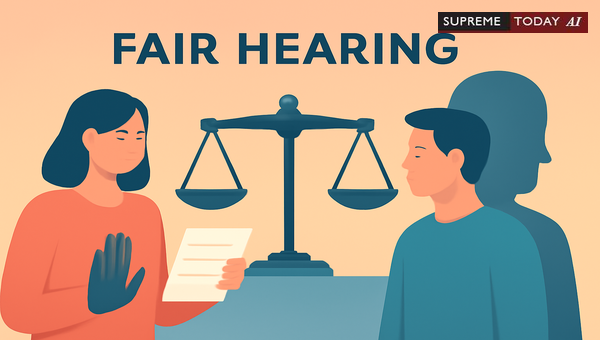
Rules for Intervening Applications
In the realm of legal proceedings, fairness is paramount. But what happens when a third party seeks to intervene through an ? Is such an application governed by the principles of ? This question often arises in judicial, , and administrative contexts, where civil rights or liberties hang in the balance. Understanding this ensures that proceedings remain equitable and just.
This post delves into the core principles, their application to intervening applications, real-world examples, and practical recommendations. While this provides general insights, it is not legal advice—consult a qualified attorney for specific cases.
Understanding Principles of
The principles of are foundational to fair decision-making. They include two key tenets:
- (hear the other side): Every affected party must have a fair opportunity to be heard, present evidence, and respond to adverse material.
- (no one should be a judge in their own cause): Decisions must be free from bias.
These principles aim to prevent and ensure decisions are not arbitrary. As noted, Principles of are rooted in fairness and prevent 2022 0 Supreme(All) 550. They apply broadly to proceedings involving , such as rights, liberties, or legitimate interests 2022 0 Supreme(All) 550.
is not rigid; it is flexible and context-specific. Courts emphasize that is flexible, requiring context-specific application, with emphasis on actual prejudice caused to uphold in administrative decisions 2025 Supreme(Online)(NGT) 1758.
Intervening Applications: When Do Principles Apply?
An allows a non-party to join ongoing proceedings to protect their interests. Typically, such applications are governed by when they impact civil rights or lead to . Courts have held that Non-compliance with principles in interventions affecting civil rights or liberties can invalidate proceedings 2022 0 Supreme(All) 550.
Key Triggers for Application
kicks in under these scenarios:- Proceedings affect or rights—principles are implied and mandatory 2022 0 Supreme(All) 550.- Interventions influence outcomes for existing parties, requiring a fair hearing.- or administrative actions where legitimate interests are at stake.
For instance, in environmental compensation cases under the , appellants challenged orders for lack of hearing. The tribunal ruled that is context-dependent; the tribunal found adequate opportunities were provided for defense 2025 Supreme(Online)(NGT) 1758, dismissing the appeal as no prejudice was shown 2025 Supreme(Online)(NGT) 1850. This highlights that mere allegation of violation isn't enough—actual prejudice must be demonstrated.
The Role of Fair Hearing in Interventions
The cornerstone is . Affected parties must:- Receive notice of the intervention.- Present their case.- Respond to the intervenor's material.
Failure here can invalidate proceedings: The breach of principles, especially , can render proceedings invalid if it results in prejudice or injustice 2022 0 Supreme(All) 550.
In electricity supply disputes, courts quashed assessments for violating . One ruling stated, The assessing officers entrusted with the statutory power under the , must conduct themselves impartially and in accordance with the principles of 2006 0 Supreme(Cal) 238. The court set aside bills and ordered supply restoration, underscoring impartiality 2006 0 Supreme(Cal) 238.
Exceptions and Limitations
isn't absolute. Exceptions include:- National security: Non-disclosure may be allowed if bona fide and based on cogent material 2022 0 Supreme(All) 550.- Urgent circumstances: Where delay causes harm, but courts scrutinize for arbitrariness.- No prejudice shown: Even if procedural lapses occur, proceedings stand if no real injustice results. As in university vice-chancellor removal cases, One who alleges violation of principles of , must further establish that prejudice was caused to him 2006 0 Supreme(All) 825.
In dissolutions under the , courts noted compliance where notices were issued: There is compliance of principles of . There is no dispute on the point that the Commissioner had issued notices to all the members before passing the impugned order 2008 0 Supreme(Bom) 761. However, dissolution was quashed for lacking reasoned discretion 2008 0 Supreme(Bom) 765.
Another case stressed, Even otherwise, following the principles of is the basic tenet of our Constitution. Affording one more opportunity on a particular aspect would only advance the cause of justice 2024 Supreme(Online)(CAT) 10737.
Judicial Scrutiny and Broader Context
Courts review for procedural errors, bias, or but not the merits. In administrative actions like caste certificate verifications, the burden lies on the claimant, and cross-examination isn't always required if schemes don't mandate it 2007 0 Supreme(Bom) 595.
Environmental and regulatory cases reinforce flexibility: is not an absolute concept unaffected by context; rather, its application must be attuned to the specific facts of each case 2025 Supreme(Online)(NGT) 1850. No substantial prejudice meant the appeal failed.
Practical Recommendations
To navigate intervening applications:- Seek hearing opportunities: Ensure all affected parties are notified and heard unless exceptions apply.- Demonstrate prejudice: Claimants must show how non-compliance harmed their case.- Judicial safeguards: Courts should verify non-disclosure is justified and alternatives protect rights.- Context matters: Tailor procedures to facts, prioritizing fairness without undue delay.
Any intervention in proceedings involving should be preceded by an opportunity of hearing, unless exceptional circumstances justify otherwise 2022 0 Supreme(All) 550.
Conclusion: Upholding Fairness in Interventions
Intervening applications governed by principles of must prioritize , especially the right to a fair hearing when loom. Deviations demand scrutiny, and breaches causing prejudice can nullify outcomes. Cases from environmental penalties to panchayat dissolutions illustrate this balance—flexible yet firm.
Key takeaways:- prevents arbitrariness but adapts to context.- Prove prejudice for successful challenges.- Courts protect rights while serving public interest.
Stay informed on these evolving principles to safeguard your interests in legal proceedings. For tailored guidance, reach out to legal experts.
References:- 2022 0 Supreme(All) 550: Core source on in interventions.- 2025 Supreme(Online)(NGT) 1758, 2025 Supreme(Online)(NGT) 1850: Environmental compensation and contextual application.- 2008 0 Supreme(Bom) 765, 2008 0 Supreme(Bom) 761: Panchayat dissolutions.- 2006 0 Supreme(Cal) 238, 2006 0 Supreme(All) 825, 2024 Supreme(Online)(CAT) 10737, 2007 0 Supreme(Bom) 595: Diverse cases.
#NaturalJustice #FairHearing #LegalFairness















