


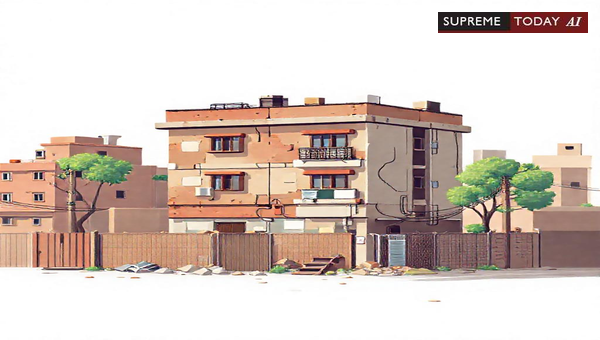
Why Courts Refuse to Stay Demolition of Illegal Construction Raised on Government Land
A recurring question before Indian courts is whether a stay or can be granted against demolition proceedings concerning . The consistent judicial answer, across the and multiple High Courts, is that no such stay should ordinarily be granted where the structure is admittedly unauthorized and no permission or sanction exists. Encroachers on public land generally find little sympathy at the interim stage, and the rule of law is allowed to take its course.
The Core Legal Position
Indian courts have settled on a clear principle: unauthorized constructions on government land are removable, and interim orders protecting them are an exception rather than the rule. Several strands of reasoning support this position.
No Court Shall Stay Demolition Proceedings on State Land
The has held that no court shall stay the proceedings of any public notice, including notices for eviction, demolition, or removal, from land or property belonging to the State Government, a Municipal Corporation, or any other local authority, without first giving the Commissioner a reasonable opportunity of representing in the matter 2006 9 Supreme 95. The power to demolish unauthorized constructions is vested in the Municipal Commissioner, and the court cannot impede that statutory discretion by issuing a mandatory order of demolition.
This principle was applied recently when the , dealing with a plea to restrain CIDCO from demolishing an illegal structure, expressly rejected the stay prayer, observing that the stay may not be granted 2025 Supreme(Online)(Bom) 351243.
A Strict, No-Leniency Approach to Unauthorized Construction
The and High Courts have repeatedly mandated a strict stance against violators of building regulations:
- Courts are expected to curtail unauthorized construction with iron hands upholding the rule of law, and must not regularize violations or show leniency that fosters impunity 2026 0 Supreme(Bom) 499.
- Delay in enforcement, heavy investment by the violator, or administrative lapses by authorities are not shields against demolition 2026 0 Supreme(Bom) 499.
- The in reaffirmed that or by the inaction of authorities 2024 0 Supreme(SC) 1199.
- Where construction was raised in open defiance of a stop-work notice, the held that regularization was unjustifiable and demolition had to follow
Gurudas Vattu Chati Aldonkar VS State of Goa
.
No Equity for the Wrongdoer on Public Land
A critical doctrine in this area is that long possession, payment of taxes, electricity bills, or user charges creates neither title nor equity in favor of an encroacher:
- Long possession over decades, electricity bills, tax receipts, and shop establishment certificates do not prove lawful authority or that a structure pre-dates a protective datum line 2026 0 Supreme(Bom) 384.
- The bars relief to litigants who have illegally occupied or constructed on public land; courts refuse aid to those who approach it with unclean hands 2026 0 Supreme(Bom) 384.
- Mere payment of property tax to a Gram Panchayat, without title documents such as a patta, is insufficient to establish legal possession of land recorded as government or sarkari land, particularly where it is earmarked for public welfare schemes like 2BHK housing 2026 Supreme(Online)(Tel) 23739.
- Once land is acquired by the government and physical possession is taken, any private right stands extinguished, and a purchase of public land is non-est in the eyes of the law; a trespasser on government land is generally not even entitled to a show-cause notice before removal 2024 0 Supreme(Del) 338.
Summarily Removable Encroachments
Encroachments on streets and public places can be removed summarily under provisions such as of the Mumbai Municipal Corporation framework, and ancillary documents confer no title or regularization 2026 0 Supreme(Bom) 384. Similarly, under the Rajasthan regime, courts have directed trial courts to decide applications for vacation of interim orders obtained by persons in possession without a clear legal right within six weeks of filing, underscoring that stays granted to encroachers should be vacated speedily 2019 0 Supreme(Raj) 831.
What About Disputed Facts?
is not the forum for deciding disputed factual questions — for example, whether a structure pre-dates a datum line or was previously tolerated by authorities. Such questions must be resolved in appropriate civil or statutory proceedings, and their existence does not automatically entitle the encroacher to an interim stay 2026 0 Supreme(Bom) 499.
Limits: Natural Justice Still Matters
The strict approach does not eliminate procedural safeguards entirely:
- Municipal authorities must ordinarily give proper notice and a before demolition, particularly where the Commissioner has not yet passed an order under 2006 9 Supreme 95.
- The in the Barjatia line of cases emphasized that prior notice is essential in demolition proceedings, though a violator who knew of the illegality gains little from this requirement 2024 0 Supreme(SC) 1199.
- Where the government itself wrongfully demolishes a lawful structure — for instance, construction raised with municipal permission on the owner's own patta land — compensation may be recoverable 2022 0 Supreme(Raj) 2321.
Why Authorities Are Pushed to Act
Courts have also criticized municipal authorities for apathy. In one Karnataka case, the High Court directed that engineers act swiftly against illegal constructions upon discovery or complaint, failing which departmental enquiries should be initiated against officers showing a lackadaisical attitude 2021 0 Supreme(Kar) 474. The message is twofold: citizens cannot obtain stays to protect illegal buildings, and officials cannot sit idle while violations multiply.
Key Takeaways
- Courts will generally not stay demolition proceedings for unauthorized construction on government, municipal, or local authority land 2006 9 Supreme 95.
- Long possession, tax receipts, and utility bills confer on an encroacher 2026 0 Supreme(Bom) 384 and 2026 Supreme(Online)(Tel) 23739.
- The clean hands doctrine rigorously applies; delay, investment, and administrative inaction are not defenses 2026 0 Supreme(Bom) 499 and 2024 0 Supreme(SC) 1199.
- A trespasser on government land typically has no right to remain and limited procedural protection 2024 0 Supreme(Del) 338.
- Authorities must still follow notice and hearing requirements, and must themselves act promptly against violations 2021 0 Supreme(Kar) 474.
The prevailing judicial attitude is that allowing stays for illegal constructions on public land would reward wrongdoing and erode urban planning norms. Litigants are therefore better served by demonstrating that their structure was authorized or that the demolition notice is mala fide, rather than by seeking blanket interim relief. This article reflects general judicial trends and is not a substitute for advice on a specific matter.
#IllegalConstruction #GovernmentLand #DemolitionCaseLaw #Encroachment #WritJurisdiction









