


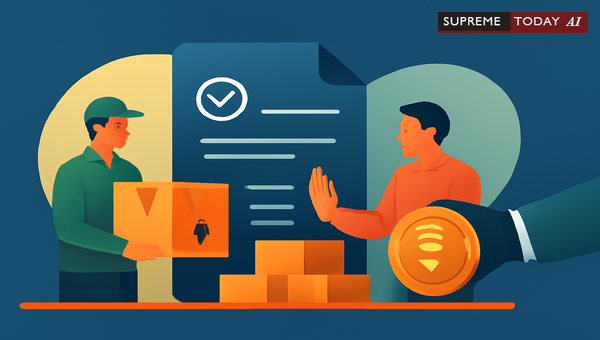
Non-Payment for Excess Goods: Not Acceptance in India
In the fast-paced world of commerce, disputes over goods delivery are common. Imagine a supplier sends more goods than ordered—does your refusal to pay for the excess automatically mean you've accepted them? This question often arises in business transactions: Not Paying Money for Goods Delivered in Excess is Not Accepting the same.
This blog post dives into Indian law, particularly the , to clarify this issue. We'll explore legal definitions, key principles, case insights, and practical advice. Note: This is general information based on legal precedents and not specific legal advice. Consult a qualified lawyer for your situation.
The Core Legal Principle: Acceptance Requires More Than Silence
Under Indian law, not paying for goods delivered in excess does not automatically constitute acceptance. Acceptance generally occurs when the buyer signifies approval, uses the goods, or retains them after a reasonable opportunity for examination, unless there's a clear agreement otherwise. Merely failing or refusing to pay does not, in itself, amount to acceptance, especially without explicit or implied agreement that non-payment equals acceptance. 2022 0 Supreme(SC) 1044
Key Points:- Acceptance is a , such as signaling approval or using the goods, or retention after a reasonable opportunity to examine. 2022 0 Supreme(SC) 1044- Non-payment alone does not constitute acceptance; it may indicate rejection unless other conduct suggests otherwise. 2022 0 Supreme(SC) 1044- Delivery and acceptance are separate acts under the Sale of Goods Act. 1959 0 Supreme(SC) 128- A buyer can refuse or reject goods without being deemed to have accepted them, particularly without signifying approval or retaining without objection. 2022 0 Supreme(SC) 1044
This distinction protects buyers from unintended liabilities when suppliers over-deliver.
Defining Acceptance Under the Sale of Goods Act
outlines acceptance: the buyer indicates approval or does any act , or retains the goods after a reasonable time without rejection. 2022 0 Supreme(SC) 1044 For instance, examining goods and then signaling rejection prevents acceptance. Using them beyond a reasonable period without objection may infer acceptance.
Non-Payment and Acceptance: A Clear DivideNon-payment does not, by itself, amount to acceptance. As clarified in legal principles, the act of not paying for goods delivered in excess does not automatically imply acceptance. The law views acceptance as affirmative, not the mere absence of payment or rejection. 2022 0 Supreme(SC) 1044
Insights from Cases and Legal Documents
Legal precedents reinforce this. Delivery alone does not transfer property or imply acceptance unless conditions are met. Delivery to a bailee does not amount to acceptance without proper conduct. 1959 0 Supreme(SC) 128
In scenarios involving excess goods, refusal to pay signals non-acceptance. For example, one case notes that even when goods are transported and a lien is exercised, non-delivery or non-payment doesn't automatically create liability if the contract is breached by the other party: the observation of the trial court that, as the goods in the fifth truck were not delivered, the defendant was not liable for the said amount, is also not correct as the defendant exercised his over the products. 2025 0 Supreme(Telangana) 292
Another context highlights claims for excess amounts on undelivered goods: The Claimant has filed a claim of Rs. 7,58,854/- as principal sum and excess amount including EMD lying with the Respondent for the goods not delivered. 2025 0 Supreme(Del) 630 This shows courts scrutinize actual delivery and acceptance, not just receipt.
In fraud or complex cases, courts distinguish: This is not a simple case of goods sold and delivered, their price unpaid without just cause.
MSTC Ltd. VS Export Credit Guarantee Corporation of India Ltd. -
2014 0 Supreme(Bom) 295 Non-payment in excess delivery often points to rejection, not acceptance.Relatedly, for transportation disputes: when the goods are not delivered, there is a .
-
This underscores that retention without payment or proper handling doesn't equate to acceptance.Suppliers claiming excess payments must prove entitlement, as recipients may be liable to refund: Suppliers delivered goods within extended timelines and without complaints; however, they claimed excess amounts (e.g., Rs.28,83,279) which they are liable to return. 2023 0 Supreme(Telangana) 1
Exceptions and Limitations
While non-payment typically signals non-acceptance, exceptions exist:- Retention beyond reasonable time without objection may infer acceptance. 2022 0 Supreme(SC) 1044- Specific agreements or trade practices where non-payment constitutes acceptance could alter this, though none are indicated here.- Circumstances matter; for instance, if goods are used or integrated, acceptance may be presumed.- In lien cases, like the defendant exercised his over the products and he had transported the goods, possession doesn't always mean acceptance. 2025 0 Supreme(Telangana) 292
Excess collections or mistaken payments must be refunded: Excess collected (Rs.) in tax contexts shows obligations to return unentitled amounts. 2024 Supreme(Online)(Ker) 63312
Practical Recommendations for Buyers and Sellers
To avoid disputes:- Clearly specify in contracts consequences of non-payment, excess delivery, or rejection timelines.- Buyers: Document rejection explicitly—notify in writing to prevent inference of acceptance.- Sellers: Seek explicit acknowledgment; don't assume acceptance from non-payment. Invoice separately for excess and confirm receipt.- In excess payment scenarios, refund promptly to avoid breach claims. 2025 0 Supreme(Gau) 658 2023 Supreme(Online)(NCLT) 468- For transportation or liens, ensure contracts cover deficiencies: Where the contract for transportation is for a consideration (freight charge), the mere fact that such consideration is not paid does not negate service.
-
Failure to pay or return excess can lead to recovery suits: Failure to pay for goods delivered or to return excess payments... amounts to a . 2023 0 Supreme(Cal) 822 2023 0 Supreme(Ker) 89
Conclusion and Key Takeaways
In summary, under Indian law, not paying for goods delivered in excess is not accepting the same. Acceptance demands positive acts, not passive non-payment. This principle, rooted in the Sale of Goods Act and supported by cases like 2022 0 Supreme(SC) 1044 and 1959 0 Supreme(SC) 128, empowers buyers to reject extras without liability.
Key Takeaways:- Non-payment often means rejection, protecting against unwanted excess.- Document everything to clarify intent.- Contracts are your best defense—detail acceptance terms.- Recipients of excess payments or goods should refund or reject promptly to avoid legal action.
Stay informed, draft robust agreements, and consult professionals for tailored advice. For more on commercial law, follow our blog.
#SaleOfGoodsAct, #ContractLawIndia, #LegalInsights















