


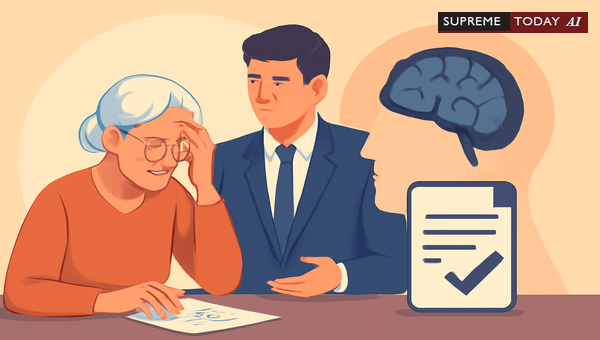
Does Old Age and Ailments Automatically Mean Lack of ?
In an aging population, questions about often arise when elderly individuals execute wills, deeds, or other legal documents. A common misconception is that advanced age or health issues alone prove someone lacked the mental ability to understand their actions. But does old age and ailments automatically mean that the executant lacked ? Under Indian law, the answer is a resounding no. Courts emphasize that capacity is determined by specific evidence of comprehension, not mere age or infirmity. This blog post dives into key legal principles, landmark cases, and practical insights to clarify this vital issue.
Understanding in Legal Transactions
refers to an individual's ability to understand the nature and consequences of a legal act, such as signing a will or deed. Indian courts, guided by principles from the , and , consistently reject presumptions based solely on age or health. As held in several judgments, advanced age or enfeebled state due to old age and disease does not negate if the individual can understand the nature of the act. 1897 0 Supreme(Cal) 181
This fact-specific approach protects genuine transactions while safeguarding vulnerable persons. For instance, even if someone is elderly and ailing, evidence like witness testimony or consistent prior actions can uphold their capacity. In one case, the mere advanced age of the testatrix does not imply lack of ; the law requires only one to prove execution. 2025 0 Supreme(Cal) 47
for Wills: Age Alone Isn't Enough
When probating a will, challengers often cite the testator's old age or diseases to question capacity. However, courts demand concrete proof of incomprehension. The court held that the testator had sufficient to execute the will, despite his enfeebled mental state due to old age and disease. 1897 0 Supreme(Cal) 181
Similarly, in a property dispute involving a will, the court noted: Even if Sushil Kumar was sick, that does not mean that he lacked . Even such incapacity has not been pleaded by the plaintiffs. 2020 0 Supreme(P&H) 707 This reinforces that illness or age raises no automatic bar—plaintiffs must plead and prove incapacity with cogent evidence.
Post-execution behavior, like living independently for years afterward, often rebuts claims. Courts favor upholding wills unless are proven, distinguishing legal capacity from medical conditions.
Shifts in Vulnerable Cases
While age doesn't presume incapacity, it can trigger heightened scrutiny, especially for elderly, infirm, or dependent persons. In deeds or transactions, where old age combines with infirmities (e.g., blindness, grief-induced distress), courts apply a presumption of or incapacity, shifting the burden to the party benefiting from the transaction. 1995 0 Supreme(All) 973
A key ruling states: In cases involving the validity of a deed executed by a person who is old, infirm, ignorant, illiterate, mentally deficient, inexperienced, or dependent upon others, the lies on the person seeking to enforce the deed to prove that it was executed after full comprehension and in a healthy condition of body and mind. 1995 0 Supreme(All) 973 Failure to rebut this—as in a case voiding a deed for a 90-year-old blind man out of senses post-tragedy—leads to invalidation. (https://supremetoday.ai/doc/judgement/02500037185)
In , the principle is even stricter: A person standing in a to another... the burden of proving the absence of fraud, misrepresentation or is upon the person in the dominating position. 2017 0 Supreme(Mad) 3857 For example, allegations that a grandson exploited his grandmother's old age, dim eyesight and mental condition via settlement deeds shifted the burden, requiring proof of free will. 2009 0 Supreme(SC) 525
Yet, this is rebuttable. Admittedly, there is no evidence to show that the settlor was in weak health... Ex. D1 clearly show that... he was hale and healthy and had good . 2017 0 Supreme(Mad) 3857
and Fiduciary Scrutiny for the Elderly
Old age paired with ailments like dim eyesight or mental distress invites claims of domination, particularly in family transactions. Case set up by them is that the first defendant, exercising dominating influence over his grandmother, got the two settlement deeds executed from her exploiting her old age, dim eyesight and mental condition. 2009 0 Supreme(SC) 525
Courts examine factors like the beneficiary's position, independent advice, and the executant's demeanor. Additional cases echo this: In a matter, an old, ailing illiterate executant prompted scrutiny of age and benefit nature, but capacity wasn't presumed lost.
.
In eviction disputes, old age ailments justified a landlord's needs without questioning capacity, showing context matters. 2019 0 Supreme(Del) 2026 Even in bail pleas citing old age ailments, courts assess holistically without automatic incapacity. 2022 0 Supreme(Bom) 1312
Exceptions: When Incapacity May Be Inferred
Rarely, extreme evidence overrides rebuttals:- Total Lack of Comprehension: Unrebutted proof, like post-death delirium in a blind 90-year-old, voids deeds. 1995 0 Supreme(All) 973- No Fiduciary Tie: Standard proof by executant suffices. 1897 0 Supreme(Cal) 181- Strong Rebuttals: Medical records, post-execution health (e.g., living 5 years post-settlement), or consistent acts prevail. 2017 0 Supreme(Mad) 3857- Distinction from Insanity: Legal capacity differs from medical insanity, requiring fact-specific inquiry.
In , courts liberally view old age ailments for senior citizens over 66, balancing justice. 2017 0 Supreme(AP) 165
Practical Recommendations for Elderly Transactions
To navigate these issues:- Gather Evidence: Contemporaneous medical reports, witness attestations, and video recordings of execution.- Seek Independent Advice: Especially in fiduciary cases, consult neutral lawyers to prove free will.- Challengers' Burden: Allege specific incapacity proof beyond age/health; courts uphold acts absent grave suspicion.- Litigants: Use prior consistent documents or post-execution conduct to rebut claims.
This generally aligns with Indian courts' protective yet pragmatic stance.
Key Takeaways
- Old age and ailments do not automatically mean lack of —evidence rules. 1897 0 Supreme(Cal) 181 2025 0 Supreme(Cal) 47
- Burden shifts to beneficiaries in vulnerable/fiduciary cases, but is rebuttable. 1995 0 Supreme(All) 973 2017 0 Supreme(Mad) 3857
- Prioritize documentation to safeguard or challenge transactions.
This post provides general insights based on case law and is not legal advice. Consult a qualified lawyer for your situation.
References
- 1897 0 Supreme(Cal) 181: Upholds will capacity despite enfeeblement.
- 2025 0 Supreme(Cal) 47: Age alone doesn't imply incapacity.
- 1995 0 Supreme(All) 973: Burden on beneficiaries for infirm executants.
- 2017 0 Supreme(Mad) 3857: Rebuts claims.
- 2009 0 Supreme(SC) 525: Fiduciary scrutiny in old age cases.
- 2020 0 Supreme(P&H) 707: Sickness doesn't equate to incapacity.















