


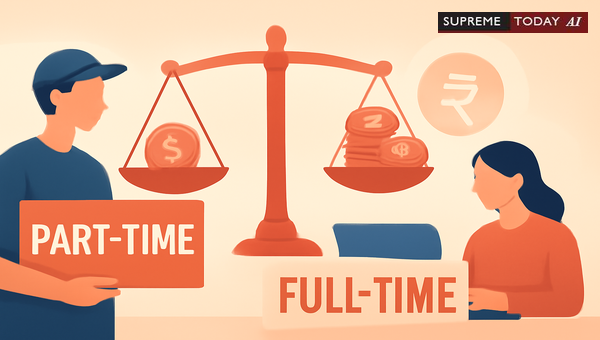
Part-Time Employees Working Full-Time: Entitled to the Pay Scale Attached to the Post?
In today's flexible workforce, many organizations hire part-time employees to meet varying demands. But what happens when these workers end up performing full-time duties? A common question arises: Part Time Employees Working Full Time Entitled Pay Scale Attached to the Post? This issue touches on core labor rights, particularly the principle of , and has been addressed in numerous Indian court judgments.
This blog post breaks down the legal landscape, drawing from precedents and tribunal decisions. Note: This is general information based on case law and not specific legal advice. Consult a qualified lawyer for your situation. We'll explore entitlements, limitations, and key takeaways to help employers and employees navigate this complex area.
Overview of the Legal Framework
Under Indian labor law, part-time employees who shoulder the same duties and responsibilities as their full-time counterparts may be entitled to the same pay scale. This stems from the constitutional mandate of equality under and , emphasizing .
However, entitlement isn't automatic. Courts scrutinize factors like employment terms, hours worked, and the nature of engagement (e.g., vs. regular post). As held in landmark cases, temporary or part-time workers are often limited to the without increments unless occurs. 2023 0 Supreme(AP) 726
Key Legal Principles Governing Entitlement
1.
The cornerstone principle is . Part-time employees performing identical duties to full-time staff are entitled to parity in pay scales. judgments like and affirm this. 1995 0 Supreme(All) 1254
For instance, if a part-time worker clocks full-time hours and handles the same tasks, they may claim the full pay scale. Yet, this applies selectively—courts demand proof of similar qualitative and quantitative work.
2. Minimum Pay Scale for Temporary/Part-Time Employees
Even without full parity, courts frequently direct payment of the attached to the post. In , the clarified that temporary employees seeking are entitled to this minimum. 2023 0 Supreme(AP) 726
Supporting this, one ruling states: pay scale is admissible to such employees, they would be entitled to which is attached to the post but without any increments. 2023 0 Supreme(AP) 680 Another directs payment of minimum in the time scale**. 2023 0 Supreme(AP) 680
Government orders often extend to casual, daily wage, and part-time employees meeting service criteria, including allowances like DA and HRA—but not necessarily increments. 2025 0 Supreme(AP) 152 2023 0 Supreme(AP) 726 2023 0 Supreme(Gau) 254
3. Limitations for Part-Time and Workers
Not all part-time roles qualify. Workers on or with limited duty hourscannot claim or pay parity. Courts hold that their engagement's nature precludes regular employee benefits. 2006 0 Supreme(All) 2869 2006 0 Supreme(UK) 592
Explicitly: Part-time employees cannot seek and the time scale of pay applicable to full time posts. 2014 0 Supreme(Mad) 3919 In another case: the pay scale directed to be paid by this Court was for full-time employees and the petitioners, being part-time employees, are not entitled to the benefits of the judgment. 2020 0 Supreme(Ker) 904
4. Differentiation: Daily Wagers vs. Regular Employees
Daily wage workers are typically restricted to per government notifications and cannot claim pay parity solely on similar duties. 2014 0 Supreme(Guj) 1070 The equal pay principle has limited application here, as they don't hold .
Part-time employees generally cannot seek because they do not work against and cannot claim parity. 2024 0 Supreme(Guj) 2082 2023 0 Supreme(Del) 1845
5. and Long Service Considerations
Long service can tip the scales. Employees with extended tenure or working in regularized capacitiesmay qualify for regular pay scales and increments. Courts direct authorities to consider cases for minimum pay scales or against . 2024 0 Supreme(Del) 118 2025 0 Supreme(Telangana) 1126
Petitioners classified as permanent on their posts are entitled for the pay scale and other benefits attached. 2015 0 Supreme(MP) 474 Policies extending benefits to certain categories may render denials to others discriminatory. 2022 0 Supreme(Mad) 975
In Tamil Nadu contexts, full-time regular scale workers received pension benefits, highlighting how employment classification matters. 2022 0 Supreme(Mad) 702
Practical Implications for Employers and Employees
- For Employees: Document duties, hours, and comparisons to full-time peers. Long service strengthens claims for minimum pay scale.
- For Employers: Clearly define part-time terms. Avoid ad-hoc full-time work without adjusting pay to prevent litigation.
- Government/Semi-Govt Roles: Adhere to G.O.s on minimum scales for casual/part-time staff. 2025 0 Supreme(Telangana) 1126 2025 0 Supreme(AP) 174
Conclusion and Key Takeaways
Part-time employees working full-time duties may be entitled to the pay scale attached to the post, particularly the minimum thereof, under —but exceptions abound for , daily wagers, or non-sanctioned roles. Courts prioritize identical work performance and service conditions.
Key Takeaways:- Entitlement: Possible for same duties; minimum scale common without increments. 2023 0 Supreme(AP) 726 2023 0 Supreme(AP) 680- No Automatic : Limited to . 2024 0 Supreme(Guj) 2082- Recommendation: Assess specific terms and seek legal review.
References:- 2023 0 Supreme(AP) 726 (Uma Devi)- 1995 0 Supreme(All) 1254 (Surendra Kumar, Vijay Kumar)- 2014 0 Supreme(Guj) 1070- 2006 0 Supreme(All) 2869 2006 0 Supreme(UK) 592- 2023 0 Supreme(AP) 680- 2022 0 Supreme(Mad) 702 2020 0 Supreme(Ker) 904 2015 0 Supreme(MP) 474 2014 0 Supreme(Mad) 3919- 2025 0 Supreme(AP) 152 2023 0 Supreme(Gau) 254 2024 0 Supreme(Guj) 2082 2023 0 Supreme(Del) 1845 2024 0 Supreme(Del) 118 2025 0 Supreme(Telangana) 1126 2022 0 Supreme(Mad) 975 2025 0 Supreme(AP) 174
Stay informed on labor rights—share your experiences in the comments!
#EqualPay #LaborLaw #EmployeeRights












