


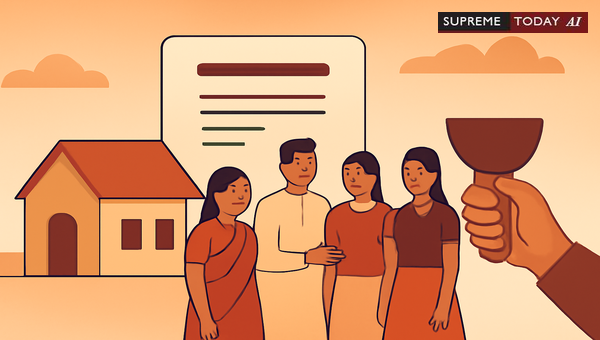
Partitioning : Key Legal Implications in Hindu Law
In the intricate world of Hindu family law, holds a special place, passed down through generations and shared among by birthright. But what happens when this joint family asset is partitioned? The legal implications of partitioning can profoundly affect ownership rights, inheritance, and family dynamics. If you're a coparcener, daughter, or family member navigating such disputes, understanding these implications is crucial.
This article delves into the legal implications of partitioning , drawing from established Hindu law principles and recent judicial insights. We'll cover definitions, effects, key principles, exceptions, and practical recommendations. Note: This is general information, not specific legal advice. Consult a qualified lawyer for your situation.
What is ?
is typically defined as property inherited from a paternal ancestor, where sons, grandsons, and great-grandsons acquire an interest by birth. This property must have been inherited for more than three generations to retain its ancestral character 2020 0 Supreme(Mad) 271.
As explained in judicial precedents, an is a property acquired by great grandfather, which has been passed down from generation to generation i.e., grandfather and father, up to the present generation, i.e., son, without being divided or partitioned by the family 2022 0 Supreme(Mad) 413. All acquire a right over the coparcenary property by birth, with shares fluctuating as the family grows.
Coparcenary property can be divided into and (not ancestral). The distinction lies in acquisition: comes with the aid of prior ancestral assets, while is acquired individually but treated as family-owned 2012 0 Supreme(Kar) 1120.
of : Process and Effects
occurs when is divided among joint family members. Once partitioned, it ceases to be and becomes the separate property of the individuals who received it2020 0 Supreme(Mad) 271 2021 0 Supreme(Mad) 627.
Key points on :1. Real Required: A must be real and not merely a paper transaction; otherwise, the property remains ancestral 2021 0 Supreme(Guj) 550.2. Post- Character: The divided shares become self-acquired or separate property 2020 0 Supreme(Mad) 271.3. Disposal Rights: Individual members can dispose of their shares without others' consent 2016 2 Supreme 345 1992 0 Supreme(Kar) 413.4. No Reversion on Birth: The birth of a male coparcener after does not revert the property to ancestral status unless blended back 2013 5 Supreme 666.
In one case, after a 1983 , property purchased in 1984 was deemed self-acquired. After under , ceases to be joint property and becomes of the respective parties 2025 Supreme(Online)(Mad) 26426. Daughters' rights under the do not extend to such post- .
Key Legal Principles Governing
Several principles shape the outcomes:- : A coparcener can blend with , making it by volition. The separate property of a Hindu coparcener ceases to be his separate property and acquires the characteristics of his joint family or , not by mere act of physical mixing... but by his own volition 2025 Supreme(Online)(Mad) 26426 1981 0 Supreme(AP) 48.- : Family members cannot claim over undivided 2021 0 Supreme(Guj) 550.- Rights of After-Born Sons: Sons born post- have no automatic rights over the father's separate property unless proven as joint 2021 0 Supreme(Kar) 281.
Under the , 1956 (as amended), daughters are by birth in . However, if property was partitioned years ago, like via registered deeds, it is no longer undivided coparcenary property. In order that a Hindu claims a right of coparcenery he or she must prove that property... is a or coparcenery property and it is undivided 2022 0 Supreme(Mad) 413.
Exceptions and Counterarguments
Not all inherited property is ancestral:- Property from a maternal grandfather is not ancestral 1958 0 Supreme(SC) 89.- Presumption of jointness can be rebutted with evidence of separate treatment 2022 0 Supreme(Mad) 3703.
In , like village office lands, may be delayed, but enure to the joint family. The regrant of lands attached to a village office would enure to the benefit of the joint family 2012 0 Supreme(Kar) 1120. Even if a member dies before , persist for heirs.
Sale deeds over require proof, especially for illiterate executants. Lack of evidence can void such transactions, preserving family claims 2016 0 Supreme(Ori) 647.
Additionally, property inherited by a sole heir may start as self-acquired but revive as coparcenary upon sons' birth 2010 0 Supreme(P&H) 1424.
Daughters' Rights Post-: A Modern Perspective
The 2005 amendment to grants daughters equal by birth. However, this applies only to undivided . Post-, shares are separate, and daughters cannot claim them unless blending is proven. In a suit for , the court upheld: Daughter's entitlement in arises by birth but only in , not in 2025 Supreme(Online)(Mad) 26426. The onus is on claimants to show conversion to joint property.
Practical Recommendations
To avoid disputes:- Clear Deeds: Explicitly state property nature 2021 0 Supreme(Mad) 627.- Document Blending: Record intentions to change character.- Consider HSA Amendments: Evaluate coparcenary impacts, especially for daughters.- Evidence Preservation: Maintain records of inheritance, partitions, and sales.
Conclusion and Key Takeaways
Partitioning transforms it from a shared family asset into individual separate property, severing coparcenary ties. While blending can reverse this, it requires clear intent. Courts emphasize real partitions, evidence of character, and undivided status for claims.
Key Takeaways:- loses character post- 2020 0 Supreme(Mad) 271.- Daughters' rights limited to joint, undivided property 2025 Supreme(Online)(Mad) 26426.- survive delays like impartibility 2012 0 Supreme(Kar) 1120.- Always substantiate claims with proof.
Navigating these issues demands careful planning. For personalized guidance, seek expert legal counsel.
References: 2020 0 Supreme(Mad) 271 2021 0 Supreme(Mad) 627 2021 0 Supreme(Guj) 550 2016 2 Supreme 345 1981 0 Supreme(AP) 48 1992 0 Supreme(Kar) 413 1958 0 Supreme(SC) 89 2022 0 Supreme(Mad) 3703 2025 Supreme(Online)(Mad) 26426 2022 0 Supreme(Mad) 413 2016 0 Supreme(Ori) 647 2012 0 Supreme(Kar) 1120 2010 0 Supreme(P&H) 1424.
#AncestralProperty #HinduLawPartition #CoparcenaryRights















