


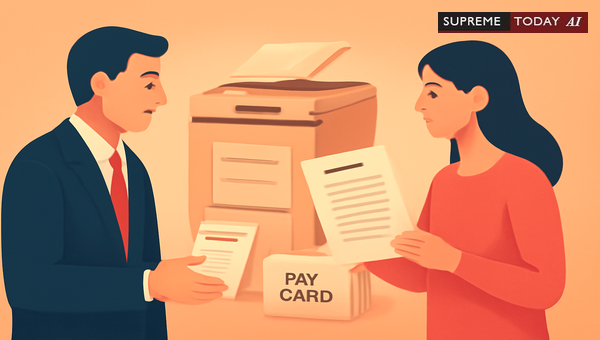
Do Xerox Copies of Pay Cards Prove No ?
In the realm of labor disputes, one common question arises: Would the Xerox Copies of Individual Pay Cards Suffice to Prove that there is no ? This issue frequently surfaces in cases involving , terminations, or claims for benefits under laws like the . Employers often rely on photocopies to contest employment claims, while workers assert their rights based on such documents. However, Indian courts have consistently scrutinized the reliability of like Xerox copies.
This blog post delves into the legal analysis, , key precedents, and practical recommendations. While this provides general insights based on judicial trends, it is not legal advice—consult a qualified lawyer for your specific situation.
Understanding the in Employment Disputes
The foundation of any claim rests on who bears the . Under the , the burden lies with the employee to establish the existence of such a relationship. Courts have repeatedly affirmed this principle, stating it is the responsibility of the employee to provide evidence supporting their claim of employment 2014 0 Supreme(Bom) 438 2018 0 Supreme(Del) 2048 2022 0 Supreme(Cal) 921.
For instance, in various rulings, the judiciary has emphasized that the claimant must produce reliable evidence. Mere assertions without substantiation fail to meet this threshold. This shifts the dynamic: employers can challenge claims effectively if the employee relies solely on weak evidence like photocopies.
Are Xerox Copies of Pay Cards Sufficient Evidence?
Xerox copies of individual pay cards may not suffice to prove—or disprove—an . Courts demand original documents or highly credible alternatives, especially when authenticity is disputed. Photocopies are often deemed inadequate because they can be easily fabricated or lack context 2022 0 Supreme(Mad) 3675 2016 0 Supreme(Guj) 325.
Key reasons include:- Lack of originality: Without originals, courts question tampering or incompleteness.- No contextual proof: Pay cards alone don't show appointment terms, control, or duration of service.- Disputable nature: Employers can deny issuance, as seen in cases where photocopies were rejected without corroboration.
In one precedent, the court noted that reliance on photocopies without originals or explanation led to failure in proving employment status 2023 0 Supreme(Del) 1844 2019 0 Supreme(Kar) 972. Similarly, Xerox copies of identity cards, entry permits, vouchers, or receipts—by themselves—are generally not conclusive proof of an 2025 Supreme(Online)(MAD) 14722. Courts stress direct evidence like appointment orders or records of continuous work over .
Legal Precedents on in Labor Cases
Indian courts have built a robust body of case law rejecting photocopies as standalone proof:
- Burden on Claimant: The burden is on the person claiming the relationship of employer and employee 2023 0 Supreme(P&H) 2102. High Courts, exercising , uphold this rigorously.
- No Automatic Proof from Documents: Issuance of identity cards or admit cards does not establish a direct relationship between laborers and the . In a case, petitioners failed to prove genuineness before the 2015 0 Supreme(Bom) 1911.
- PF Deposits Insufficient: Merely depositing provident fund amounts does not prove an employer-employee tie, absent appointment orders 2023 0 Supreme(P&H) 1959 2025 Supreme(Online)(AP) 1263.
Further, in disputes over , courts apply tests like . Workers of contractors aren't deemed employees without such proof 2018 0 Supreme(Ker) 1540. A Calcutta High Court ruling reinforced: there is no relationship between the employer and the employee when evidence falls short 2014 0 Supreme(All) 2509.
Another example: Petitioners failed to prove no despite lists or tenders, as they couldn't destroy the complainants' pleas 2012 0 Supreme(Bom) 1079. Even admissions in some contexts under may suffice for liability but not broadly establish ties 2025 Supreme(Online)(AP) 1263.
Xerox copies were challenged for admissibility, ruled insufficient without supporting proof like continuous records 2024 Supreme(Online)(Mad) 68986 2023 0 Supreme(Del) 10808 2025 Supreme(Online)(KAR) 7745.
Insights from Broader Case Law
Disputes often involve contractors, where employers contest ties. In one writ petition, counsel argued no relationship of employer-employee existed between management and petitioner, upheld via written statements 2023 0 Supreme(Del) 6804. Factors to establish ties include: (i) who appoints the workers; (ii) who pays wages, per Supreme Court guidelines in Air India Ltd. (2014) 9 SCC 407 2023 Supreme(Online)(JHK) 2444.
Deposits or cards don't override denials: It is stated that there was no despite PF contributions 2023 0 Supreme(P&H) 1959. Courts clarify indirect indicators like bank accounts or work cards do not automatically establish employment
INDYHJK00000009027
.Practical Recommendations for Stronger Cases
To navigate these challenges:- Prioritize originals: Secure appointment letters, wage registers, or PF statements with originals.- Corroborate with witnesses: Testimonies from supervisors or co-workers add weight.- Document continuity: Prove 240+ days of work via muster rolls or attendance.- Avoid sole reliance on Xerox: As courts note, mere production of xerox copies does not suffice, especially sans appointment orders 2025 Supreme(Online)(MAD) 14722.
Employers should maintain clear contractor records to rebut claims early.
Conclusion and Key Takeaways
Xerox copies of pay cards alone are unlikely to suffice in proving the absence (or presence) of an . The employee's burden requires originals or robust corroboration, as precedents consistently hold inadequate 2014 0 Supreme(Bom) 438 2022 0 Supreme(Mad) 3675. While supportive, photocopies falter against disputes, emphasizing primary proof's primacy.
Key Takeaways:- Burden rests on the employment claimant.- Photocopies need originals or strong backups.- Tests like control and appointment are crucial.- Gather comprehensive evidence for labor disputes.
This analysis draws from established Indian jurisprudence, but outcomes vary by facts. For tailored guidance, seek professional legal counsel. Stay informed on labor laws to protect your rights.
#LaborLaw #EmploymentDisputes #IndianCourts












