


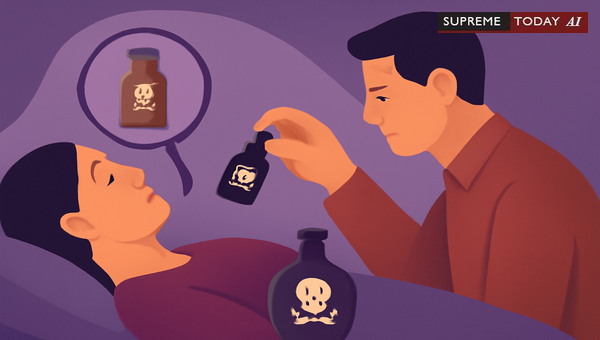
Poisoning Wife: Must Prosecution Prove Possession?
Imagine a husband accused of a heinous crime: administering poison to his wife, leading to her tragic death after years of marriage. Such cases grip headlines and courts alike, raising critical questions about evidence in secretive crimes. Client is Accused of Administering Poison to his Wife—a scenario that demands clarity on what the prosecution must prove for conviction under Indian law, particularly for murder.
This blog dives into the legal framework governing poison murder cases, drawing from landmark judgments and recent observations. We'll explore whether direct proof of poison possession is mandatory or if suffices. Note: This is general information based on judicial precedents and not specific legal advice. Consult a qualified lawyer for your situation.
Legal Essentials in Poison Murder Cases
In cases of murder by poisoning, courts have outlined specific on the prosecution. Primarily, they must establish:
- The deceased died from poison.
- The accused had the poison in possession.
- The accused had the opportunity to administer it. 2021 1 Supreme 168
However, the secretive nature of poisoning crimes means direct evidence is rare. As held in key judgments, proof of possession may be inferred from , and its absence doesn't automatically lead to acquittal if the overall circumstances point irresistibly to guilt. 2021 1 Supreme 168 1959 0 Supreme(SC) 195
The in Sharad Birdhichand Sarda v. State of Maharashtra () clarified: The insistence on proof of possession of poison with the accused invariably in every case is neither desirable nor practicable. It would mean to introduce an extraneous ingredient to the offence of murder by poisoning.2021 1 Supreme 168
Similarly, in Bhupinder Singh (), the court reinforced: The poison murder cases are not to be put outside the rule of . There may be very many facts and circumstances proved against the accused which may call for tacit assumption of the factum of possession of poison with the accused.1959 0 Supreme(SC) 195
These principles ensure justice isn't thwarted by the covert of such offenses.
Landmark Judgments Shaping the Law
Sharad Birdhichand Sarda v. State of Maharashtra 2021 1 Supreme 168
This pivotal case listed four crucial circumstances for conviction:1. Death due to poison.2. Accused's possession of poison.3. Opportunity to administer.4. Totality of circumstances excluding innocence.
The court emphasized that while these are ideal, rigidity isn't required. Circumstantial chains can infer possession, especially in secret administrations.
Bhupinder Singh Case 1959 0 Supreme(SC) 195
Here, direct possession proof wasn't fatal to the case. Courts look at motive, behavior, and access. Failure to prove possession directly is not fatal if other evidence suggests guilt.1959 0 Supreme(SC) 195
Contrasting Example: 1988 0 Supreme(SC) 264
Conviction was set aside due to weak evidence on possession and opportunity, underscoring that must form a complete chain leading to only one hypothesis: guilt.1988 0 Supreme(SC) 264
Application to 'Administering Poison to Wife' Accusations
When a client faces charges of administering poison to his wife—often amid motives like dowry demands or business disputes—these principles apply directly. For instance, in a case after 14 years of marriage, the allegation stemmed from a Rs. 3 lakhs demand for business, but the FIR was deemed very much general and omnibus regarding poisoning.
Prosecution typically relies on:- Motive: Family disputes, financial pressures.- Opportunity: Accused's proximity to the deceased.- Medical evidence: Poison detection in (though negative results weaken cases).
Yet, recent matters reveal gaps:- No direct evidence of forcible administration; deceased might protest or self-administer.
- Witnesses, including children, fail to corroborate. 2024 Supreme(Online)(Tel) 37689- Accused sometimes aids the victim, like hospitalizing after consumption, suggesting no intent.
In one FIR, allegations against the applicant for administering poison to the wife lacked other evidence, tied to family disputes.
Insights from Recent Cases and Bail Trends
High courts frequently grant bail in such matters due to vague allegations and absent direct proof. For example:
- Chemical analysis negative: No poison found in or food, pointing to suicide or natural causes.
- Alternative narratives: Bottles near deceased suggest self-poisoning from frustration.
- Witness inconsistencies: Children or family couldn't confirm administration.
2024 Supreme(Online)(Tel) 37689
Courts note: There is no other evidence against the applicant in regard to administering the wife of the informant with poison.
Bail is favored when chains break—e.g., accused consuming poison themselves or fleeing patterns unexplained.
Exceptions, Limitations, and Defenses
While is powerful, pitfalls exist:- Incomplete chain: Any link suggesting innocence gives . 2021 1 Supreme 168- Weak corrobation: No poison or procurement proof can doom prosecution. 1988 0 Supreme(SC) 264- Omnibus FIRs: General claims without specifics invite scrutiny.
Defenses often highlight:- Suicide motives (e.g., harassment).- Lack of motive or alibi.- Medical discrepancies.
Practical Recommendations
For accused or investigators:- Bolster circumstantial web: Motive, pre-death behavior, exclusive opportunity.- Challenge gaps: Demand reports, witness cross-examination.- Seek bail early: If evidence circumstantial and vague, courts lean favorable.
Prosecution should:- Secure robust medical/forensic evidence.- Corroborate with multiple witnesses.- Avoid reliance solely on without scrutiny.
Key Takeaways
- Possession isn't always directly provable—circumstances can infer it in wife poisoning cases. 2021 1 Supreme 168 1959 0 Supreme(SC) 195
- Totality rules: Evidence must unerringly point to guilt.
- Recent trends show bail common sans direct proof, emphasizing fair trials.
Poison murder allegations, especially administering poison to wife, hinge on nuanced evidence appreciation. Stay informed, but always seek professional counsel.
References:1. 2021 1 Supreme 168: in poison cases.2. 1959 0 Supreme(SC) 195: Inference of possession.3. 1988 0 Supreme(SC) 264: Essential proofs.4. Various matters like
,
. #PoisonMurder, #WifePoisoningCase, #CriminalLawIndia












