


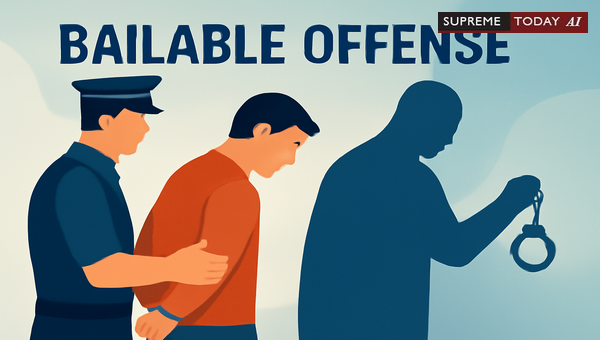
Can Police Arrest in ? Understanding Your Rights in India
Imagine being arrested for a minor traffic violation or a petty theft—scenarios common in . A pressing question arises: Whether the Police can Arrest the Accused in Case of Bailable Offense? This is a fundamental concern in Indian criminal law, balancing police powers with individual liberty. In this post, we explore police arrest authority, the golden principle that , and key judicial safeguards. Note: This is general information, not specific legal advice—consult a lawyer for your case.
What Are ?
Under the , offenses are classified as bailable or . , listed in the First Schedule of CrPC, include less serious crimes like simple hurt (), public nuisance (), or defamation (). In these cases, bail is typically a right, not a favor, under . The police or court must release the accused on bail if they apply, emphasizing liberty over .
However, this doesn't mean arrests are off-limits. Police retain powers under to arrest without a warrant for if there's reasonable suspicion. But post-arrest, release on bail is swift, aligning with constitutional protections.
Police Powers to Arrest in
Yes, police can arrest in , but with limits. For cases, allows arrest based on credible information of an offense punishable up to 7 years. Yet, mandates informing the accused of arrest grounds and their bail right. Magistrates must consider custody needs based on offense nature: learned Magistrates/Judges before whom the accused is produced, depending upon the nature of offence, shall consider as to whether judicial/police custody is required or not. 2021 0 Supreme(Ker) 462 2021 0 Supreme(Ker) 466 2020 0 Supreme(Ker) 388 2020 0 Supreme(Ker) 364
Needless to state that, bail is the rule and jail is an exception.2021 0 Supreme(Ker) 462 2021 0 Supreme(Ker) 466 2020 0 Supreme(Ker) 388 2020 0 Supreme(Ker) 364
This underscores that arrests shouldn't lead to prolonged detention without cause.
The Core Principle: Bail is the Rule, Jail is the Exception
Indian jurisprudence firmly holds: 2022 7 Supreme 641 2023 0 Supreme(SC) 301 2023 0 Supreme(Megh) 19. This principle safeguards the and under of the . Courts grant bail unless exceptional circumstances like flight risk, evidence tampering, or public order threats exist 2025 0 Supreme(Ker) 221.
- Object of bail: Secure accused attendance at trial, not punishment 2022 7 Supreme 641 2023 0 Supreme(Megh) 19.
- Liberty under : Deprivation only justified exceptionally 2022 7 Supreme 641 2023 0 Supreme(SC) 301.
- Judicial discretion: Exercised judiciously per case facts 2022 7 Supreme 641 2023 0 Supreme(Megh) 19.
- No punitive denial: Even serious charges don't auto-deny bail without compelling reasons 2023 0 Supreme(SC) 301.
The in emphasized bail secures trial attendance, not withheld as punishment 2022 7 Supreme 641. In , it reaffirmed bail as rule based on 2022 7 Supreme 641 2023 0 Supreme(Megh) 19.
Landmark Rulings and Legal Commentaries
Courts consistently reiterate this doctrine:
Gurbaksh Singh Sibbia and Beyond
The principle that is explicitly articulated in multiple judgments. 2022 7 Supreme 641. Legal commentaries root it in liberty guarantees, with State bearing proof burden for detention 2022 7 Supreme 641 2023 0 Supreme(Megh) 19.
Recent Affirmations
In various cases, courts note: It is settled law that bail is the rule and jail an exception.2021 0 Supreme(P&H) 936. Even post-challan, undue delay warrants bail, especially for family breadwinners 2021 0 Supreme(P&H) 936.
affirms grant as norm, refusal exceptional 2025 0 Supreme(Ker) 677 2025 0 Supreme(Ker) 481 2025 0 Supreme(Ker) 1242 2025 0 Supreme(Ker) 1238 2025 0 Supreme(Ker) 1221 2025 0 Supreme(Ker) 1225 2025 0 Supreme(Ker) 509 2025 0 Supreme(Ker) 450 2025 0 Supreme(Ker) 1305 2025 0 Supreme(Ker) 221.
Exceptions: When Jail May Be Justified
While bail prevails, exceptions include:- Risk of absconding, witness tampering, or public order threats 2025 0 Supreme(Ker) 221.- Grave societal danger, supported by concrete evidence—not mere suspicion 2022 7 Supreme 641 2025 0 Supreme(Ker) 221.
Courts caution: Mere bald statements... do not justify detention. 2025 0 Supreme(Ker) 221. No inflexible rules; decide per facts 2022 7 Supreme 641 2023 0 Supreme(Megh) 19. Even serious economic offenses need specific reasons beyond gravity 2023 0 Supreme(SC) 301.
Judicial challenges: Some courts withhold bail cautiously, breaching the rule—urging adherence to liberty jurisprudence 2025 0 Supreme(Ker) 481 2025 0 Supreme(Ker) 1242 2025 0 Supreme(Ker) 1238. Conditions like sureties or reporting may apply 2025 0 Supreme(Ker) 1242 2025 0 Supreme(Ker) 221.
Practical Implications and Safeguards
For accused in :- Demand bail: Right under Section 436; police station or magistrate.- (): Pre-arrest protection if apprehension exists 2010 8 Supreme 353 2011 0 Supreme(SC) 369 2011 8 Supreme 270.- Deep societal roots: Factors like family dependence favor release 2021 0 Supreme(P&H) 936.
Courts should:- Adhere to bail rule judiciously.- Require specific, evidenced grounds for denial.- Grant with conditions in serious but low-risk cases.- Prevent 2022 7 Supreme 641 2023 0 Supreme(Megh) 19.
Key Takeaways
- Police can arrest in but must facilitate quick bail.
- Bail is the rule, jail the exception—upheld by and 2022 7 Supreme 641 2023 0 Supreme(SC) 301 2023 0 Supreme(Megh) 19.
- Exceptions demand concrete proof 2025 0 Supreme(Ker) 221.
- Uphold liberty; detention as last resort.
In conclusion, while arrests occur, the legal position favors prompt release on bail unless exceptional circumstances are demonstrated with material support. This promotes justice, minimizing unwarranted incarceration. Stay informed, know your rights, and seek professional advice promptly.
Word count: 1028. References based on cited documents.
#BailIsRule, #CriminalLawIndia, #LegalRightsIndia












