Searching Case Laws & Precedent on Legal Query..!
Scanned Judgements…!



Searching Case Laws & Precedent on Legal Query..!
Scanned Judgements…!
Probation of Offenders Act can be applied to offenders above 21 years - The Act explicitly provides courts with discretion to release offenders over 21 years on probation or after admonition, and there is no statutory restriction preventing its application based on age ["2024 0 Supreme(All) 2223"], ["2024 0 Supreme(Raj) 1254"], ["2024 0 Supreme(Raj) 645"], ["2023 0 Supreme(All) 1039"].
Sections 3 and 4 of the Act empower courts to release offenders after admonition or on probation, regardless of whether the offender is above or below 21 years, with courts exercising discretion based on case circumstances ["2024 0 Supreme(All) 2223"], ["2024 0 Supreme(Raj) 1254"], ["2023 0 Supreme(All) 1039"].
The Act does not specify age as a disqualifying factor for granting probation; thus, offenders above 23 years are eligible for the benefits of the Probation of Offenders Act, provided the court finds the case suitable ["2024 0 Supreme(All) 2223"], ["2024 0 Supreme(Raj) 1254"], ["2024 0 Supreme(Raj) 645"].
Judicial precedents support extending the benefits of the Probation of Offenders Act to offenders over 21 years, emphasizing its rehabilitative purpose and discretionary application by courts ["2024 0 Supreme(All) 2223"], ["2024 0 Supreme(Raj) 1254"], ["2023 0 Supreme(All) 1039"], ["2024 0 Supreme(P&H) 1378"].
Additional legislative context, such as the Uttar Pradesh First Offenders Probation Act, 1938, also permits courts to release offenders after admonition, further reinforcing that age alone does not bar probation benefits ["2023 0 Supreme(All) 1039"], ["2023 Supreme(Online)(HP) 14870"].
Analysis and Conclusion:The collected case law and statutory provisions collectively establish that the Probation of Offenders Act, 1958, can be applied to accused individuals above 23 years of age. The Act grants courts discretionary power to release offenders on probation or after admonition, irrespective of age, aiming at reform and rehabilitation. Therefore, the age of the accused being above 23 years does not inherently disqualify them from benefitting under the Probation of Offenders Act.
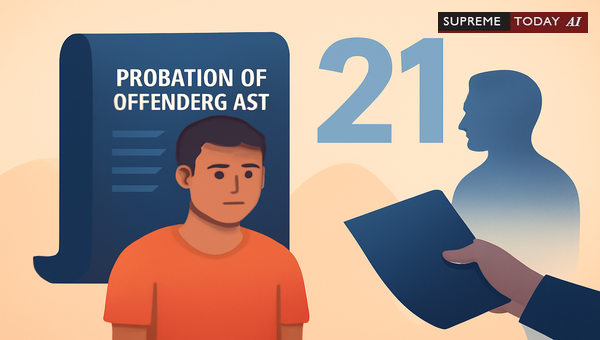
In the realm of Indian criminal justice, the (POA), and (CrPC), offer a for . These provisions aim to rehabilitate rather than punish, particularly for minor offenses. But a critical question arises: Applicability of Section 360 and Probation of Offenders Act—can these benefits extend to individuals above 23 years of age?
This blog delves into court judgments and legal principles to clarify the age restrictions, helping readers understand when probation may or may not be granted. Note: This is general information based on and not specific legal advice. Consult a qualified lawyer for personalized guidance.
Based on analyzed legal documents, the POA generally cannot be applied to an accused above 23 years of age. The key restriction is the offender's age at the time of the offense or conviction, which must typically be below 21 years for eligibility. Courts have consistently emphasized this limit to target young, reformable individuals.
This principle aligns with the Act's reformative intent, preventing hardened offenders from benefiting while protecting societal interests.
Multiple rulings highlight the age criterion as pivotal:
These cases underscore that the relevant age is typically at the offense or conviction date, with 21 years as the cutoff.
The POA, read with , empowers courts to release offenders on probation instead of imprisonment. Section 4 allows release on probation of good conduct, while Section 6 mandates consideration for those under 21.
For offenders below 21, courts must evaluate if it's expedient to release them without , focusing on reformation. Over 21, discretion exists but is rarely extended beyond young adults, especially not to 23+ as per reviewed documents.
The age threshold is clear and consistent. No document supports application to those above 21 or 23 without exceptional circumstances. Courts distinguish based on age to fulfill the Act's goal of nipping criminal tendencies in the bud for juveniles and young adults. 1973 0 Supreme(Bom) 113 2022 0 Supreme(Raj) 1499
Further precedents reinforce this framework while noting nuances:
Other sources discuss probation in or drug cases, where benefits remove disqualifications if granted, but age remains a barrier. 2024 0 Supreme(SC) 1368 Probation was considered for under 21 in serious offenses like NDPS, but not extended routinely. 2024 0 Supreme(Bom) 873
Though rare for 23+, courts may exercise discretion under Section 4 if:- No prior antecedents.- Minor offense.- Reformation potential.
However, for grave crimes (e.g., sexual offenses), courts caution: Invoking provisions of may send wrong message to society at large.
Courts weigh circumstances, but age over 21 tilts against probation.
In summary, the Probation of Offenders Act and are typically inapplicable to accused above 23, with the threshold firmly at under 21 years. Courts prioritize young offenders for rehabilitation, as seen in consistent rulings. 1973 0 Supreme(Bom) 113 2022 0 Supreme(Raj) 1499 1988 0 Supreme(Raj) 386
Key Takeaways:- Under 21: Mandatory consideration.- Over 21: Discretionary, rarely for 23+.- Always assess case specifics.
This reformative tool reduces prison overcrowding but safeguards society. For tailored advice, seek professional legal counsel.
References:1. 1973 0 Supreme(Bom) 1132. 2022 0 Supreme(Raj) 14993. 1988 0 Supreme(Raj) 3864. 2023 0 Supreme(All) 11935. 2005 0 Supreme(Ker) 6846. Others as cited.
#ProbationOfOffendersAct, #AgeLimitLaw, #IndianCriminalJustice


The learned counsel, therefore, prayed that benefit of the Probation of Offenders Act, 1958 may be granted to the accused. The prayer made on behalf of the accused seems to be reasonable. The accident is more than ten years old. ... The benefit of the provisions of Section 6 of the Probation of Offenders Act (relating to restrictions ....

The learned counsel, therefore, prayed that benefit of the Probation of Offenders Act, 1958 may be granted to the accused. The prayer made on behalf of the accused seems to be reasonable. The accident is more than ten years old. ... Section 4 of the Act of 1958 nowhere says that the benefit of probation cannot be allowed to an accused....

He applied to get benefit of Section 12 of the Probation of Offenders Act as on account of conviction under Sections 3 /25 of the ARMS ACT , he was denied appointment. ... Per contra, learned counsel for the State is not in a position to dispute the fact that the benefit of Section 4 of the Probation of Offenders Act was extended to appellant while con....

Section 4 of the Act of 1958 nowhere says that the benefit of probation cannot be allowed to an accused who is above 21 years of age. The Act of 1958 deals with the powers of the Court to release certain offenders for good conduct. ... While in the case of offenders who are above the age of 21 years, absolute discretion is given to the court to release....

The learned counsel, therefore, prayed that benefit of the Probation of Offenders Act, 1958 may be granted to the accused. The prayer made on behalf of the accused seems to be reasonable. The accident is more than ten years old. ... While in the case of offenders who are above the age of 21 years, absolute discretion is given to the court to release th....

of Offenders Act. ... While in the case of offenders who are above the age of 21 years absolute discretion is given to the court to release them after admonition or on probation of good conduct, subject to the conditions laid down in the appropriate provisions of the Act, in the case of offenders below the age of 21 years ... If I look further deep int....

Learned counsel lastly made an alternative plea that the Probation of Offenders Act may be applied to secure his job. This Court has held in Dalbir Singh v. State of Haryana [ Section 4 of the Probation of Offenders Act, 1958 for releasing the applicant/accused on probation. Section 4 of the Probation of O....

One is on reducing the sentence, and another is on extending the benefit of the Probation of Offenders Act. ... be appropriately applied. ... In this case, the Hon’ble Supreme Court held that even if there is a minimum sentence provided in Section 7 of the Essential Commodities Act, in our opinion, the appellant is entitled to the benefit of probation, the EC Act, being....

Hon’ble Supreme Court while considering the scope of the Probation Act had held as under:- “The Probation of Offenders Act was enacted in 1958 with a view to provide for the release of offenders of certain categories on probation or after due admonition and for matters connected ... The object underlying the provisions of Sections 4 and 6 of the Probation#HL_....
The object of the Probation of Offenders Act is to nip that attitude in the bud. Winifred A. ... That Section 20AA of the PoFA Act violates Article 21 of the Constitution as denial of probation impacts the liberty of individuals without due consideration of their circumstances considering that the Probation of Offenders Act, 1958 [Probation#H....

16. According to the learned counsel for the appellant/accused, as the accused was only 19 years at the time of the commission of the offence, the provisions of Section 4 and Section 6 of the PO Act may be applied. Section 4 of the PO Act deals with the power of the Court to release certain offenders on probation of good conduct. 15. Section 19 of the PO Act says that subject to the provisions of Section 18, Section 562 Cr.P.C. shall cease to apply to the States or parts ther....

In such a case, consideration of probation is mandatory. So far as benefit of probation is concerned, learned advocate Mr. Shinde, would rely on certain observations in "Bhupesh Ramchandra More v. State of Maharashtra, 2 1994 (1) Crimes 2". The observations in the given case relate to provision of Section 6 of the Probation of Offenders Act where the accused was aged below 21 years.

Therefore, as the first accused had crossed the age of 21 years as on the date of conviction as per the impugned judgment we are of the view that Section 6 of the Probation of Offenders Act cannot be applied in his case. Going by the dicta in N.S. Giri v. Corporation of City of Mangalore (1974) 4 SCC 697) and P. Ramachandra Rao v. State of Karnataka (2004) 4 SCC 578), we are obliged to follow the decision by the bench consisting of more number of judges.

The Court can refuse to invoke the provisions of Sec. 4 only if it is satisfied that having regard to the circumstances of the case including the nature of the offence and character of the offender it would not be desirable to deal with under Sec.3 or 4 of the probation of Offenders Act. In Mohammed Aziz Mohammed Nasir v. State of Maharashtra AIR 1976 SC 730 it was held: If the case is one in which the provisions of the Probation of Offenders Act can be invoked and it is shown that t....

According to the learned counsel, once the sentence is 10 years or less than 10 years and the accused is less than 21 years of age, then he may be entitled to the benefit of Probation of Offenders Act, 1958 (for brevity, the Act). The learned counsel has argued that Baldev Singh has already undergone one year and six months of sentence and would be entitled to the grant of bail during the pendency of the appeal because on merits he is likely to be acquitted and the appeal is ....


An indispensable Tool for Legal Professionals, Endorsed by Various High Court and Judicial Officers
Please visit our Training & Support
Center or Contact Us for assistance

Scan Me!
India’s Legal research and Law Firm App, Download now!


For Daily Legal Updates, Join us on :



 Back to top


