Searching Case Laws & Precedent on Legal Query.....!
Analysing the retrieved Case Laws
Scanned Judgements…!



Searching Case Laws & Precedent on Legal Query.....!
Analysing the retrieved Case Laws
Scanned Judgements…!
KING v. APPUHAMY
"].Penukula Sadaiah Sadi VS State of Telangana - Crimes
"].Penukula Sadaiah Sadi VS State of Telangana - Crimes
"], ["2025 Supreme(Online)(TEL) 37"].AIYA v. PENIYA
"], ["1942 0 Supreme(Sindh) 86"].In cases where the accused is deaf and dumb, the court must carefully verify their ability to understand and communicate, and the recording of their confession must be done in a manner that confirms voluntariness and comprehension ["2025 0 Supreme(Gau) 2115"], ["1942 0 Supreme(Sindh) 86"].
Analysis and Conclusion:
References:- ["2025 0 Supreme(Ker) 2624"]- ["2018 Supreme(Online)(Chh) 695"]- ["2022 0 Supreme(Gau) 953"]- ["2008 0 Supreme(Ori) 369"]- ["
AIYA v. PENIYA
"]- ["1942 0 Supreme(Sindh) 86"]- ["2021 0 Supreme(Telangana) 113"]- ["Penukula Sadaiah Sadi VS State of Telangana - Crimes
"]- ["2025 Supreme(Online)(TEL) 37"]- ["2025 0 Supreme(Gau) 2115"]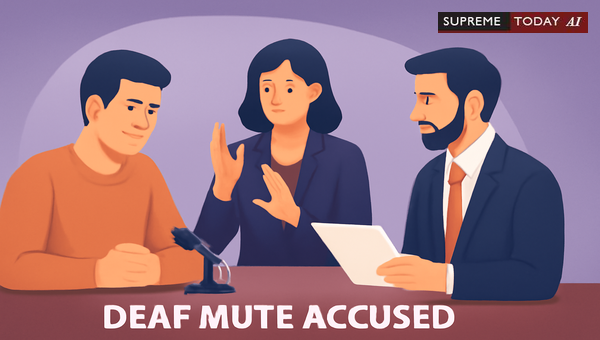
In criminal investigations, obtaining a confession from an accused person who is deaf and mute—often referred to as a dumb accused—presents unique challenges. The question arises: how to record confession of dumb accused? Indian courts have addressed this through specific procedural safeguards to ensure the statement is , authentic, and . This post explores the legal framework, key requirements, and practical insights from precedents, helping legal professionals, investigators, and the public understand these nuances.
While deaf-mute individuals are competent to make confessions, strict protocols must be followed to uphold their rights and the integrity of evidence. Failure to do so can lead to rejection in court. Let's break it down step by step.
Deaf-mute persons are not presumed to be or incapable of making confessions1985 0 Supreme(AP) 188. Courts recognize that they can communicate effectively through signs, gestures, or writing, and are often mentally alert and capable of understanding 1985 0 Supreme(AP) 188. This competency extends to both accused persons and witnesses.
For instance, in cases involving deaf-dumb witnesses, courts have emphasized proper recording methods. A deaf and dumb person is a , and if able to read and write, it is desirable to record his statement giving him questions in writing and seeking answers in writing 2023 0 Supreme(Chh) 265. This principle applies analogously to confessions, ensuring clarity and voluntariness.
Recording a confession from a deaf-mute accused demands adherence to safeguards outlined under provisions like of the and with . The investigating officer must:
The certificate must explicitly state:- The accused was informed they were not bound to confess.- The confession was and free from inducement.- It was recorded in the accused's presence.- It is a full and true account of the statement 2007 3 Supreme 993.
Non-compliance, such as failing to confirm understanding of rights, can render the confession inadmissible 1985 0 Supreme(AP) 188. Even under TADA, procedural formalities are mandatory 2007 3 Supreme 993.
Courts may rely on signs, gestures, writing, or other effective substitutes for speech, provided voluntariness and authenticity are satisfied 1985 0 Supreme(AP) 188. Assistance from persons intimately associated with the accused—like family members, children, husband, or parents—is permissible to interpret signs accurately 1985 0 Supreme(AP) 188.
The court must verify the method's effectiveness. For example, in a rape case involving a deaf-dumb victim, the deposition was deemed untrustworthy because it was not recorded in question-answer form nor through an interpreter familiar with the surroundings, violating guidelines from precedents like Dharshan Singh 2023 0 Supreme(Chh) 265. Similarly, for confessions, investigators should use written questions/answers or trusted interpreters to avoid disputes.
In another context, a deaf-dumb witness's evidence was scrutinized, but the court upheld reliance on confessions and recoveries where properly documented 2004 0 Supreme(Mad) 1654. This underscores the need for tailored communication without compromising safeguards.
Confessions are ideally recorded by a Magistrate under . The Magistrate must prepare a memorandum certifying compliance, as per (4): It was taken in my presence and hearing, and was read over to the person making it and admitted by him to be correct, and it contains a full and true account of the statement made by him 1996 0 Supreme(Mad) 1252.
Notifications may direct non-jurisdictional Magistrates to record such statements to avoid bias, especially in sensitive cases 2017 0 Supreme(Mad) 3702. For deaf-mute accused, the Magistrate should ensure the process accommodates their communication needs, potentially using interpreters.
also require scrutiny. In a murder case, an extra-judicial confession was upheld when supported by medical evidence, but courts caution against reliance without corroboration, particularly if recording was improper 2007 0 Supreme(MP) 45.
Procedural lapses often lead to rejection:- Lack of certification or proof of voluntariness 2007 3 Supreme 993.- Ineffective communication, e.g., no interpreter from the accused's community 2023 0 Supreme(Chh) 265.- Delayed FIRs or weak corroboration in involving deaf-dumb witnesses 2006 0 Supreme(P&H) 1518.
In one appeal, a conviction was set aside due to unproven circumstances and improper identification, highlighting that confessions alone aren't sufficient without procedural rigor 2019 0 Supreme(AP) 361. Courts demand , especially with vulnerable accused.
Even statements under from non-accused persons aren't automatically confessional and may not be relied upon if not incriminating 2010 0 Supreme(Gau) 852. For deaf-mute cases, this reinforces careful handling.
To ensure admissibility:- Use written formats for questions and answers where possible 2023 0 Supreme(Chh) 265.- Involve familiar interpreters and certify their role.- Document every step, including rights explanations via alternative methods.- Scrutinize for voluntariness; produce before a Magistrate promptly.- Courts should verify authenticity before reliance 1985 0 Supreme(AP) 188.
Investigating agencies can request alternative Magistrates for efficiency 2017 0 Supreme(Mad) 3702. Always prioritize the accused's comprehension to withstand judicial review.
This overview draws from established precedents and is for informational purposes only. Legal procedures can vary by case and jurisdiction—consult a qualified lawyer for advice tailored to specific circumstances. Stay informed on evolving case law to navigate these complexities effectively.
References:- 1985 0 Supreme(AP) 188: Competency and communication for deaf-mute persons.- 2007 3 Supreme 993: TADA confession safeguards.- 2023 0 Supreme(Chh) 265: Recording statements of deaf-dumb witnesses.- Additional insights from 2004 0 Supreme(Mad) 1654, 2007 0 Supreme(MP) 45, 2006 0 Supreme(P&H) 1518, 2019 0 Supreme(AP) 361, 2017 0 Supreme(Mad) 3702, 1996 0 Supreme(Mad) 1252, 2010 0 Supreme(Gau) 852.
#DeafMuteConfession, #CriminalLawIndia, #LegalSafeguards


The law requires that there must be a record of signs and not the interpretation of signs. 29. To sum up, a deaf and dumb person is a competent witness. If in the opinion of the court, oath can be administered to him/her, it should be so done. ... He submits that this is a case where the victim was a deaf and dumb person. ... To sum up, a deaf and dumb person is a competent witness. If in the opinion of the Court, oath can be administered to him / her, it should be so done. Such a witness, if able to read and write, it i....

for an expert and proceeded to record statement of PW - 12, deaf and dumb witness. ... On being said by Thakur Prasad (PW - 10) that he understands the signs of Lohri Ram (PW - 12), the Court proceeded to record evidence of Lohri Ram (PW - 12). According to Lohri Ram (PW - 12) he knows the accused / appellant. ... Thus, before recording the statement of deaf and dumb witness, the Court is required to ascertain that he / she possesses the requisite amount of intelligence, and that he understands the natu....

dispose of the case and (2) while making reference under Section 341, the Court should record a finding as to whether the accused, though deaf and dumb, had sufficient intelligence to understand the criminal character of the act committed by him. ... In the absence of any record to that effect we hold that there was no means of communication of the appellant who was deaf and dumb with his counsel. ... No. 3/2021], the accused was charged under Section 376(2)(f) of IPC and Section 4 of ....

7(2) It is further submitted that the victim is deaf and dumb girl, and there is no evidence that she has taken any education from such type of special school of deaf and dumb. ... To sum up, a deaf and dumb person is a competent witness. If in the opinion of the court, oath can be administered to him/her, it should be so done. Such a witness, if able to read and write, it is desirable to record his statement giving him questions in writing and seeking answers in writing. ... The accused were arrested,....

Evidence of prosecution is further strengthened by the Arrest of the accused, Confession and Recovery. A.2 to A.4 were arrested by P.W.17 I.O. on 04.05.1995. ... Pursuant to the Confession Statements of A.4 and A.5, M.O.4 Veechu Aruval, M.O.5 Blood Stained Shirt and M.O.6 Casurina Stick were recovered under Ex.P.8 Seizure Mahazar. Pursuant to the Confession Statement of A.2, M.O.7 Veechu Aruval and M.O.8 Blood Stained T. ... Drawing the attention of the Court to the evidence of P.W.2 Dumb Witness Iyyapp....

accused/appellant in his room. ... Therefore, it could not be considered as surprise, making of extra-judicial confession of murder of deceased Dr. P. B. Singh by hitting a dumb-bell on his head. The extra-judicial confession finds sufficient support from the medical evidence of Autopsy Surgeon dr. R. K. ... Singh) and the appellant took him in a room of his house situated at G-36, M1g Colony, Indore and caused blow by means of an iron dumb-bell. Thereafter the accused/appellant went t....

sides, Judgment of the trial Court, evidence and consideration of the arguments of the Appellants / A.1 to A.4 and the materials on record ... Based on his watching the accused.

Deaf and dumb accused-Unable to understand the nature of proceedings against him. ... The Magistrate states in his judgment that the accused is deaf and dumb, and cannot be made to understand the nature of the proceedings against him. ... Where an accused was a deaf and dumb person, who cannot be made to understand the nature of the proceedings against him, and where the Magistrate notwithstanding heard the ev....

If any of the witnesses had stated about extra-judicial confession made by the accused, then that should have been brought on record in lawful manner. ... She arrived at the spot and found the dead body of the deceased and the accused being detained. It is stated by the prosecution that accused made extra-judicial confession before the villagers and also gave recovery of the weapon of offence. M.O. ... Sessions Judge took note of the fact stated by the prosecution but not by the witnes....

The sole piece of evidence with the prosecution against the petitioner and other co-accused is an extra-judicial confession made on 21.4.2005 before Shankar Singh, Sarpanch. It is an extra-judicial confession made jointly by all the seven accused in this case. ... Said Ramesh Singh is deaf and dumb boy. He even did not see any of the accused committing the murder of Desa Singh. Occurrence had taken place on 19.3.2005 and the FIR was lodged on 13.4.2005. The petitioner is not related to....

He further admits that he had narrated what the accused had stated before him and what was written in Ex.P.3 in Telugu language. Police who said to have recorded the confession of accused. He further admits that he knew Tamil and Telugu languages. Thereafter, he took the accused and produced him before PW-13, Inspector of Police.
Therefore, in order to save time, whenever the investigating agency wants the statement of an accused to be recorded under Section 164 Cr.P.C., 1973 it should file an application before the CMM/CJM for nominating a Magistrate other than the jurisdictional Magistrate for the purpose of recording such a statement. In other words, though a Special Judge has the power to record the confession statement of an accused, yet, demands of propriety require that he should refrain from recording the confession of an accused in order to avoid the embarrassment of being examined as a witness in ....
On 26.11.2007, the accused was produced before him. He made a request to the Court to record the confession of the accused. P.W.9, the then Judicial Magistrate of Melur, received the said requisition from P.W.15. He arrested the accused on 27.10.2007 and sent her to Court for judicial remand.
If it is a confessional statement, prosecution can rely on it against the accused. Such is, however, not the case of a person, who is not an accused, but claims to be acquainted with the facts of a case, for, such a person does not make any incriminating statement against himself if he claims to be a mere witness of fact. Therefore, a confession may, perhaps, be recorded by a Magistrate on the accused opting to get his confession recorded. His statement, in a given case, may not be relied upon by the prosecution.
It was taken in my presence and hearing, and was read over to the person making it and admitted by him to be correct, and it contains a full and true account of the statement made by him But we find much force in the contention of defence counsel in relation to the non-compliance of Section 164(4), Cr.P.C. sub-sec. (4) of Section 164 reads as follows :-" * Any such confession shall be recorded in the manner provided in Section 281 for recording the examination of an accused person and shall be signed by the person making the confession and the Magistrate shall make a memorandum at ....


An indispensable Tool for Legal Professionals, Endorsed by Various High Court and Judicial Officers
Please visit our Training & Support
Center or Contact Us for assistance

Scan Me!
India’s Legal research and Law Firm App, Download now!


For Daily Legal Updates, Join us on :



 Back to top


