


Protecting Your Property: Rights Against Government and Access to Adjacent Land
Owning property comes with certain expectations of use and access, but what happens when government land blocks your way? Many property owners face challenges when their land is landlocked or when government actions threaten . This blog delves into the rights of property owners against government , focusing on access rights through government or adjacent land, , and strategies to safeguard your interests.
If you're an adjacent landowner seeking access via government property—perhaps offering alternative land in exchange—you're not without legal recourse. Understanding key principles like easements and acquisition rules can make all the difference. Note: This is general information based on legal precedents and not specific legal advice. Consult a qualified attorney for your situation.
Understanding the Core Issue: Rights of Property Owners Against Government
The question at the heart of many disputes is: What are the rights of property owners against government , especially regarding access to landlocked properties? When government land separates your property from public roads, or when acquisition looms, owners often propose alternatives like swapping land. However, government authority in public-purpose acquisitions is strong, balanced by your right to .
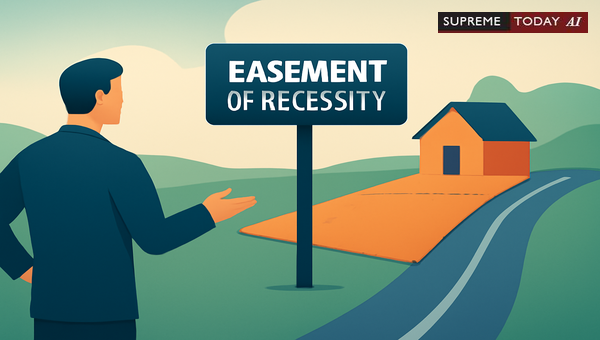
Landlocked properties—those without direct road access—invoke . This legal doctrine ensures you can reach your property if no other route exists. Case law supports this, stating that access rights can be established based on necessity, especially when no other access is available 2020 0 Supreme(Mad) 1413.
Key Legal Principles Governing Access and Acquisition
Several principles guide these cases:
: If your land touches a highway or public street, you generally have a right of access at any point at which his land actually touches it. 2022 0 Supreme(Mad) 1387 2021 0 Supreme(Mad) 678. A member of the public cannot be compelled to confine himself to a part of the street at the choice of another. This protects against arbitrary restrictions.
Government Land Acquisition Powers: Governments can acquire land for public use, but must evaluate alternatives. Their satisfaction on suitability is key, unless challenged. For instance, if proposed alternative land is near structures like petrol pumps, it may be rejected 2024 0 Supreme(P&H) 29. Objections to acquiring non-adjacent land when alternatives exist have been noted 2023 0 Supreme(Bom) 741.
and Access Provisions: Municipal Commissioners can grant access through adjacent plots for landlocked properties, with the owner bearing costs 1997 0 Supreme(Bom) 3. vest in municipalities, and no are allowed; owners retain access rights 2019 0 Supreme(Raj) 285.
Right to Separate Access: Courts have ordered separate access (e.g., 3.2 meters) along national highways to avoid infringing , even if common access is proposed 2021 Supreme(Online)(KER) 45418. The court established that rights must be preserved without undermining the of adjacent properties.
These principles ensure balance: government needs versus private rights.
Landmark Cases and Precedents
Judicial decisions provide clarity:
Access to Highways and Streets: In a case involving , the court affirmed that the owner of a property adjacent to a highway or a public street has got a right of access to such highway or street at any point at which his land actually touches it. However, his right to use such highway or public street as soon as he is 'on the highway' or the public street becomes a public right. 2022 0 Supreme(Mad) 1387. The court ordered removal of illegal structures blocking access, prioritizing without denying private entry rights.
Public Road : When a property owner encroached on an approved public road, the court set aside an injunction, emphasizing the public right to use the approved public road and the limitations on private rights. 2021 0 Supreme(Mad) 678.
Land Acquisition and Compensation: For landlocked parcels, courts consider access in valuing compensation. One ruling noted that land which is landlocked will fetch less price than the property which has an access, adjusting awards accordingly 2011 0 Supreme(Bom) 551. Compensation was modified to Rs.85 per square meter, rejecting inflated access sale deeds as market value benchmarks 2011 0 Supreme(Bom) 551.
Rejection of Alternatives: Authorities rejected unsuitable alternative land, justifying original acquisition 2024 0 Supreme(P&H) 29. Access width requirements were outlined, stressing proper entry for landlocked sites 2020 0 Supreme(Bom) 719.
These cases illustrate courts' willingness to intervene for fair access while respecting public needs.
Practical Steps for Adjacent Landowners
Facing potential or access denial? Consider these recommendations:
Propose and Evaluate Alternatives: Submit alternative land for government review. Ensure it's suitable; proximity issues can doom proposals 2024 0 Supreme(P&H) 29.
Engage Municipal Authorities: Approach the Commissioner under for access facilitation 1997 0 Supreme(Bom) 3.
Document Necessity: Prove no other access exists to strengthen easement claims 2020 0 Supreme(Mad) 1413.
Challenge Unsuitable Decisions: If government ignores viable options, object formally 2023 0 Supreme(Bom) 741.
Seek Legal Remedies: File for or if rights are violated, as in highway access modifications 2021 Supreme(Online)(KER) 45418.
In one instance, despite adjacent commercial buildings, courts preserved access without merging ownerships 2021 Supreme(Online)(KER) 45418.
Broader Implications for Property Owners
Government projects like highways often trigger these issues. Under the , separate access trumps common points to protect ownership 2021 Supreme(Online)(KER) 45418. allow passage over every inch, with adjacent owners retaining touch-point entry 2019 0 Supreme(Raj) 285.
Compensation disputes highlight access's value: landlocked sites warrant adjustments 2011 0 Supreme(Bom) 551. Always verify if land forms part of a way—it can't be repurposed without due process 2019 0 Supreme(Raj) 285.
Conclusion and Key Takeaways
Property owners have robust rights against arbitrary government , anchored in , access regulations, and judicial oversight. While governments hold acquisition power—especially for public purposes—your right to , particularly for landlocked parcels, is protected. Success hinges on proving necessity, proposing suitable alternatives, and engaging authorities early.
Key Takeaways:- Claim easement if landlocked 2020 0 Supreme(Mad) 1413.- Insist on suitability assessments for swaps 2024 0 Supreme(P&H) 29.- Leverage Development Rules for municipal aid 1997 0 Supreme(Bom) 3.- Courts favor separate access over common impositions 2021 Supreme(Online)(KER) 45418.
Stay proactive: document everything and consult professionals. References: 2023 0 Supreme(Bom) 741 2024 0 Supreme(P&H) 29 2020 0 Supreme(Bom) 719 2020 0 Supreme(Mad) 1413 1997 0 Supreme(Bom) 3 2021 Supreme(Online)(KER) 45418 2022 0 Supreme(Mad) 1387 2021 0 Supreme(Mad) 678 2019 0 Supreme(Raj) 285 2011 0 Supreme(Bom) 551.
This post is for informational purposes only and does not constitute legal advice.
#PropertyRights #EasementNecessity #LandAcquisition












