


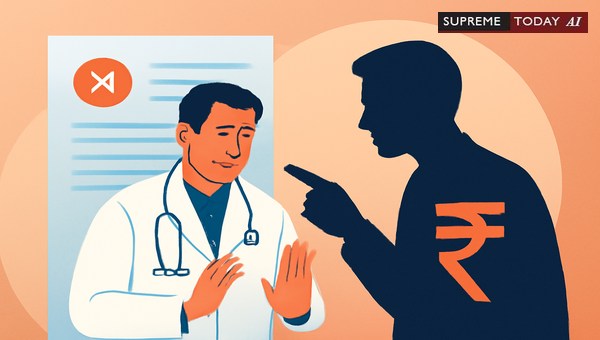
Charges for Impersonating a Medical Professional in India
In an era where trust in healthcare is paramount, impersonating a medical professional strikes at the heart of public safety and professional integrity. Imagine someone posing as a doctor, offering treatments or advice without qualifications— the potential harm to patients is immense. This blog explores the legal question: Charges against a person impersonating as a medical professional. We'll delve into the Indian legal framework, potential repercussions, and insights from related cases, helping you understand the gravity of such offenses.
While this information is for educational purposes and draws from established legal principles, it is not a substitute for professional legal advice. Consult a qualified lawyer for specific situations.
Legal Framework Governing Impersonation
Medical practitioners in India operate under strict regulations to ensure accountability. The , and the by the (now ) form the backbone. These laws outline disciplinary actions for , explicitly including impersonation. As noted, Medical practitioners are governed by the , and the established by the . These regulations provide a framework for disciplinary action against medical professionals for , which includes impersonation 1995 0 Supreme(SC) 1136 1995 0 Supreme(Raj) 598.
Additionally, if impersonation undermines court authority—such as falsifying medical evidence—charges under the may apply. A medical practitioner may also face charges of if their impersonation leads to actions that undermine the authority of the court. This is distinct from and is regulated by the 2023 5 Supreme 365.
Serious Implications of Impersonation
Impersonating a medical professional isn't just unethical; it's a grave offense with far-reaching consequences. It can trigger criminal charges, damage reputations, and lead to professional ruin. The seriousness mirrors cases of , where courts emphasize the impact on status and reputation. For instance, Charge of on a medical person is a serious one as it affects his professional status and reputation and as such the would be more onerous
.
Key implications include:- Reputation and Career Damage: Similar to negligence claims, impersonation allegations can end careers. Courts have ruled, A doctor cannot be held negligent only because something has gone wrong. He also cannot be held liable for mischance or misadventure or for an error of judgment in making a choice when two options are available
, highlighting how serious accusations demand rigorous scrutiny.- : The accuser must prove impersonation occurred and caused harm. In cases involving , the is on the accuser to demonstrate that the impersonation occurred and that it resulted in harm or potential harm to patients or the public 2023 7 Supreme 154. This aligns with negligence precedents: The in an action for damages for negligence rests primarily on the complainant, and medical professionals cannot be held liable for mischance or misadventure
.
Even in peripheral areas like hospital taxation, courts stress intent and proof. Under the , penalties for non-declaration require : The court ruled that the imposition of penalties for non-declaration of medical bed receipts was unjustified, as the petitioner acted under a belief of non-liability. The court emphasized that penalties should not be imposed without establishing 2024 Supreme(Online)(KER) 35225. This underscores the need for evidence in professional liability cases.
Potential Criminal and Disciplinary Charges
Offenders face a multi-layered response from the law:
- Criminal Charges under (IPC):
- Section 419: Cheating by impersonation.
Section 420: Cheating and dishonestly inducing delivery of property. Impersonation of a medical professional can lead to criminal charges under relevant sections of the (IPC), such as Section 419 (cheating by impersonation) and Section 420 (cheating and dishonestly inducing delivery of property) 1995 0 Supreme(SC) 1136.
Disciplinary Actions:
- The or may suspend or revoke licenses. The or can initiate disciplinary proceedings against the individual for , which may include suspension or revocation of medical licenses 1995 0 Supreme(SC) 1136 1995 0 Supreme(Raj) 598.
Related case law reinforces standards: A medical practitioner would be liable only where his conduct fell below that of standards of a reasonably competent practitioner in his field
. Impersonators, lacking qualifications, inherently fall short.
Insights from Related Medical Liability Cases
While direct impersonation cases are rare in the provided sources, parallels from negligence and ethics violations illuminate the landscape. In maternity and treatment disputes, courts dismiss claims without proof: Complainants have failed to establish that opposite parties did not take proper care of patient as per then normal medical standard prescribed by law thereby committing breach of duty
.
Similarly, gratuitous treatment doesn't confer consumer status under the : Person taking medical treatment gratuitously—Not a consumer under the provisions of the Act
. For impersonators, false pretenses could invoke consumer laws if patients pay for bogus services.
In alternative medicine contexts, courts scrutinize qualifications rigorously, setting aside negligence findings absent proof: The court found no deficiency in service or medical negligence on the part of the appellant
. This bolsters the defense strategy for accused impersonators—demand solid evidence.
Hospital luxury tax cases further highlight proof burdens: Luxury tax applies to non-essential services in hospitals, and penalties require proof of intent to evade tax 2024 Supreme(Online)(KER) 35225 2024 0 Supreme(Ker) 1215. Petitioner liable to pay luxury tax on receipts for medical beds provided to expecting mothers, as these do not fall under exclusions for food, medicine, or professional services - Penalty imposed under set aside due to belief of non-liability 2024 0 Supreme(Ker) 1215.
Key Takeaways and Recommendations
Impersonating a medical professional typically invites severe penalties, from IPC prosecutions to license revocation, emphasizing India's commitment to healthcare integrity. Impersonating a medical professional is a serious offense that can lead to both criminal charges and professional disciplinary actions. The legal framework governing medical practitioners emphasizes the importance of maintaining professional integrity and the severe consequences of violating these standards 1995 0 Supreme(SC) 1136 1995 0 Supreme(Raj) 598.
If facing such charges:- Seek Legal Representation: Engage lawyers versed in medical law and criminal defense.- Gather Documentation: Compile evidence refuting claims, as the burden lies with accusers.- Know Your Rights: Insist on fair trials and challenge weak evidence.
In conclusion, these charges protect public health but require proof to uphold justice. Stay informed, act ethically, and consult professionals for guidance. By understanding these laws, individuals and institutions can better safeguard against fraud while ensuring fair processes.
This post is based on general legal principles and cited sources as of the latest available data. Laws evolve; verify with current statutes.
#ImpersonatingDoctor #MedicalFraudIndia #LegalCharges















