Searching Case Laws & Precedent on Legal Query.....!
Analysing the retrieved Case Laws
Scanned Judgements…!



Searching Case Laws & Precedent on Legal Query.....!
Analysing the retrieved Case Laws
Scanned Judgements…!
DATO FOO MING LAM & ANOR vs WEE MENG CHEE - 2024 MarsdenLR 493
,CROWD CARE SDN BHD & ANOR vs LING LEK FOO - 2021 MarsdenLR 790
).DATO FOO MING LAM & ANOR vs WEE MENG CHEE - 2024 MarsdenLR 493
,SUHARNIZAN MD SIDEK vs NOORAZIRA PISSAL - 2022 MarsdenLR 228
).DATO FOO MING LAM & ANOR vs WEE MENG CHEE - 2024 MarsdenLR 493
).INDRANI RAMASAMY vs KESAVAN SUBRAMANIAM - 2023 MarsdenLR 1516
,SUHARNIZAN MD SIDEK vs NOORAZIRA PISSAL - 2022 MarsdenLR 228
).When defamation involves open sources like videos or social media posts, the plaintiff must demonstrate that the content is indeed defamatory, identifies them, and was published to third parties (e.g.,
CROWD CARE SDN BHD & ANOR vs LING LEK FOO - 2021 MarsdenLR 790
,TAN BOON PING vs NG BOO ABA @ NG HOOI HONG - 2022 MarsdenLR 1006
).What to Prove in Defamation:
The impact or harm caused by the publication (e.g.,
MALAYAN BANKING BERHAD vs FLEUR CHEM SDN BHD & ORS & ANOTHER CASE - 2009 MarsdenLR 801
, 2023 Supreme(Online)(AP) 19064).Best Evidence for Defamation through Open Sources (Videos, Audio Calls):
Analysis and Conclusion:In defamation cases, the burden initially rests with the plaintiff to prove that a statement is defamatory, refers to them, and was published to third parties. When open-source media like videos or audio calls are involved, authenticating the evidence is paramount. The best evidence includes original, verifiable recordings with supporting forensic or expert analysis to establish authenticity. Once the plaintiff proves these elements, the defendant must then justify or prove the truth of the statements. Properly authenticated multimedia evidence, combined with credible witnesses, offers the strongest proof in cases involving open sources.
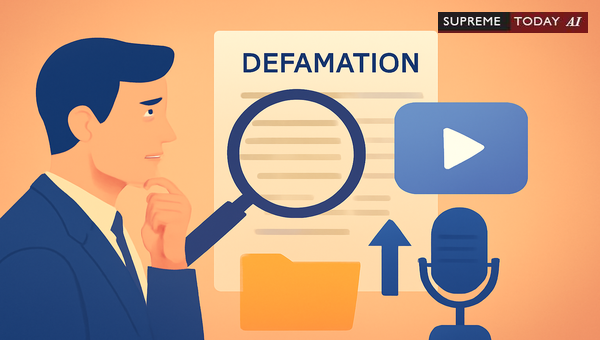
In today's digital age, defamation often spreads through videos, audio calls, and social media, making it easier for false statements to damage reputations instantly. If you've been defamed online via open sources like YouTube videos or recorded calls, understanding the on the plaintiff in a defamation case is crucial. What exactly must you prove? And what is the best piece of evidence to support your claim?
This article breaks down the essentials, drawing from legal principles and case insights. Note: This is general information, not specific legal advice. Consult a qualified attorney for your situation.
Typically, the lies on the plaintiff to establish that the statements are false, , and harmful to their reputation. Courts require plaintiffs to prove their case on a , meaning it's more likely than not that the elements are met. 2014 0 Supreme(Guj) 600
As held in a Malaysian case, until and unless the plaintiff has discharged the onus on her to prove her case on a , the burden did not shift to the defendant.
The plaintiff bears the initial responsibility, while defendants may raise defenses like or . 2013 1 Supreme 322
In one instance, a plaintiff failed because they couldn't show the article was or referred to them when read in context, leading to dismissal.
To succeed, plaintiffs generally need to demonstrate several key elements:
Additionally, plaintiffs may need to show the statement was made with or intent, especially if defenses are raised. In an Indian case involving a Major General, the court found defamation where defendants falsely alleged a bribe without due care, awarding Rs. 1 crore in damages. 2023 0 Supreme(Del) 3032
The is on the publication to prove that the assertions made by them are justified... but initially, it's the plaintiff's onus. 2023 0 Supreme(Del) 3032
When defamed via open sources such as videos, audio calls, or electronic media, the best evidence is a , , and unaltered recording that clearly identifies the source, time, and place. 2009 0 Supreme(SC) 1329 2009 0 Supreme(Mad) 4524
Why is this superior?- It directly captures the content without reliance on memory or secondary accounts.- Courts favor original or properly preserved recordings over transcripts or descriptions.
The Court emphasizes that such evidence is under the if authenticity is proved and tampering is excluded. A tape record of a relevant conversation is under Sections 8 of the if the authenticity is proved, and possibility of tampering must be totally excluded. 2009 0 Supreme(Mad) 4524
For videos, the footage must fairly and accurately illustrate the events with an unbroken . 2009 0 Supreme(SC) 1329
In a case against YouTube, the plaintiff (a newspaper) failed because they couldn't prove the videos were , caused damage, or hold the intermediary liable under . 2025 Supreme(Online)(Mad) 66406
demands rigorous authentication due to tampering risks. Plaintiffs must prove:
Failure here can doom the case. Courts apply a higher standard: Mere production of a recording without proof of its authenticity and unaltered state may not suffice. 2009 0 Supreme(Mad) 4524
Guidelines include proper sealing and judicial discretion on admissibility, stressing context and integrity. 2025 6 Supreme 591
In another ruling, even defendants require plaintiffs to prove viewership and damage from videos. 2025 Supreme(Online)(Mad) 66406
To strengthen your defamation claim with video/audio evidence:
The plaintiff should obtain and preserve , unaltered recordings with proper seals and custody. 2009 0 Supreme(SC) 1329
Courts are cautious with digital evidence due to editing ease. Defendants can challenge authenticity or claim , , or . 2023 0 Supreme(Del) 3032 2014 0 Supreme(Guj) 600
Publication includes all mediums, including the internet, but wider reach doesn't lower the proof burden. 2024 0 Supreme(Kar) 554
In summary, succeeding in defamation via open sources hinges on robust . By meeting the with authenticated recordings, plaintiffs can hold defamers accountable. Always remember, laws vary by jurisdiction—consult local experts.
#DefamationLaw, #BurdenOfProof, #DigitalEvidence


, - C.S.No.595/2010 to contend that the concept of onus of proof and burden of proof are different and swings like a pendulum in each case from one end to the other. 6. ... (v) The Trial Court in terms of the impugned order rejected the application on the ground that the burden of proof is upon the person who brings a claim before the Court and in the case of an act....

Defamation Act 1957 , the burden of proof lies on the plaintiff to show (1) the words are defamatory; (2) the words refer to the plaintiff; and (3) the words were published. ... In malicious falsehood, the burden of proof that the words are false is on the plaintiff. Whereas in libel, the plaintiff does not have to prove#HL_....
[2016] 5 MLJ 205 where the court of Appeal decided that the burden of proof lies with the plaintiff to prove the existence of the three elements. ... In order to prove a claim in defamation, it is also essential that the offending words are not only defamatory and that they are published but also that they identify the plaintiff as the person defamed. ....
The Law [8] The burden of proof: [1939] 1 MLJ 253 , it was held: [1981] 1 MLJ 139 , it was held: "It was all a matter of proof and that until and unless the plaintiff has discharged the onus on her to prove her case on a balance of probabilities, the burden did not shift to the defendant, and no matter if the defendant's ... [18.3] The law is trite that the legal #HL_....

Further, the burden of proof is on the publication to prove that the assertions made by them are justified and is thus a "fair comment" as held in the case of The Editor, Rashtra Deepika Ltd and ors vs Vinaya N.A., ILR 2017 (3) Kerala 456. ... Thus, the evidence on record and in fact the admissions made on behalf of defendant No.1 to 4, establish a case of defamation ag....
to answer, the Defendant is accepting the Plaintiff's evidence at its face value, no case has been established in law or that the evidence led for the Plaintiff is so unsatisfactory or unreliable that the Court should find that the burden of proof has not been discharged by the Plaintiff ... transcriptions to prove her case. ... estab....
Therefore, in this case, the burden is on the Plaintiff to prove all the essential elements of defamation. Failing which the Plaintiff's action must fail. ... A must prove that B defamed him to C. ... [19] It is also trite law that under s 103 of the Evidence Act 1956 [Act 56], the burden of proof as to any particul....

When the plaintiff alleged that some incident occurred on 16.04.1994, the burden is on the plaintiff to prove said fact by adducing legally acceptable evidence. ... Burden of proof.- Whoever desires any Court to give judgment as to any legal right or liability dependent on the existence of facts which he asserts, must prove that those facts exist. .......

Though the 1st defendant was set exparte and not contested the case, it is the duty of the plaintiff to prove the case that the contention of the video are defamatory and viewed by somebody and thereby the said video caused hardship and inconvenience to the plaintiff-newspaper, but no sufficient evidence ... In order to prove the #HL_....
[51] Accordingly, the burden of proof is on the Plaintiffs to prove that the impugned statements in FB Post No 1, FB Post No 2 and FB Post No 3 referred to and are "of and concerning" the 1st Plaintiff and the 2nd Plaintiff. ... [1989] 1 MLJ 315 ), Mohamed Dzaiddin J (later CJ) held that: "In our law on libel, which is governed by the Defamation Act 1957 , the burden....

39. It would be apparent from the above discussion that publication is a comprehensive term, embracing all forms and mediums -including the Internet. That an internet publication has wider viewership, or a degree of permanence, and greater accessibility, than other fixed (as opposed to intangible) mediums of expression does not alter the essential part, i. The viewership of each of these or the public accessing the content through these varied mediums can differ, depending on taste, cost, incl....

What the victim must prove to establish defamation as per some generally accepted rules is, if you believe you are or have been "defamed," to prove it you usually have to show there's been a statement that is all of the following: published, false, injurious and unprivileged. (vide Bannett Coleman & Co. Ltd.(supra)). 11(a.iv).

What is made punishable in Indian Penal Code is the offence of defamation as defamation and not as Contempt of Court. If the defamation of a subordinate Court amounts to Contempt of Court, proceedings can certainly be taken under Section 2 of Act, 1971, quite apart from the fact that other remedy may be open to the aggrieved officer under Section 499 IPC.
It would be sufficient to show that the accused intended or knew or had reason to believe that the imputation made by him would harm the reputation of complainant, irrespective of whether complainant actually suffered directly or indirectly from the imputation alleged-as held in Jeffrey J. Diermeier v. State of West Bengal, 2010 (3) ALT (Crl.) 8 SC : 2010 (5) SCJ 629. 8(a.iv). 1. First, the "statement" can be spoken, written, pictured, or even gestured. What the victim must prove to ....
What is made punishable in Indian Penal Code is the offence of defamation as defamation and not as contempt of Court. If the defamation of a subordinate Court amounts to contempt of Court, proceedings can certainly be taken under Section 2 of Act, 1971, quite apart from the fact that other remedy may be open to the aggrieved officer under Section 499 IPC.


An indispensable Tool for Legal Professionals, Endorsed by Various High Court and Judicial Officers
Please visit our Training & Support
Center or Contact Us for assistance

Scan Me!
India’s Legal research and Law Firm App, Download now!


For Daily Legal Updates, Join us on :



 Back to top


