


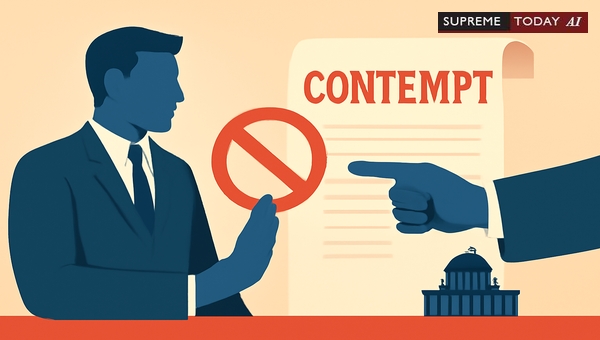
Govt Servants' Accountability for Court Order Compliance
In the realm of , one of the foundational principles is that government servants must uphold the by strictly adhering to court orders. But what happens when public officials delay or defy judicial directives? The question of Accountability of Government Servants to Comply Court Order is not just theoretical—it's a pressing issue highlighted in numerous judicial pronouncements. This blog post delves into the legal framework, court findings, key principles, and real-world implications, drawing from landmark cases to provide clarity for citizens, officials, and legal professionals alike.
Note: This article offers general information based on legal precedents and is not a substitute for professional legal advice. Consult a qualified attorney for specific cases.
Legal Framework Governing Compliance
Public servants, by virtue of their positions, bear a heightened duty to comply with court orders. Courts have consistently ruled that deliberate disobedience of judicial orders from subordinate courts constitutes and an abuse of the court's process. As emphasized in one ruling, public servants must act promptly and effectively in compliance with court directives, with failure potentially leading to personal consequences for responsible officers 2004 0 Supreme(Pat) 774 2007 0 Supreme(J&K) 282.
Penal Laws and Disciplinary Measures
To enforce accountability, especially in cases of corruption or delays in civil and criminal actions, courts advocate invoking penal laws and discipline rules. Key statutes include:- : Targets corrupt practices by public servants.- : Provides mechanisms for internal disciplinary action 2019 0 Supreme(Bom) 1714.
These frameworks ensure that lethargy or indifference does not undermine justice delivery. For instance, in matters involving welfare schemes, delays in action against accused officials have drawn sharp judicial rebuke, with directives for compliance reports from departmental heads 2019 0 Supreme(Bom) 1714.
Court Findings and Directives on Non-Compliance
Judicial scrutiny often reveals systemic issues like delays, indifference, and lethargy among government officers. Courts have criticized such attitudes, stressing the need for timely action to serve the public interest effectively 2004 0 Supreme(Pat) 774.
Personal Accountability and Actions
A cornerstone principle is that public servants can be held for arbitrary or conduct. The has reinforced this in cases where officials flout orders, holding them accountable under 2006 0 Supreme(Pat) 1172 1998 0 Supreme(Bom) 306.
In a related context, courts have issued writs of mandamus to compel compliance with guidelines. For example, in a petition seeking action for non-registration of FIRs, the court referenced , directing authorities to adhere to protocols and fix officer accountability for violations 2024 0 Supreme(All) 976. This underscores that law enforcement agencies must follow established judicial mandates, or face redressal through appropriate forums.
Broader Concerns: Discipline and Punctuality
have linked compliance to overall governance. One observation notes that without strict enforcement, it becomes difficult for the State to enforce accountability, punctuality & discipline amongst the civil servants, even with laws like the Act empowering bodies such as the for inquiries
. Similarly, investigations into public servants' roles in various matters highlight the need for thorough probes to assign responsibility 2025 Supreme(Online)(Kar) 37311.
Key Principles of Accountability
Accountability rests on three pillars, as articulated in legal precedents:- Responsibility: Clear identification of duties and performance obligations for those in authority.- Answerability: Mandating reasoned decision-making for transparency and public scrutiny.- Enforceability: Providing mechanisms for corrective actions against lapses 2023 7 Supreme 539.
These principles extend to assisting courts without fear of reprisal. Filing affidavits or statements in court does not constitute misconduct for government servants; rather, it's a pious obligation to aid justice. Courts have quashed dismissals where officials were punished merely for truthful court assistance, ruling that false statements alone warrant action under or provisions 2009 0 Supreme(All) 2315 2009 0 Supreme(All) 2136.
Lessons from Public Interest Litigations (PILs)
PILs often expose state apathy. In one case involving deaths due to alleged medical negligence, the petition aimed to tie accountability of the deaths on the erring government servants, revealing unholy nexuses but requiring substantiation before court intervention 2020 0 Supreme(Ker) 864. Courts caution against unsubstantiated claims, ensuring PILs address genuine public harm without private motives.
Conduct rules further bind servants. For instance, policies permitting private practice for doctors were struck down as violating , emphasizing uniform application to prevent discrimination 2008 0 Supreme(Guj) 3 2008 0 Supreme(Guj) 1.
Practical Implications and Recommendations
Non-compliance erodes public trust and delays justice. Citizens facing official inaction can seek remedies like mandamus or contempt proceedings, while departments must prioritize training.
Key Recommendations
- Awareness Programs: Train officers on legal obligations to comply with court orders.
- Timely Disciplinary Actions: Invoke rules against contemptuous conduct swiftly.
- Compliance Reporting: Mandate regular reports on judicial directive implementation.
Conclusion: Upholding the
The judiciary's firm stance—that government servants must comply with court orders or face personal repercussions—reinforces administrative accountability. From contempt rulings to mandamus directives, cases like those cited illustrate that public interest trumps official inertia 2019 0 Supreme(Bom) 1714 2004 0 Supreme(Pat) 774. By embracing responsibility, answerability, and enforceability, servants can fulfill their constitutional duties.
Key Takeaways:- Deliberate non-compliance equals contempt 2007 0 Supreme(J&K) 282.- Personal liability applies for acts 2006 0 Supreme(Pat) 1172.- Use statutes like POCA for enforcement 2019 0 Supreme(Bom) 1714.
Stay informed, act diligently, and contribute to a just system. For tailored advice, reach out to legal experts.
References:- 2019 0 Supreme(Bom) 1714 2007 0 Supreme(J&K) 282 2004 0 Supreme(Pat) 774 2006 0 Supreme(Pat) 1172 2023 7 Supreme 539 1998 0 Supreme(Bom) 306 2024 0 Supreme(All) 976
2025 Supreme(Online)(Kar) 37311 2020 0 Supreme(Ker) 864 2009 0 Supreme(All) 2315 2009 0 Supreme(All) 2136 2008 0 Supreme(Guj) 3 2008 0 Supreme(Guj) 1 #GovtAccountability, #CourtCompliance, #PublicServantsDuty












