


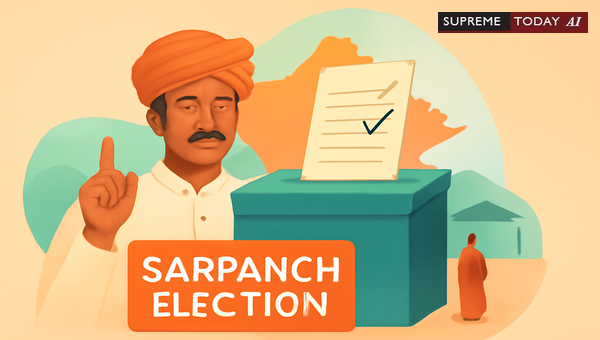
Rajasthan's Proposed 12th Pass Rule for Sarpanch Elections: Is It Legally Sound?
In a move aimed at enhancing governance in rural areas, the is considering a proposal to impose a condition that only a person who is 12th pass can contest the election of Sarpanch. This has sparked debates among stakeholders, with some individuals already seeking to challenge it in courts. But does this proposal hold water under Indian law? In this post, we dive deep into the legal framework, judicial precedents, and potential pitfalls of such a requirement.
Panchayati Raj institutions form the bedrock of local self-governance in India, and qualifications for positions like Sarpanch are governed by state-specific laws such as the . While the intent behind raising educational standards is noble, the method of implementation could determine its fate. Let's break it down.
Legal Basis for Sarpanch Election Qualifications
Educational qualifications for contesting Sarpanch elections are typically prescribed by statute or rules, not administrative whims. Currently, under the (as amended), a candidate is required to possess qualification of 8th pass to contest the election of Sarpanch2018 0 Supreme(Raj) 114. The provided documents do not indicate any existing provision mandating 12th grade completion. Courts have long held that such qualifications must be explicitly laid down in the statute or rules 2018 0 Supreme(Raj) 194 1994 0 Supreme(Raj) 842.
The right to contest an election is a statutory right, not fundamental or common law. As noted in judicial rulings, the , and 2018 0 Supreme(Raj) 194. Any deviation requires proper legislative backing.
Validity of Executive Circulars and Proposals
A critical issue here is how the proposal is being introduced. If via an administrative circular, executive order, or departmental instruction, it stands on shaky ground. Courts have consistently ruled that 1994 0 Supreme(Raj) 842.
In one key case, 1994 0 Supreme(Raj) 842. Similarly, executive amendments attempting to alter qualification standards have been struck down for lacking statutory authority 2017 0 Supreme(Raj) 1771. For instance, a circular adding a Mathematics requirement in secondary exams was invalidated, underscoring that unilateral changes are impermissible.
This principle extends to the Rajasthan proposal. Without amending the Panchayati Raj Act or rules through legislative channels, an executive push for 12th pass would likely be deemed arbitrary and violative of the .
Judicial Precedents on Qualification Disputes
Indian courts have a robust history of safeguarding electoral qualifications from executive overreach:
- Qualifications must be statutory: Disputes are resolved based on enacted law, not directives 2018 0 Supreme(Raj) 194.
- Executive additions invalid: Courts struck down attempts to impose extra requirements without legislative sanction 1994 0 Supreme(Raj) 842 2017 0 Supreme(Raj) 1771.
- Proper channels required: Any amendment or addition to these conditions must be made through proper legislative or rule-making channels2018 0 Supreme(Raj) 194.
Comparative examples from other states highlight valid paths. In Haryana, the government amended Section 175 via the , to insert minimum qualifications for Sarpanch, including educational criteria 2021 0 Supreme(P&H) 1215. This legislative route ensured validity, unlike mere proposals or circulars.
Application to Rajasthan's 12th Pass Proposal
Applying these principles, the proposal faces significant hurdles if not legislated properly. Challengers could argue:
- It imposes a unilateral administrative condition beyond legal authority.
- It violates .
- Courts are likely to strike it down as arbitrary and unreasonable, echoing precedents 1994 0 Supreme(Raj) 842 2017 0 Supreme(Raj) 1771.
Other eligibility factors like caste, residency, and voter list inclusion remain crucial. For reserved seats, candidates must belong to the relevant SC/ST category of the state per 2024 0 Supreme(MP) 283 2024 Supreme(Online)(MP) 2030. These statutory disqualifications underscore that educational tweaks cannot bypass core legal frameworks.
Potential Legal Challenges and Implications
Individuals seeking to challenge the proposal have strong grounds:
- Lack of legislative process: Administrative imposition exceeds executive powers.
- Equal opportunity concerns: Higher barriers may disenfranchise rural candidates, raising Article 14 equality issues (though not directly addressed in sources).
- Precedent alignment: Similar to cases where false qualification declarations led to disqualifications under existing 8th pass rules 2018 0 Supreme(Raj) 114.
Broader implications include impacts on voter choice and Panchayat representation. Sources note that qualifications for Sarpanch often mirror those for Panch, requiring basic eligibility under 2004 0 Supreme(MP) 344. Migration or caste mismatches can disqualify candidates, adding layers to eligibility 2024 0 Supreme(MP) 283.
Exceptions and Valid Alternatives
Not all hope is lost for the proposal:
- Legislative amendment: If the amends the Act or rules to include 12th pass, it would be enforceable 2021 0 Supreme(P&H) 1215.
- Clarificatory instructions: Those interpreting existing law (e.g., 8th pass standards) within delegated authority may survive scrutiny.
- Evolving standards: Courts recognize progressive qualifications via proper channels.
Recommendations for Stakeholders
- Government: Pursue amendments through legislative procedures; withdraw any unsupported circulars.
- Candidates: Verify qualifications against the Act; appeal Collector decisions to State Government within 15 days 2023 0 Supreme(Bom) 574.
- Public: Monitor bills and ensure compliance with constitutional norms.
Note: This analysis is for informational purposes only and does not constitute legal advice. Consult a qualified lawyer for specific cases.
Conclusion and Key Takeaways
Rajasthan's 12th pass proposal for Sarpanch elections, while well-intentioned, is vulnerable to legal challenges unless enacted via proper legislative or rule-making processes. Executive shortcuts have repeatedly failed in courts, prioritizing the 1994 0 Supreme(Raj) 842 2018 0 Supreme(Raj) 194 2017 0 Supreme(Raj) 1771.
Key Takeaways:- Current qualification: 8th pass 2018 0 Supreme(Raj) 114.- Executive orders invalid; legislation required.- Precedents protect statutory integrity.- Align with caste/residency rules for holistic eligibility.
Stay informed as this unfolds—rural democracy hangs in the balance. (Word count: 1028)
#SarpanchElection #RajasthanPanchayat #ElectionLaw















