Searching Case Laws & Precedent on Legal Query.....!
Analysing the retrieved Case Laws
Scanned Judgements…!



Searching Case Laws & Precedent on Legal Query.....!
Analysing the retrieved Case Laws
Scanned Judgements…!
Statutory Period for Remand and Bail - In Rakesh Kumar Paul, the Supreme Court examined whether the 90-day remand extension under Section 167(2)(a)(i) applies to offences with a maximum imprisonment of 10 years but a minimum less than 10 years. The majority opinion clarified that the 90-day limit is only applicable to offences where a minimum of ten years' imprisonment is stipulated. The Court also emphasized that oral submissions regarding default bail made during hearings can suffice in lieu of written applications, provided the prosecution does not oppose. ["2024 0 Supreme(UK) 595"], ["2023 0 Supreme(UK) 448"], ["2023 0 Supreme(Manipur) 26"], ["2022 0 Supreme(All) 1290"], ["2023 0 Supreme(Gau) 1510"], ["
Azharudheen VS State of Kerala, Represented by Public Prosecutor - Crimes
"], ["2022 Supreme(Online)(Chh) 1635"], ["2021 Supreme(Online)(KER) 8150"], ["2001 0 Supreme(AP) 440"], ["O&M) RAJINDER PAL SHARMA AND ORS vs SURAH BHAN AND ANR - Punjab and Haryana"], ["1993 0 Supreme(Bom) 9"], ["2024 0 Supreme(Ker) 22"], ["1992 0 Supreme(MP) 196"], ["Azharudheen VS State of Kerala, Represented by Public Prosecutor - Crimes
"], ["O&M) RAJINDER PAL SHARMA AND ORS vs SURAH BHAN AND ANR - Punjab and Haryana"], ["2001 0 Supreme(AP) 440"], ["2020 Supreme(US)(ca1) 10"], ["Paul v. Murphy - Court of Appeals for the First Circuit"], ["2018 Supreme(Online)(MP) 1171"]]Main Points & Insights:
In cases where charge sheets are not filed within the statutory period, accused persons are entitled to default bail, and subsequent arrests are permissible on cogent grounds, but the statutory timelines must be strictly followed. ["2018 Supreme(Online)(MP) 1171"]
Analysis & Conclusion:
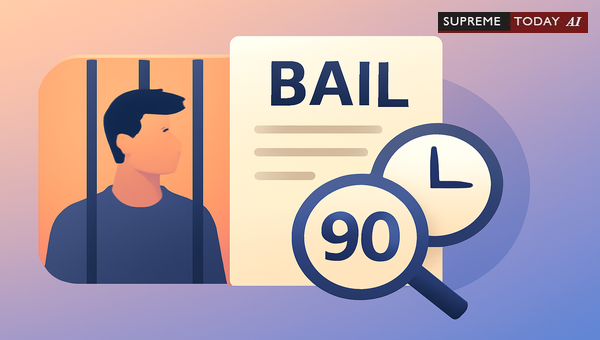
In the realm of criminal law, the right to is paramount, especially when investigations drag on without conclusion. One landmark decision that clarifies this balance is the case of . A frequent legal query arises: summary of Rakesh Paul case with respect to . This blog post delves into the nuances of , explaining how the statutory timelines for filing a determine the accrual of rights. We'll break down the judgment, its implications, and insights from related cases, all while emphasizing that this is general information and not specific legal advice—consult a qualified lawyer for your situation.
Section 167(2) CrPC mandates that if the investigation isn't completed and a (under ) isn't filed within prescribed periods, the accused gains an to . The key distinction hinges on the offence's punishment:
The in Rakesh Kumar Paul meticulously interpreted the phrase not less than 10 years. The majority judgment, authored by Justice Lokur, held that this applies only where the is 10 years or more. Offences with a maximum below 10 years, even if life imprisonment is possible in some contexts, fall under the 60-day rule. As the Court stated: the words 'not less than 10 years' would mean imprisonment should be 10 years or more and would cover only those offences for which punishment could be imprisonment for a clear period of 10 years or more 2022 7 Supreme 641.
This ruling referenced earlier precedents like Rajeev Choudhary (2001), reinforcing that legislative intent protects liberty by tying timelines to offence severity 2020 6 Supreme 514.
Here are the pivotal holdings:
The Court emphasized computing the period from arrest, ensuring courts prioritize Article 21 rights 2020 6 Supreme 514.
The phrase in was scrutinized against its plain meaning. The bench overruled contrary views, affirming Rajeev Choudhary's stance that governs. For instance, offences like those under with minima of 10 years qualify for 90 days, but others do not 2022 7 Supreme 641.
Once the 60/90 days expire sans , the accused's right vests immediately. The Court clarified: the right to is triggered automatically and does not require a formal application; an oral or implied application suffices 2022 7 Supreme 641. This aligns with constitutional protections, preventing indefinite detention.
The Rakesh Kumar Paul principles have been echoed and applied in subsequent judgments, reinforcing 's robustness.
In a case involving petitioners seeking after a failed 90-day police report, the court held: The entitlement of the accused to statutory/ under Section 167(2) of Cr.P.C. 1973 and the importance of the police report/challan in activating the right. It deemed an 'empty' challan insufficient, granting bail as the right is of constitutional character and cannot be denied by any disguise 2023 0 Supreme(J&K) 38.
Another ruling under stressed: the court must inform accused of their entitlement post-period expiry, as held in Rakesh Kumar Paul (2017) 15 SCC 67. Failure renders remands illegal, even sans formal application: it has to be presumed that applicants were already willing and ready to furnish 2021 0 Supreme(Ori) 263.
In a dissent discussion from Rakesh Kumar Paul, it was noted: The law laid down as above shows that the requirement of an application claiming the statutory right under Section 167(2) of the Code is a prerequisite for the grant of bail on default 2021 0 Supreme(All) 1536, but the majority upheld broader access.
A Madhya Pradesh case affirmed: for offences with life imprisonment but minimum less than 10 years, it's 60 days, citing Rakesh Kumar Paul (2017) 15 SCC 67 2021 0 Supreme(MP) 366. During COVID lockdowns, courts rejected prosecution delays, granting bail where charge sheets missed deadlines, as the limitation embodied under Section 167(2) must be seen on the date of filing of the charge-sheet 2020 0 Supreme(All) 814.
These cases illustrate uniform application: courts cannot frustrate the right through procedural maneuvers.
While robust, the right has caveats:
In Practice:- Check the offence's first.- Track days from arrest/remand.- Argue expiry immediately upon lapse.
Legal practitioners should: carefully examine the prescribed for the offence to determine the applicable period for and enforce expiry arguments 2022 7 Supreme 641.
Courts should strictly enforce the interpretation that favors the liberty of the accused 2020 6 Supreme 514.
The Rakesh Kumar Paul case stands as a bulwark for , mandating strict adherence to statutory periods under Section 167(2) CrPC. By tying 90 days to offences with 10+ year minima, it ensures proportionate investigation limits. remains indefeasible, safeguarding Article 21 rights against dilatory probes.
Key Takeaways:- 90 days only for min. 10-year offences; else 60 days.- Right accrues automatically on lapse; apply promptly.- Courts can't deny via technicalities—liberty prevails.
This overview draws from authoritative sources but is for informational purposes. Legal outcomes vary by facts; seek professional counsel. Stay informed on evolving CrPC jurisprudence to protect rights effectively.
References:- 2022 7 Supreme 641: judgment on statutory periods.- 2020 6 Supreme 514: Legislative history and interpretations.- 2023 0 Supreme(J&K) 38, 2021 0 Supreme(Ori) 263, 2021 0 Supreme(All) 1536, 2021 0 Supreme(MP) 366, 2020 0 Supreme(All) 814: Related applications.
#DefaultBail, #CrPC167, #RakeshPaulCase


The questions before the three-Judge Bench in Rakesh Kumar Paul [Rakesh Kumar Paul v. ... Learned counsel for the applicant argued that since the majority opinion in the case of Rakesh Kumar Paul (supra) was affirmed in the case of M. Ravindran (supra) the period of 90 days limit is only available in respect of the offences where a minimum ten years imprisonment period is stipulated. ... In this r....

It is submitted by learned counsel for the applicants that the impugned orders, whereby, the default bail granted to the applicants were cancelled, run contrary to the law enunciated by the Hon’ble Apex Court in case of Rakesh Kumar Paul Vs. ... I have given a thoughtful consideration to the entire judgment of Rakesh Kumar Paul (Supra), which is being mainly relied upon by learned counsel for the applicants. ... State of Uttarakhand, wherein the Coordinate Bench also had an occasion to consider the judg....

In the leading case of Rakesh Kumar Paul v. ... The questions before the three-Judge Bench in Rakesh Kumar Paul (supra) were whether, firstly, the 90-day remand extension under Section 167(2)(a)(i) would be applicable in respect of offences where the maximum period of imprisonment was 10 years, though the minimum period was less than 10 years. ... RK Umakanta, learned PP submits that in the case of Rakesh Kumar #HL....

The questions before the three-Judge Bench in Rakesh Kumar Paul were whether, firstly, the 90-day remand extension under Section 167(2)(a)(i) would be applicable in respect of Offences where the maximum period of imprisonment was 10 years, though the minimum period was less than 10 years. ... In this regard we find it useful to refer to the decision of the three-Judge Bench of this Court in Rakesh Kumar Paul v. ... The Supreme Court in passing remarks in paragraph 17.....

Case of Rakesh Kumar Paul vs. State of Assam, AIR 2017 SC 3948 serves the factual position of the present case in favour of the petitioners. 17. ... State of Rajasthan, 2019 (14) SCC 599, Rakesh Kumar Paul vs. State of Assam, AIR 2017 SC 3948, Bikramjit Singh vs. ... attending the death of said Rakesh Kumar. ... It is with respect to this charge sheet so filed that the court of learned Sessions Judge Udhampur came to put up the case....

The questions before the three-Judge Bench in Rakesh Kumar Paul were whether, firstly, the 90 day remand extension under Section 167(2)(a) (i) would be applicable in respect of offences where the maximum period of imprisonment was 10 years, though the minimum period was less than 10 years. ... In this regard we find it useful to refer to the decision of the three-Judge Bench of this Court in Rakesh Kumar Paul v. ... Further, as the majority opinion in Rakesh....

In Rakesh Kumar Paul (supra) the Apex Court held that an application for statutory bail even made orally must be treated as valid and considered on merits. ... Relying on Rakesh Kumar Paul vs. State of Assam, (2017) 15 SCC 67 it was further argued the special court has a duty to inform the accused of his right to be released on statutory bail. ... We agree with the view expressed in Rakesh Kumar Paul that as a cautionary measure, the counsel for the accused as well as the Magistrate ou....

The questions before the three - Judge Bench in Rakesh Kumar Paul were whether, firstly, the 90 - days remand extension under S.167(2)(a) (i) would be applicable in respect of offences where the maximum period of imprisonment was 10 years, though the minimum period was less than 10 years. ... The Hon'ble Supreme Court in case of Rakesh Kumar Paul v. State of Assam reported in (2017) 15 SCC 67 : (AIR 2017 SC 3948) has examined the issue and held as un....
In this case reliance was placed on Rakesh Kumar case (supra) and Rudra Pratap and another v. Board of Revenue. AIR 1975 All 125 and submitted that the High Court should interfere where they restricted to question of possession and also decide the question of title. ... Sri paul has also submitted that in view of the provisions laid down in the Revenue Court Manual in the proceedings under Section 34, only question of possession should be decided in summary manner and title should not be decided, theref....

//True Copy// P.S. to Judge APPENDIX OF WP(C) 2725/2021 PETITIONER'S EXTS:- EXHIBIT P1 TRUE COPY OF THE TAX RECEIPT IN RESPECT ... 2020 AND FORWARDED TO 5TH RESPONDENT FOR SUBMITTING REPORT DATED 14.12.2020 EXHIBIT P4 TRUE COPY OF THE APPLICATION SUBMITTED BY THE PETITIONER IN FORM 6 DATED 06.11.2020 AND THE SAME IS NUMBERED AS 716/2020 ON 06.11.2020 BY THE 2ND RESPONDENT EXHIBIT P5 TRUE COPY OF THE CHALLAN EVIDENCING PAYMENT OF STAUTORY

Moreover, they have specifically pleaded in the present application at paragraph-20 that for the aforementioned illegality committed by the Court, they are entitled to be released on bail. Since, as held by the Apex Court in the case of Rakesh Kumar Paul vs. It is immaterial that the accused persons had not filed any application for bail on that day. State of Assam, reported in (2017) 15 SCC 67, as reiterated in the case of M. Ravindran (supra) and followed by this Court in Lombadar Bag (supra), in the absence of information to the accused by the Court of their entitlement ....
35. P.C. Pant, J., however, dissented holding: (Rakesh Kumar Paul case, SCC p. 123, para-113) The law laid down as above shows that the requirement of an application claiming the statutory right under Section 167(2) of the Code is a prerequisite for the grant of bail on default.

The relevant para(s) of Rakesh Kumar Paul (supra), reads thus : While it is true that merely because a minimum sentence is provided for in the statute it does not mean that only the minimum sentence is imposable. The above declaration of law has been affirmed by the majority in the matter of Rakesh Kumar Paul v. State of Assam [(2017) 15 SCC 67 and contrary view expressed in Bhupinder Singh v. Jarnail Singh [(2006) 6 SCC 277] has been overruled on this point.

State of Assam, (2017) 15 SCC 67 dealing with the earlier decisions has further enlarged the scope of default bail in paragraph 40 as under: The apex court in the case reported in Rakesh Kumar Paul vs. This judgment, however, reiterated the requirement of filing an application consequent upon the accrual of indefeasible right before the charge-sheet was filed.


An indispensable Tool for Legal Professionals, Endorsed by Various High Court and Judicial Officers
Please visit our Training & Support
Center or Contact Us for assistance

Scan Me!
India’s Legal research and Law Firm App, Download now!


For Daily Legal Updates, Join us on :



 Back to top


