


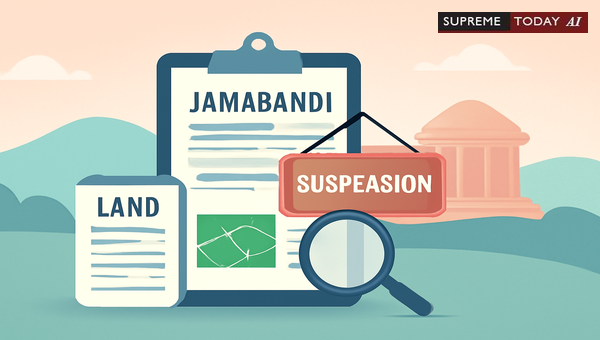
Can Revenue Authorities Suspend Jamabandi Pending ?
In land disputes across India, particularly in states like Punjab and Haryana, such as jamabandi play a crucial role in documenting possession and cultivation. But what happens when a over ownership is ongoing? Can revenue authorities simply suspend or cancel these entries until the court decides? This question often arises for landowners facing .
Is it lawful to suspend jamabandi in by revenue authorities till the final decision of a ? The short answer, based on established judicial precedents, is generally no. Revenue officers lack the statutory power to unilaterally suspend or cancel long-standing jamabandi entries merely because a is pending. Such actions contravene legal principles and can be challenged in court. This post breaks down the law, key judgments, and practical advice.
Understanding Jamabandi and
Jamabandi is a key revenue document under laws like the , recording ownership, possession, and tenancy details for fiscal purposes—primarily . Importantly, these entries do not confer or extinguish title to land; they serve only a fiscal purpose 2021 0 Supreme(HP) 857.
As held in multiple cases, entries in or jamabandi have only 'fiscal purpose' and do not confer title 2021 0 Supreme(HP) 857. Ownership disputes must be resolved by , not revenue officials 2025 0 Supreme(Jhk) 136.
Jurisdiction Limits of Revenue Authorities
Revenue authorities are empowered to maintain and correct records but cannot act as substitutes for in . Courts have repeatedly clarified that revenue officers lack jurisdiction to suspend or cancel jamabandi without proper legal process.
For instance, 2025 0 Supreme(Jhk) 136 states: the revenue authority is only vested with the power to conduct enquiry and thereafter annul transfer, but does not have the power to cancel jamabandi. Similarly, 2021 0 Supreme(Jhk) 466 emphasizes: no provision confers upon any authority of the State to cancel the Jamabandi, concluding that long standing jamabandi cannot be cancelled except by filing a suit in a competent Civil Court.
This principle is reinforced elsewhere: confer rights subject to civil court review, but entries do not create title 2024 0 Supreme(Pat) 91. Revenue authorities cannot arbitrarily rescind orders without hearing parties 2022 0 Supreme(J&K) 21.
Key Restriction: No Unilateral Suspension Pending Suits
Suspending jamabandi solely because a is pending is unlawful. 2025 0 Supreme(Jhk) 136 and 2021 0 Supreme(Jhk) 466 confirm that administrative actions cannot interfere with civil rights during litigation. Instead, one practical approach seen in judgments is for revenue officers to note in the 'remarks' column that a is pending, without altering entries 2013 0 Supreme(P&H) 193.
Judicial Precedents Protecting Jamabandi
Courts have consistently prioritized civil jurisdiction:- prove possession but not title; corrections do not resolve ownership 2021 0 Supreme(HP) 857.- The revenue record is only for payment of land revenue, and ownership is to be decided by a civil court 2025 0 Supreme(Jhk) 136.- Revenue orders cannot supersede civil court judgments 2004 0 Supreme(P&H) 615, which notes: order of the revenue officer for correction or cancellation of jamabandi cannot supersede the judgment of a competent civil court.
Long-standing jamabandi, like those from , establish possession unless proven otherwise 2023 0 Supreme(P&H) 3495. Once created, jamabandi establishes tenancy rights and cannot be cancelled without fraud, misrepresentation, or 2010 0 Supreme(Jhk) 916.
Presumptions under attach to jamabandi entries, which must be challenged properly 2017 0 Supreme(P&H) 2042.
Exceptions and Proper Procedures
While generally impermissible, limited exceptions exist:- Statutory Corrections: Revenue authorities can correct clerical errors or act within principles, providing notice and hearing 2022 0 Supreme(J&K) 21.- Fraud or Misrepresentation: Cancellation possible if proven, but not arbitrarily 2010 0 Supreme(Jhk) 916.- Pending Suit Notation: Enter ' pending' in remarks, not suspend entries 2013 0 Supreme(P&H) 193.
However, actions during civil suits are scrutinized; manipulative changes are invalid 2025 Supreme(Online)(P&H) 7235. Long-standing entries require civil suits for alteration 2024 0 Supreme(Jhk) 818 2023 0 Supreme(Jhk) 317.
Practical Recommendations for Landowners
If facing jamabandi suspension:- Challenge Immediately: File a for or petition the revenue authority/.- Provide Suit Details: Inform revenue officers of the pending suit to get a neutral 'remarks' entry 2013 0 Supreme(P&H) 193.- Seek : Courts can restrain unlawful suspensions.- Avoid : Insist on statutory compliance; unilateral actions by revenue staff, like illegal jamabandi letters, are void 2006 0 Supreme(Del) 1997.
Revenue authorities should:- Refrain from suspensions pending suits.- Update records only post-final civil orders.- Follow .
Conclusion and Key Takeaways
In summary, it is generally not lawful for revenue authorities to suspend jamabandi pending a 's final decision, absent explicit statutory authority or court orders. are fiscal tools, not title deciders— hold primacy in ownership disputes 2025 0 Supreme(Jhk) 136 2021 0 Supreme(Jhk) 466 2021 0 Supreme(HP) 857
Key Takeaways:- Jamabandi suspension without jurisdiction is unlawful.- File civil suits for title challenges; note pendency in records.- Long-standing entries are protected.
This post provides general information based on judicial precedents and is not legal advice. Consult a qualified lawyer for your specific case.
References
- 2025 0 Supreme(Jhk) 136: No revenue power to cancel jamabandi.
- 2021 0 Supreme(Jhk) 466: required for long-standing entries.
- 2021 0 Supreme(HP) 857: Fiscal purpose only.
- 2004 0 Supreme(P&H) 615: Revenue can't override civil judgments.
- Additional: 2013 0 Supreme(P&H) 193, 2010 0 Supreme(Jhk) 916, etc.












