Searching Case Laws & Precedent on Legal Query.....!
Analysing the retrieved Case Laws
Scanned Judgements…!



Searching Case Laws & Precedent on Legal Query.....!
Analysing the retrieved Case Laws
Scanned Judgements…!
Second Wife Asking for Maintenance After Marriage During First Wife's Lifetime with First Wife’s Consent - Main Points and Insights
The legality of maintenance claims by a second wife who marries during the lifetime of the first wife but with her consent varies based on facts and evidence.
In some instances, courts have acknowledged that if the second marriage is performed with the first wife's consent and the first marriage remains valid, the second wife may not be entitled to maintenance.
Analysis and Conclusion
Generally, a second wife cannot ask for maintenance if she marries during the lifetime of the first wife, especially if the second marriage is not legally recognized or if the first marriage is still valid and subsisting.
References:- Urmila Badshah Godse (2014) 1 SCC 188- Court judgments discussing subsisting marriages and maintenance rights during second marriages, including Badshah (Supra) and other cited cases.
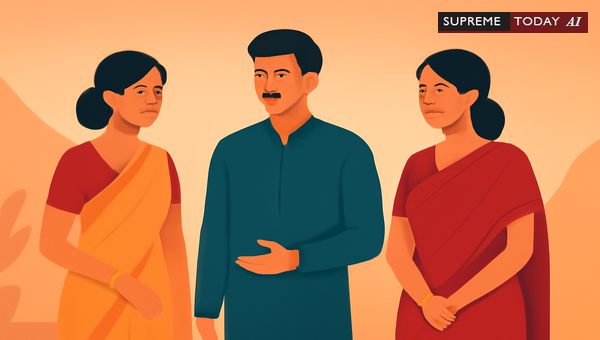
In the complex landscape of family law in India, questions about multiple marriages and maintenance rights often arise, especially under Hindu personal law. Imagine a scenario where a man marries a second wife during the lifetime of his first wife, with the explicit consent of the first wife. Does the second wife gain legal rights to maintenance? This is a common query that can lead to prolonged legal battles. Can the second wife ask for maintenance when she got married to the opposite party during the lifetime of the first wife but with the consent of the first wife?
This article delves into the legal nuances, drawing from key court judgments and statutory provisions under the . We'll examine why such marriages are typically void, the impact of consent, and exceptions highlighted in landmark cases. Note: This is general information based on precedents and not personalized legal advice. Consult a qualified lawyer for your specific situation.
Under Hindu law, a second marriage solemnized during the lifetime of the first wife is generally considered (invalid from the beginning), regardless of the first wife's consent. As a result, the second wife does not acquire the legal status of a 'wife' or 'widow' and cannot claim maintenance or . This principle is firmly established in judicial precedents.
The court has held that any marriage solemnized after the commencement of this Act shall be if either party has a spouse living at the time of the marriage2005 1 Supreme 155. This provision from the , leaves no room for exceptions based on consent.
Key points include:- Marriages during the lifetime of a first wife are void under the Hindu Marriage Act 2005 1 Supreme 155.- Such a marriage does not confer the status of a wife or widow 2022 0 Supreme(Mad) 774.- Even with first wife's consent, the second wife cannot claim maintenance or 2022 0 Supreme(Mad) 774.
, mandates that neither party should have a living spouse at the time of marriage. Courts have consistently ruled that breaching this renders the marriage . The marriage is void regardless of whether the first wife consents or not, as law presumes the marriage’s invalidity when a spouse is alive2005 1 Supreme 155.
In detailed analysis, the legal documents clarify: a marriage contracted during the lifetime of a spouse, without legal annulment or divorce, is void under the 2005 1 Supreme 155. Without dissolution of the first marriage via divorce or annulment, the second union lacks legal sanctity.
A critical misconception is that consent from the first wife validates the second marriage. However, courts emphasize that validity hinges on statutory compliance, not personal agreements. The marriage’s validity depends on compliance with legal conditions, not on the consent of the first wife2022 0 Supreme(Mad) 774.
For instance, a marriage during the existence of a living spouse is void under the Hindu Marriage Act, and such marriage does not confer the status of a widow or a legally wedded wife2022 0 Supreme(Mad) 774. Consent might reflect social customs in some communities, but it does not override the law. Cases like 2023 Supreme(Online)(Kar) 37569 note scenarios where second marriages occurred with consent during the first wife's lifetime, yet legal recognition was absent, as she married Sri.A.D.Shambulingappa during the lifetime of the first wife.
Similarly, 2019 0 Supreme(Guj) 374 describes with the consent of his first wife, her husband got married with the applicant, but this did not confer legal rights, highlighting the gap between custom and law.
Since the marriage is void, the second wife holds no matrimonial rights. The second wife does not acquire the legal status of a wife or widow2022 0 Supreme(Mad) 774. Maintenance under or schemes is reserved for legally wedded wives or widows.
Courts have ruled: the is not payable to such second wives 2022 0 Supreme(Mad) 774. In 2022 0 Supreme(Mad) 351, it was stated the wife got second marriage and she is not entitled for maintenance after the date of second marriage, reinforcing that invalid unions bar claims.
While the general rule denies rights, courts have carved limited exceptions, particularly when the second wife is unaware of the first marriage. In the seminal case of , the granted maintenance to a second wife who was kept in the dark about her husband’s first 2025 0 Supreme(All) 2882. The Court observed: 13.3. ... emphasizing protection for innocent parties under .
However, this does not apply when consent is involved or the second wife knows of the . In Badshah (Supra), referenced in 2023 0 Supreme(Bom) 1616, where the wife got divorce from her first husband and thereafter, got married to another person (second husband), rights were assessed based on validity. If the first marriage subsists, as in 2025 Supreme(Online)(P&H) 2976, the marriage of Sheetaldeen with the first wife is very much subsisting when the second wife got married, only the first wife prevails.
Other cases like 2022 0 Supreme(Mad) 414 note when the first wife was alive, the first defendant got married to the second wife, rendering it void. Consent-based marriages, as in 2013 0 Supreme(Kar) 1095, during the lifetime of the first wife, the first defendant married her with the consent of all the members of the family, still fail legally.
Pre-1955 customs might offer leeway if proven valid under prior personal law, but post-Act, such claims are rare 2022 0 Supreme(Mad) 774. Evidence of prior marriage dissolution is crucial 2023 0 Supreme(All) 1190.
In 2023 0 Supreme(Jhk) 1460, disclosure of marital status was mandated, underscoring transparency.
Generally, a second wife cannot claim maintenance if married during the first wife's lifetime, even with consent, as the union is void. While cases like Urmila Badshah Godse offer hope in specific circumstances, the law prioritizes post-1955. This underscores the importance of legal compliance in family matters.
Disclaimer: This article provides general insights based on cited judgments 2005 1 Supreme 155 2022 0 Supreme(Mad) 774 and is not legal advice. Laws evolve, and outcomes depend on facts. Consult a family law expert.


that opposite party was married with Madhu Yadav. ... Urmila Badshah Godse and Another (2014) 1 SCC 188, this Court granted maintenance to a second wife who was kept in the dark about her husband’s first subsisting marriage. The Court noted: “13.3. ... The opposite party was married with Sangeeta Yadav, daughter of ....

Since the opposite party-petitioner has not paid a single farthing to O.P. No. 1 during her lifetime and O.P. ... No. 2 has also attained majority and got married without any help from the petitioner, no purpose would be served by remitting the matter to determine the income of the opposite party-petitioner. ... by mutual consent. ... On behalf of the ....

Per contra learned counsel for opposite party no.2 submitted that opposite party no.2 is the legally wedded wife of revisionist, as the marriage of the revisionist and opposite party no.2 was solemnized on 08.06.2010 with their consent as per Hindu Rites and Rituals in the presence of both the families ... The opposite party....

Jiten Swargiary brought him to the court and asked him to adduce evidence before the court that he got married to the first party and accordingly he stated so. But this witness subsequently stated that about 25/26 years back, Jiten got married to Sumitra. ... In his cross-examination, DW-1 admitted that he contracted second marriage in the year 2010 and the name of his ....

In a later Judgment delivered by Supreme Court in the case of Badshah (Supra), wherein the facts were that the wife got divorce from her first husband and thereafter, got married to another person (second husband), the said marriage was as per the Hindu Marriage Customs. ... After few months of her second marriage, the first wife of t....

The High Court held that the marriage of Sheetaldeen with the first wife is very much subsisting when the second wife got married. Consequently, the first wife alone was entitled to the grant of succession certificate. ... We may observe that the amount of Rs.3,60,000/- was attached towards arrears of maintenance amount of the #HL_STA....

The petitioner-husband was married with the opposite party No.2-wife on 02.05.1995 at Kalyaneshwari Temple and the marriage was registered on 03.06.1995 under the Special Marriage Act, 1954. ... The opposite party No.2-wife was required to disclose her assets and liabilities, also the status of the parties and reasonable needs of the wife. Whether the ....

During his lifetime, he took VRS. It is stated that he had a first wife namely Smt.Jayamma and she did not beget any children. Hence, with her consent, Sri.A.D.Shambulingappa married Vijayalakshmi - the plaintiff. They were living jointly under a common roof. ... During the course of oral evidence, she admitted that she married Sri.A.D.Shambulingappa during the lifetime....
However, since the appellant has also got married second time and has a child from the second marriage, in the interest of justice, we think it proper to reduce the amount of maintenance of Rs 23.000 to Rs 20.000 per month as maintenance to the respondent wife and son. ... opposite party no. 1- wife namely Sazia Khat....

With regard to the second issue referring to the cross-examination of opposite party no. 1-wife, Mr. ... The opposite party no.1-wife has left her matrimonial home out of her own accord and parties are living separately on mutual consent. The petitioner-husband has taken steps but the wife has not returned back to the matrimonial home....

8. On the side of the revision petitioner-husband, it is stated that the document was dated 23.06.2012 and not on 20.06.2012. The wife got second marriage and she is not entitled for maintenance after the date of second marriage. On the side of the respondent-wife, it is stated that the petitioner / husband failed to prove that the respondent / wife married somebody else and prayed that the petition is to be dismissed.

She is the mother of the plaintiff and the second defendant. Hence, the marriage solemnised between the first defendant and Devaki become void and thereby, the son born to them, is not entitled to any share from the suit schedule property. Hence, the present suit has been filed for the relief of partition. When the first wife was alive, the first defendant got married to the second wife, namely, Devaki.

With the consent of his first wife, her husband got married with the applicant. That, some property situated in the sim of village Nagdaka, field admeasuring 50 Bigha and huge portion in the immovable property of village Dhajala as well as agricultural land of survey no. 63 paiki admeasuring acre 6-33 guntha known as Khakharaat village Dhajala and one big house known as Thakar temple and entire income of the said temple was given to the first wife of her husband namely Aaybab....

3. In O.A.No.281 of2014, it is averred that the applicant is the second wife of the deceased L.Somu, who served as Senior Trackman in Southern Railway and he passed away in harness in the year 2005. During his lifetime, he married the applicant with the consent of his first wife, since she has not begotten any issue.

The 5th defendant was running a Fair Price Shop and also doing business of Pawn Broker. Item Nos. 19 and 31 are self-acquired properties of the 5th defendant. 8. The 5th defendant filed written statement contending that the suit filed by the plaintiffs is not maintainable and is a collusive one and the same is barred for non-joinder of parties. During the lifetime of the first wife, the first defendant married her with the consent of all the members of the family.


An indispensable Tool for Legal Professionals, Endorsed by Various High Court and Judicial Officers
Please visit our Training & Support
Center or Contact Us for assistance

Scan Me!
India’s Legal research and Law Firm App, Download now!


For Daily Legal Updates, Join us on :



 Back to top


