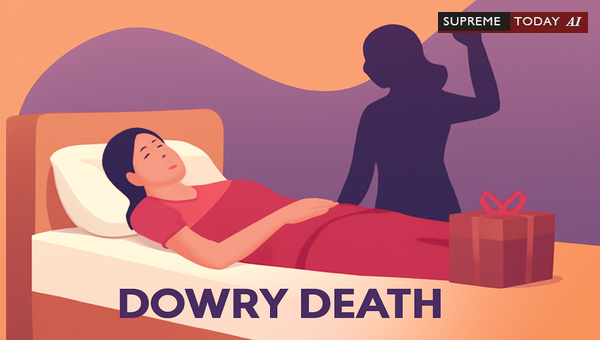
Understanding Section 304B IPC: Ingredients for Dowry Death Prosecutions
Dowry-related deaths remain a tragic and pressing issue in India, often leading to legal battles under Section 304B of the Indian Penal Code (IPC). This provision addresses cases where a woman's death occurs under suspicious circumstances linked to dowry demands. But what exactly constitutes a dowry death under the law? If you're searching for 304B IPC ingredients, this guide breaks down the essential elements required for a successful prosecution, drawing from statutory provisions and judicial interpretations.
This article provides general information on the topic and is not legal advice. Laws can vary by case, and consulting a qualified lawyer is recommended for specific situations.
What is Section 304B IPC?
Enacted to combat the menace of dowry deaths, Section 304B IPC defines dowry death and prescribes punishment—imprisonment for a minimum of seven years, which may extend to life imprisonment. The section applies when a woman dies from burns, bodily injury, or unnatural circumstances within seven years of her marriage, and it is shown that she was subjected to cruelty or harassment by her husband or his relatives in connection with dowry demands.
The provision works in tandem with Section 113B of the Indian Evidence Act, which raises a presumption of dowry death if the prosecution establishes the foundational facts. However, courts emphasize that all ingredients must be proven beyond reasonable doubt. Preet Pal Singh VS State of Uttar Pradesh - Supreme Court
Essential Ingredients of Section 304B IPC
To invoke Section 304B, the prosecution must establish four key ingredients. Failure to prove any one can lead to acquittal, as highlighted in multiple judgments.
1. Death in Unnatural Circumstances
The woman's death must occur otherwise than under normal circumstances, such as burns, poisoning, or suicide. Natural death or accidental death without suspicious elements does not qualify. For instance, The death of the woman was caused due to burns, bodily injury or due to unnatural circumstances. Subhash Natthuji Bhandare VS State of Maharashtra - 2018 Supreme(Bom) 139
2. Death Within Seven Years of Marriage
A strict timeline applies: the death must happen within seven years from the date of marriage. This temporal link underscores the vulnerability period post-marriage. Preet Pal Singh VS State of Uttar Pradesh - Supreme Court
3. Cruelty or Harassment by Husband or Relatives
There must be evidence of sustained cruelty or harassment by the husband or his relatives. Cruelty includes physical or mental harm aimed at coercing the woman or her family. Importantly, this must be for or in connection with the demand for dowry. Preet Pal Singh VS State of Uttar Pradesh - Supreme Court
4. Cruelty or Harassment Soon Before Death
The harassment must be proximate to the death—not remote or isolated incidents from years prior. Courts interpret soon before on a case-by-case basis, looking for a direct nexus. The term 'soon before her death' is not defined in the statute. Courts must analyze the facts and circumstances of each case to determine if there is a proximate connection between the demand for dowry and the act of cruelty or harassment leading to the death. Paranagouda VS State of Karnataka - Supreme Court
Presumption Under Section 113B of the Evidence Act
Once the prosecution proves the death occurred in unnatural circumstances within seven years of marriage and there was cruelty or harassment for dowry soon before death, a statutory presumption arises. The burden shifts to the accused to rebut it. Section 113B of Evidence Act will be attracted only when the prosecution successfully establishes existence of all the three ingredients of section 304B of the Indian Penal Code. Rohit Pandey, son of Indrajeet Pandey VS State of Jharkhand - 2024 Supreme(Jhk) 889
This presumption is rebuttable; the accused can demonstrate otherwise through evidence like lack of dowry demands or alternative explanations for the death.
Judicial Interpretations and Case Examples
Indian courts have refined these ingredients through precedents, often acquitting where links are weak.
Successful Prosecutions
In cases where all elements align, convictions stand. For example, if a woman dies within a year of marriage from burn injuries after proven dowry harassment, the presumption operates. If the prosecution proves that the deceased died within a year of her marriage due to burn injuries and was subjected to harassment and cruelty for dowry demands before her death, the presumption under Section 113B of the Evidence Act operates against the accused. SATBIR SINGH VS STATE OF HARYANA - Supreme Court
Another instance: In the present case, ingredients of Section 304B IPC are satisfied. Urmila @ Guddi was subjected to harassment and cruelty by accused-Kashmira Devi for non-fulfillment of demand of dowry. State VS Govind Singh - 2017 Supreme(UK) 195 Here, proximate demands led to upheld charges.
That demand was proximate to her death is also apparent. Therefore, the ingredients of Section 304B I.P.C. are satisfied. State of West Bengal VS Tapas Mondal - 2016 Supreme(Cal) 998
Unsuccessful Prosecutions and Acquittals
Prosecutions frequently fail without proof of dowry demand or proximity. The prosecution must prove all three ingredients of Section 304B IPC for conviction; failure to establish demand for dowry and torture led to acquittal. Rohit Pandey, son of Indrajeet Pandey VS State of Jharkhand - 2024 Supreme(Jhk) 889
In one case, despite unnatural death within the timeframe, vague witness testimonies on dowry demands resulted in acquittal: Prosecution failed to establish demand for dowry or torture soon before death, leading to acquittal. Rohit Pandey, son of Indrajeet Pandey VS State of Jharkhand - 2024 Supreme(Jhk) 889
Similarly, There is also no evidence to the effect that the appellant ever demanded dowry or harassed the deceased soon before her death for demand of dowry. Thus, the ingredients of Section 304B I.P.C. are totally lacking. Bharat Gadvi VS State of Rajasthan - 2019 Supreme(Raj) 1663 The court quashed charges, stressing prima facie evidence at framing stage.
In another ruling, inconsistencies in evidence and delayed FIRs undermined the case: The court acquitted under Sections 304B and 498A, noting failure to prove cruelty soon before death. Subhash Natthuji Bhandare VS State of Maharashtra - 2018 Supreme(Bom) 139
Even in anticipatory bail matters, absence of immediate demands weakens Section 304B claims: The main contention... does not show that there was any immediate demand of dowry prior to the date of the death. Danish VS State - 2012 Supreme(Del) 3116
Proving the Proximate Link: 'Soon Before Her Death'
This phrase is pivotal and fact-specific. Demands months earlier may not suffice if disconnected from the death. Courts examine timelines, witness credibility, dying declarations, and recovery evidence. Remote harassment alone triggers Section 498A (cruelty) but not necessarily 304B. Paranagouda VS State of Karnataka - Supreme Court
If the prosecution fails to establish a proximate link between the demand for dowry and the deceased's suicide, the conviction under Section 304B cannot be sustained. Paranagouda VS State of Karnataka - Supreme Court
Related Provisions: Section 498A IPC and Dowry Prohibition Act
Section 304B often pairs with Section 498A (husband or relatives subjecting woman to cruelty). While 498A has no 'soon before' requirement, dowry death demands stricter proof. The Dowry Prohibition Act defines 'dowry' broadly, aiding interpretations. Subhash Natthuji Bhandare VS State of Maharashtra - 2018 Supreme(Bom) 139
Key Takeaways for Dowry Death Cases
- Prosecution Burden: All four ingredients must be proven; presumption follows.
- Defense Strategy: Rebut with evidence disproving dowry link or proximity.
- Court Scrutiny: Judicial mind applied at charge-framing; weak cases dismissed early. Bharat Gadvi VS State of Rajasthan - 2019 Supreme(Raj) 1663
- Prevention Focus: Awareness of rights under these laws empowers families.
In conclusion, Section 304B IPC serves as a shield against dowry atrocities but requires rigorous evidence. Cases turn on factual proximity and credibility. While presumptions aid prosecution, acquittals remind us of the need for solid proof. For personalized guidance, always seek professional legal counsel.
This post is for informational purposes only and reflects general legal principles as of the latest available judgments.
#Section304B, #DowryDeath, #IPCDowry