


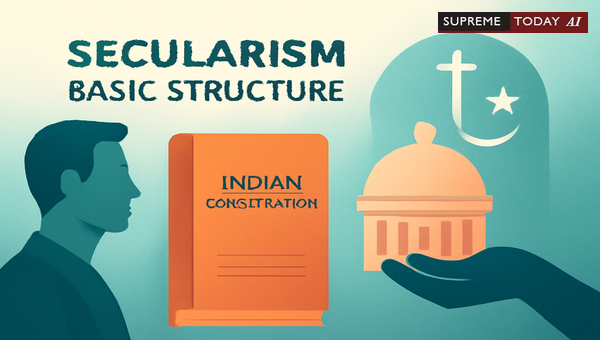
Is a Basic Structure of the Indian Constitution?
In a diverse nation like India, where multiple religions coexist, the principle of plays a pivotal role in maintaining harmony and . But is a basic structure of the Constitution? This question has been at the heart of numerous judicial interpretations and remains crucial for understanding the foundational ethos of India's democracy. This blog post delves into judgments, constitutional provisions, and evolving legal perspectives to provide clarity on this vital issue.
Note: This article offers general information based on established legal precedents and is not intended as specific legal advice. Consult a qualified lawyer for personalized guidance.
Understanding the
The , propounded in the landmark Kesavananda Bharati v. State of Kerala case (), holds that certain core features of the Constitution cannot be amended by Parliament. These include democracy, federalism, , and the , among others. ensures the state remains neutral towards all religions, treating them equally without favoritism or discrimination. 2022 0 Supreme(SC) 1135
Judicial Precedents Affirming as Basic Structure
The has repeatedly affirmed 's place in the Constitution's basic structure through pivotal rulings:
In this seminal 9-judge bench decision, the Court explicitly held that is an essential feature of the Constitution and part of its basic structure, especially in the context of (President's Rule). The judgment emphasized that is linked to the right to and cannot be undermined. 2022 0 Supreme(SC) 1135 2023 0 Supreme(SC) 731 2024 Supreme(Online)(SC) 12214
A key quote from the ruling underscores: is part of the basic structure of the Constitution.2016 0 Supreme(Ker) 85
This case reiterated that the basic structure encompasses alongside the supremacy of the Constitution and . 2022 0 Supreme(SC) 1135
Here, the Court stressed that principles like are overarching and integral to under Articles 14, 19, and 21, beyond Parliament's amendment powers. 2022 0 Supreme(SC) 1135
Additional judgments reinforce this:- In Ismail Faruqui v. Union of India (), the Court stated: the concept of is a basic feature of the Constitution of India and the way of life adopted by the people of India as their abiding faith and creed.2015 0 Supreme(Ker) 667- is the basic structure of the Constitution. This was echoed in rulings prohibiting religious instruction in state-funded institutions under (1). 2022 0 Supreme(Gau) 24- , therefore, is a basic feature of our constitution. as held in the Bommai case (AIR SC 1918). 2002 0 Supreme(Mad) 957
Constitutional Provisions Embedding
The Indian Constitution inherently embodies , even before explicit insertion:
- Preamble: The added secular to declare India a , underscoring its foundational role. 2022 0 Supreme(SC) 1043
- Articles 25-30: These guarantee freedom of religion, conscience, and minority rights, prohibiting a and mandating equal treatment. 2023 0 Supreme(SC) 731 2024 0 Supreme(Chh) 348
- (): Reinforces non-discrimination on religious grounds, making a facet of . 2024 8 Supreme 713
The Court interprets Indian positively as equal treatment of all religions, rather than mere religious tolerance, with the state maintaining strict . 2022 0 Supreme(SC) 1043
in Political and Legislative Contexts
extends to politics and governance:
- Political parties' constitutions must declare allegiance to the Constitution's basic tenets of socialism, , and democracy. Parties promoting one religion exclusively, like the petitioner's claim against , may face scrutiny. 2024 0 Supreme(Del) 805
- The term used under the Indian Constitution means equal status to all religions without prohibition or discrimination. Any government order overriding this is invalid. 2023 Supreme(Online)(ALL) 8046
In D.A.V. College v. State of Punjab (), the Court upheld restrictions on religious instruction in state-aided institutions, affirming 's mandate. 2022 0 Supreme(Gau) 24
Recent cases, like challenges to circulars on religious matters, declare them unconstitutional as affronts to under . 2023 0 Supreme(Mad) 2844
Challenges and Amendments: Limits on Parliamentary Power
Amendments violating can be struck down. The judiciary views as embedded in provisions defining the basic structure, not an abstract ideal. 2022 0 Supreme(SC) 1135 2024 Supreme(Online)(SC) 12214
For instance:- India is a secular State and is its constitutional goal.2016 0 Supreme(Ker) 85- as a Basic Feature - Multiple judgments... affirm that is an integral part of the Constitution's basic structure.2024 8 Supreme 713 2023 0 Supreme(SC) 731
Indian : Unique Positive Concept
Unlike Western models of strict separation, Indian promotes equal respect and support for all religions while preventing state-sponsored religion. , in Indian Constitution, does not mean an anti-God or aesthetic society, but it means equal status of all religion, without any preference.2002 0 Supreme(Mad) 957
This aligns with the Preamble's promise of liberty of thought, expression, belief, faith, and worship under . 2003 0 Supreme(Ker) 154
Key Takeaways and Implications
- is firmly part of the basic structure, safeguarded against amendments.
- It underpins (), religious freedom (Articles 25-28), and democratic governance.
- Political entities and legislation must align with this principle to avoid judicial invalidation.
- Courts continue to protect it as essential to India's pluralistic fabric. 2024 Supreme(Online)(SC) 11262 2022 Supreme(Online)(Ker) 63571
In conclusion, extensive judicial precedents like S.R. Bommai and constitutional reinforcements confirm that is indeed a basic structure of the Indian Constitution. It ensures the state's , fostering unity in diversity. As India navigates contemporary challenges, upholding this principle remains paramount for constitutional integrity.
For deeper insights, reference key cases and consult legal experts. Stay informed on evolving jurisprudence!
References:2022 0 Supreme(SC) 1135 2022 0 Supreme(SC) 1043 2023 0 Supreme(SC) 731 2024 0 Supreme(Del) 805 2023 Supreme(Online)(ALL) 8046 2023 0 Supreme(Mad) 2844 2022 0 Supreme(Gau) 24 2016 0 Supreme(Ker) 85 2015 0 Supreme(Ker) 667 2003 0 Supreme(Ker) 154 2002 0 Supreme(Mad) 957 2024 8 Supreme 713 2023 0 Supreme(SC) 731 2024 Supreme(Online)(SC) 12214 2024 Supreme(Online)(SC) 11262 2024 0 Supreme(Chh) 348 2024 8 Supreme 206 2022 Supreme(Online)(Ker) 63571
#SecularismIndia, #BasicStructure, #IndianConstitution












