


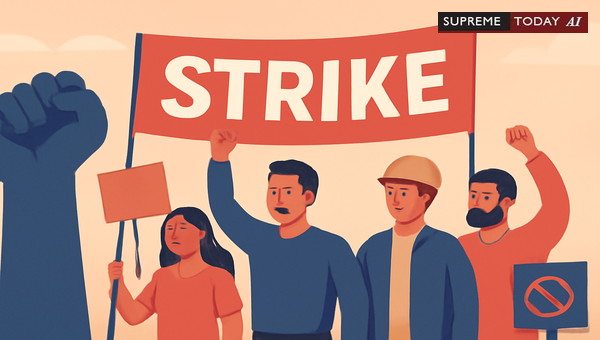
Strikes Not Part of : Key Case Law Insights
In the realm of labour law, strikes are often viewed as a powerful tool for workers to negotiate better terms. However, not every work stoppage qualifies as a legitimate aspect of . Courts have consistently drawn a line between lawful strikes tied to bargaining objectives and those that cross into illegality, violence, or unrelated motives. This raises a critical question: Case Law where Strike was Not Held as an Aspect of ?
This blog post delves into pivotal Indian case law and legal principles that clarify when strikes fall outside the protective umbrella of . Understanding these distinctions is essential for employers, unions, and workers to navigate effectively. Note: This is general information and not specific legal advice; consult a qualified attorney for your situation.
What is and the Role of Strikes?
refers to the process where employers and worker representatives negotiate terms of employment, such as wages, hours, and conditions. Strikes are traditionally recognized as a 'weapon' in this process, enabling workers to pressure management for fair demands. As noted in key judgments, on behalf of the workmen is almost the only and primary function of the trade unions, and strike is the most potent weapon which labour had got in order to have better conditions of employment 2018 0 Supreme(Mad) 2921.
However, this recognition is conditional. Strikes must be lawful, peaceful, and directly linked to bargaining goals. When they deviate—through procedural violations, violence, or extraneous purposes—courts deem them outside . This protects industrial harmony while upholding workers' rights.
When Strikes Are Not an Aspect of
Case law establishes clear criteria: a strike is excluded from if:- It violates (e.g., no notice, during conciliation).- It involves coercion, violence, or unlawful objectives.- It addresses matters not covered by settlements or awards.- It is initiated independently of negotiations.
The has been unequivocal: There is no to go on strike and that a strike called in violation of or law cannot be regarded as an aspect of 1960 0 Supreme(SC) 350. Similarly, a strike in respect of matters not covered by a settlement or award, or initiated without following prescribed legal procedures, is not part of lawful but an illegal act 2021 0 Supreme(Ker) 36.
Landmark Rulings
Illegal Strikes During Statutory Restrictions: In
In Re Disruption of Power Supply in Prayagraj VS State Of U. P. Through Additional Chief Secretary Power U. P. Government - Allahabad (2023)
and 2014 0 Supreme(Cal) 336, the Court held that strikes breaching restrictions—like those during pending or without notice—are not part of . Such actions undermine legal processes.Penalties for Unlawful Strikes: The ruling in 1999 0 Supreme(All) 757 clarifies: a strike if legal would not be an absence, if illegal would attract penalty and that resort to cannot be regarded as part of .
Grievances Outside Settlements: 1998 9 Supreme 415 emphasizes that strikes over grievances not covered by settlements, or pursued illegally, fall outside legitimate bargaining.
These cases underscore that legality and purpose are paramount. Courts scrutinize context to classify strikes.
Insights from Additional Case Law and Principles
Supporting precedents reinforce this boundary. For instance, violent or adventurist, extremist, extraneously inspired and puerile strikes are anathema for the law, with the right to strike integral to only if peaceful
2011 0 Supreme(Mad) 3415 2007 0 Supreme(Mad) 1298.
In 2005 0 Supreme(Kar) 480, it's affirmed: A right to strike is part of which is recognized in law. Unless the strike is commenced or declared in contravention of section 22 or 23... it cannot be termed illegal. This highlights procedural compliance under the (Sections 22, 23).
Other rulings distinguish between peaceful participation and violent acts. Workers engaging in abuse, threats, or obstruction during strikes face discipline, as these are not part of strike, nor they are connected with the strike 2005 0 Supreme(Kar) 480. Even if a strike's legality is under adjudication, unrelated misconduct isn't protected under Section 33.
International perspectives, like South African cases, note strikes end with cessation, but interpretation ties to bargaining contexts
National Union of Metalworkers of South Africa vs Trenstar - 2023 Supreme(SA)(ZACC) 10
. US cases discuss expired agreements and negotiations but align on distinguishing lawful from unlawful actions 2023 Supreme(US)(scotus) 21131.Exceptions: When Strikes Qualify as
Conversely, strikes aimed at enforcing rights, conducted peacefully, and within legal bounds may be part of bargaining:- Linked to negotiation demands.- Compliant with notice and procedure.- Free from violence or coercion.
Courts balance worker rights with public order, directing conciliation and police protection where needed
.
Practical Implications and Recommendations
For unions and employers:- Unions: Ensure strikes follow Act procedures (e.g., notice under Section 22 for public utility services). Avoid violence to maintain legitimacy.- Employers: Document procedural lapses to challenge strikes legally. Seek tribunal approval for discipline during disputes (Section 33).- Both Parties: Prioritize conciliation; illegal strikes invite penalties, while lawful ones strengthen bargaining positions.
When assessing a strike:1. Check purpose and connection to bargaining.2. Verify legality and statutory adherence.3. Evaluate for violence or extraneous motives.
Tribunals must contextualize to classify accurately.
Key Takeaways
- Lawful strikes support ; illegal ones do not 1960 0 Supreme(SC) 350 2021 0 Supreme(Ker) 36.
- Procedural violations, violence, or unrelated grievances exclude strikes from bargaining
In Re Disruption of Power Supply in Prayagraj VS State Of U. P. Through Additional Chief Secretary Power U. P. Government - Allahabad (2023)
2014 0 Supreme(Cal) 336. - Peaceful, procedural strikes uphold workers' rights 2005 0 Supreme(Kar) 480.
In summary, while strikes are a recognized bargaining tool, courts rigorously exclude unlawful variants to preserve order. Staying informed on these precedents helps mitigate disputes. For tailored guidance, reach out to labour law experts.
#LabourLaw,#StrikeRights,#CollectiveBargaining















