


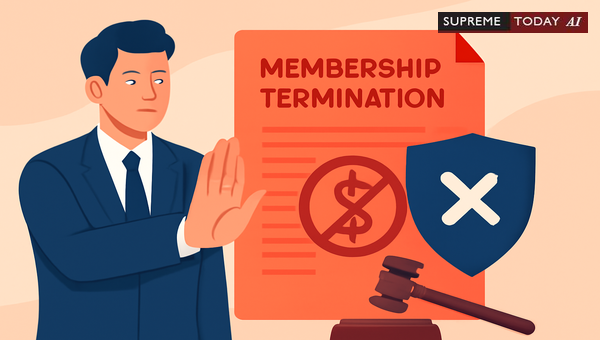
Refusing Subscription Fees: Not
In the realm of societies, clubs, and organizations, disputes over subscription fees are common. Members may face consequences for non-payment, but does a society's refusal to accept these fees amount to or ? This question often arises in legal challenges, particularly in religious, community, or professional associations. Understanding the nuances is crucial for members and administrators alike.
This article delves into the legal finding that refusal of a society or organization to accept a subscription fee does not amount to or . Instead, it typically triggers disciplinary or contractual measures, such as suspension or loss of benefits. We'll explore key principles, distinctions, and insights from relevant legal documents, while emphasizing that this is general information—not specific legal advice. Always consult a qualified attorney for your situation.
The Core Legal Question
Refusal of Receiving Subscription Fee will Not Amount to or .
This principle underscores that non-acceptance of fees is generally a procedural matter, not a formal severance of membership through ecclesiastical or severe disciplinary sanctions. or implies a profound, often religious expulsion, requiring explicit rules and processes—rarely tied directly to fee disputes.
Main Legal Finding
Legal documents consistently hold that refusal to accept subscription fees leads to exclusion from membership benefits or automatic cessation, but not automatic . As outlined in several rulings:
Non-acceptance of subscription fees can lead to termination of membership, not .
Similarly:
Non-payment of dues for a specified period results in or denial of voting rights, but not in or .
These cases highlight that such refusals are , governed by society bylaws rather than punitive religious rites.
Key Points to Note
- Procedural vs. Punitive: Non-payment triggers rules like (e.g., Rule 9(a) in 2012 0 Supreme(Pat) 631), distinct from formal .
- No Automatic Severance: Loss of voting rights or meeting participation occurs without , as in 2022 0 Supreme(Del) 612, where non-payment leads to ineligibility but not expulsion.
- : Rules must be read in context; fee non-payment is regulatory, not disciplinary.
Nitendra Sharma vs Union of India - Delhi (2022)
Detailed Analysis: Nature of Subscription Fees and Termination
Subscription fees sustain operations, and their non-payment or refusal often results in membership cessation. However, documents differentiate this from :
- Societies may charge fees beyond subscriptions, and free services don't exempt compliance, but refusal leads to termination, not .
- In bar associations, non-payment bars voting or elections without waiver power or . 2015 0 Supreme(P&H) 713 notes and without waiver provisions.
Rule 5 deals with the consequence of non-payment of subscription fee... does not provide for... any waiver of such subscription or entrance fee. 2015 0 Supreme(P&H) 713
This statutory right to vote is conditional on dues, per Bar Association rules.
Distinction Between Cessation and
Cessation is automatic upon non-payment (e.g.,
Nitendra Sharma vs Union of India - Delhi (2022)
), while demands explicit stipulation and proceedings. No reviewed documents link fee refusal directly to it, except potentially in religious contexts with clear rules.For instance:
There is no for the petitioner by the eighth respondent and there is no objection for worshiping in the temple.
Here, villagers collected subscriptions separately, and non-receipt didn't bar temple worship—mirroring administrative handling over expulsion.
In temple tax disputes:
The temple management was directed to receive the temple tax from the petitioner... 2024 Supreme(Online)(Mad) 78343
Refusal due to didn't invoke ; it remained a fee collection issue.
Insights from Broader Cases
Other sources reinforce this trend:
- Cable Services: Disputes over subscription fees as activation charges led to disconnection claims, but required proof and notice—no analogy. 2024 Supreme(Online)(TDSAT) 9 emphasized burden of proof for refunds.
- Corporate Subscriptions: Neglect to pay led to defaults, not expulsion beyond contractual breach.
- Health Schemes: Late CGHS card applications post-deadline incurred revised fees, but rights persisted without severance. 2025 Supreme(Online)(CAT) 10772
- Consumer Disputes: Extra club fees weren't unfair if per agreement; no membership .
Rasheed Ahmad Usmani VS (through its Chairman & MD) DLF Centre
- Society Enrollments: Executive discretion to reject applications refunds fees, without . 2019 0 Supreme(Bom) 666
- Trust Elections: Non-payment didn't remove life members; focused on procedural validity. 2017 0 Supreme(Bom) 942
These illustrate fee issues as contractual, resolved via rules, not drastic sanctions.
Exceptions and Special Cases
While generally not :- Explicit Rules: If bylaws state non-payment equals , it may apply—though unreviewed documents lack this.
- Ecclesiastical Contexts: Religious groups might differ, requiring formal processes.
- No Waiver Power: Associations can't arbitrarily waive dues without authority, upholding consequences. 2015 0 Supreme(P&H) 713
Recommendations for Organizations and Members
- Clear Bylaws: Specify sanctions explicitly to avoid disputes.
- Procedural Compliance: Treat refusals as administrative (suspension, not expulsion).
- Seek Review: Examine specific rules; aids clarity.
Nitendra Sharma vs Union of India - Delhi (2022)
Members facing issues should document communications and reference bylaws.
Conclusion and Key Takeaways
Refusal to receive subscription fees typically results in membership suspension or cessation, not or —absent explicit provisions. This protects organizations while safeguarding members from undue severity.
Key Takeaways:- Fee disputes are contractual, per rules like those in 2012 0 Supreme(Pat) 631 and 2022 0 Supreme(Del) 612.- Distinguish administrative loss (voting rights) from formal expulsion.- Integrate lessons from diverse cases: temples
, bars 2015 0 Supreme(P&H) 713, and more.- Disclaimer: This is for informational purposes; laws vary by jurisdiction and bylaws. Consult legal experts.
Stay informed to navigate membership matters effectively.
#MembershipLaw, #Excommunication, #SubscriptionFees















