


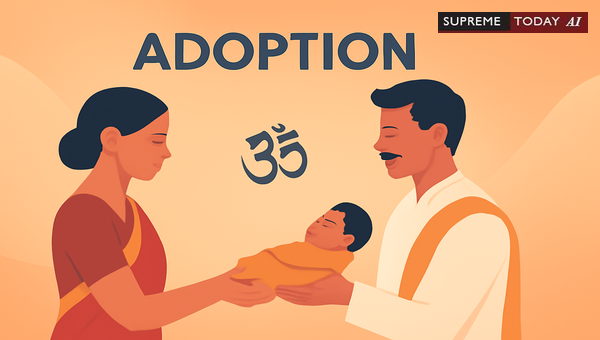
Proof of Giving & Taking: Mandatory for Valid Hindu Adoption
Adoption under Hindu law can be a deeply personal and legally complex process. Imagine a family dispute where one party claims adoption based on long-term upbringing, only for the Supreme Court to rule that without concrete proof of a key ceremony, the adoption stands unproven. This exact scenario unfolded in : M Vanaja vs. M Sarla Devi (Dead), a landmark judgment by the ().2023 0 Supreme(Raj) 331
If you're navigating adoption claims, inheritance battles, or family law matters, understanding this ruling is crucial. This post breaks down the decision, its legal principles, and broader implications, drawing from the judgment and related cases. Note: This is general information, not specific legal advice—consult a qualified lawyer for your situation.
The Core Question: What Did the Supreme Court Decide in CA No. 8814 of 2010?
The case centered on CA.No.8814 of 2010 passed by . M Vanaja vs. M Sarla Devi (dead). The appellant sought a declaration of adoption, but lacked proof of the essential ceremony. The reaffirmed that under the (), strict compliance with —especially —is mandatory for a valid adoption. Without evidence of the actual of the child, no adoption can be presumed or declared valid based solely on circumstantial evidence or upbringing.2023 0 Supreme(Raj) 331
Main Legal Finding
The Court held: Proof of the ceremony of actual in adoption is a mandatory requirement; mere treatment or upbringing is insufficient.2023 0 Supreme(Raj) 331 This upholds , which requires the child to be actually given and taken in adoption by the parents or guardian... with intent to transfer the child from the family of its birth.
Key Points from the Judgment
- Mandatory Conditions: of are non-negotiable. No valid adoption without compliance.2023 0 Supreme(Raj) 331
- Ceremony Proof Essential: Admission of no proof by the appellant doomed the claim. Shaky evidence on record was rejected.2023 0 Supreme(Raj) 331
- No Presumption Post-1956: Unlike pre- cases, post-Act adoptions demand direct proof—no reliance on long treatment alone.2023 0 Supreme(Raj) 331
- Relief Denied: Courts cannot grant declarations based on presumption; remains unproved without ceremony evidence.2023 0 Supreme(Raj) 331
Detailed Analysis: Legal Principles Established
Strict Compliance with
The emphasized: Compliance of the conditions in is mandatory for an adoption to be treated as valid.2023 0 Supreme(Raj) 331 In this case, the appellant failed to plead or prove the ceremony, leading to dismissal.
Distinguishing Pre-Act Cases
The Court differentiated older rulings like , where long-term upbringing could infer adoption pre-1956. Post-, the law explicitly requires proof of the ceremony of .2023 0 Supreme(Raj) 331 This clarifies that statutory mandates override customary evidence.
Implications in the Case
Evidence was shaky and insufficient, with no ceremony proof. The refused recognition, underscoring: The mandate of the 1956 Act is that no adoption shall be valid unless... in compliance with the conditions mentioned in Chapter I.2023 0 Supreme(Raj) 331
Related Cases and Broader Context
This ruling echoes across Indian jurisprudence, reinforcing adoption proof in disputes.
- In and others, courts cited M Vanaja to stress parental consent and procedural compliance. Registration alone doesn't validate without adherence.
2023 0 Supreme(All) 2571
- A referenced it: Counsel for respondents have placed reliance on... M. Vanaja v. M. Sarla Devi (Dead), , decided on . Upholding rejection of invalid lacking consent.
- In motor accident claims, adoption must be proven under similar acts: The court discussed the entitlement of the claimant as the adopted son... necessity of proving adoption in compliance with... . Matter remanded for proof.2022 0 Supreme(J&K) 387
- Another instance: **In the judgment passed by the Supreme Court in Civil Appeal No. 8814/2010 titled M.Vanaja vs... it has been held that... in adoption validity challenges.
- Contrasting case: Where plaintiff failed to disprove adoption, upholding deeds—highlighting .2025 0 Supreme(Raj) 1344
These citations show M Vanaja's influence: From inheritance (equal rights absent valid adoption) to claims tribunals demanding proof.
M. VANAJA vs M. SARLA DEVI (DEAD) THROUGH LRS.
Exceptions and Limitations
- Ancient Adoptions: Circumstantial evidence may suffice pre-1956, but not post-Act.2023 0 Supreme(Raj) 331
- Upbringing Alone Insufficient: Mere treatment or upbringing of a child... does not constitute proof unless accompanied by the actual ceremony.2023 0 Supreme(Raj) 331
Practical Recommendations
- For Claimants: Document the giving-taking ceremony rigorously—witnesses, photos, affidavits. Plead it explicitly in court.
- For Courts: Demand admissible evidence; reject presumptions post-.
- Family Planning: Register adoptions promptly under relevant laws to avoid disputes.
Conclusion and Key Takeaways
The in M Vanaja vs M Sarla Devi delivers a clear message: Proof of the actual ceremony is indispensable for valid adoption under 1956. Without it, claims falter, protecting legal certainty in family matters. This ruling guides modern adoptions, distinguishing from outdated customs.
Key Takeaways:- Prioritize statutory compliance over tradition.- Gather direct evidence early.- Challenge weak claims confidently, citing this precedent.
Stay informed on evolving family law—recent cases continue to cite this for rigor in adoption proofs. For personalized guidance, seek professional legal counsel.2023 0 Supreme(Raj) 331
#HinduAdoptionAct #ValidAdoption #SupremeCourtRuling












