




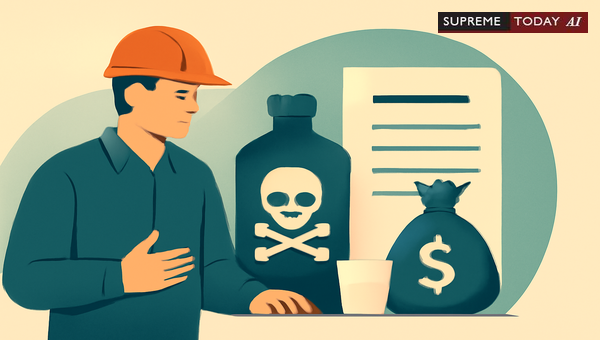
on Poisoning Death Under Employees’ Compensation Act 1923
In the realm of workplace safety and employee welfare, few issues are as poignant as claims for compensation following a fatal accident. A common query from dependents arises: Under the Employees Compensation Act, give me judgement where death due to eating poisonous substance. This question highlights a critical intersection of and legal protections under the (formerly known as the ).
While no single judgment explicitly details a case of death from eating a poisonous substance, the Court's jurisprudence firmly establishes principles that cover such incidents as accidents '.' This post delves into these principles, key cases, and practical insights to help understand when dependents may claim compensation.
Overview of the
The , is a cornerstone of social welfare legislation in India, designed to provide financial relief to workers or their dependents in cases of injury or death due to employment-related accidents. As noted in various rulings, , 1923 is a social welfare legislation and it must be given a – Matters thereunder are to be adjudicated with due process of law and also with a keen.... 2023 6 Supreme 284
is pivotal: it imposes liability on employers for compensation when a personal injury (including death) results from an accident . The Act has evolved, with 'workmen' rechristened as 'employees' via amendments, ensuring broader coverage. 2023 6 Supreme 284
Principles on Poisoning as a Work Accident
The has consistently held that death from poisoning, particularly accidental ingestion during employment, qualifies as a compensable accident. The main legal finding is clear: The has recognized cases where death occurred due to ingestion of poisonous substances as arising out of employment, thereby entitling the dependents to claim compensation under the .
In key documents, the Court clarified: The Court recognized death due to poisonous substance ingestion during employment as an accident under the Employees’ Compensation Act. 2016 8 Supreme 661 Furthermore, The Court acknowledged that death caused by , including poisoning, falls within the scope of the Act, supporting the entitlement of dependents to compensation. 2002 7 Supreme 172
This aligns with the Act's benevolent intent: to provide social security for work-related fatalities, even from seemingly unusual causes like accidental poisoning. The distinction lies in proving the accident was not intentional (e.g., suicide) but linked to employment duties.
Recognition of Accidental Ingestion
Courts emphasize that poisoning can be 'accidental' if it occurs during work hours or due to occupational exposure. For instance, if an employee ingests a poisonous substance mistaken for food or drink at the workplace, it may arise 'out of employment.' The Court has stressed: death caused by poisoning, even if resulting from ingestion of poisonous substances, can be considered an accident .
This principle extends to broader , as seen in cases involving assaults or natural causes where a causal link exists. In one ruling, The death of Ajay is an ‘accident’ for the purpose of compensation under the Employees’ Compensation Act. The deceased was working for the appellant... at the time of accident and the accident arose out of and during the course of employment. 2018 0 Supreme(Del) 2347
Supporting and Precedent Cases
While awaiting a pinpoint case on ingestion, lower courts applying principles have affirmed coverage:
- AIR 1957 MAD 216 (Subbaiah S. Chetty v. Chinnathorai): Held that the Act is social welfare legislation to be interpreted beneficially, implying poisoning deaths during employment are covered.
- AIR 1966 Maharashtra 220 (Ibrahim v. Mackenzie and Co.): Recognized , including poisoning, within the Act's scope.
These align with views on 'accidents,' such as in lightning strikes or assaults, where exposure due to work creates liability. For example, in a lightning case, courts required proving '' with employment, a test applicable to poisoning: The nature of the work exposed the deceased to the hazard of lightning, establishing a . 2007 0 Supreme(Chh) 467
Recent cases reinforce this. In a contractor-employee death by assault, the principal employer was held liable under , deeming it an 'accident.' 2018 0 Supreme(Del) 2347 Similarly, malaria from work exposure was scrutinized for linkage, but pure illness without injury nexus was denied: Death due to illness cannot be termed as an accidental death due to injury. 2012 0 Supreme(Gau) 1331
Exceptions and Limitations
Not all poisoning deaths qualify:- Intentional acts or suicide: Excluded, as they do not 'arise out of employment.'- No employment nexus: If ingestion occurs outside work hours or premises without connection.- Pre-existing conditions: Illness unconnected to duties, like unrelated ailments, fails the test. 2012 0 Supreme(Gau) 1331
Appeals under are limited to ',' not re-appreciating facts. Commissioner is last authority on facts involved in a case – Conclusions arrived at by Commissioner, were a possible view. 2023 6 Supreme 284
Evidence and Practical Recommendations for Claimants
To succeed:- Prove accident and nexus: Gather medical reports, toxicology, witness statements showing ingestion during employment.- Wages and dependency: Use employer records; courts accept oaths and statements. 2024 0 Supreme(Pat) 558- Timely filing: Notify employer promptly; interest (up to 12%) and penalties apply for delays. 2024 0 Supreme(Pat) 558
In one case, compensation was awarded with 12% interest, modifiable on appeal, emphasizing evidence like payroll. Employers/insurers must contest actively, or presumptions apply. 2024 0 Supreme(Pat) 558
Dependents should consult the , as claims under this Act may preclude routes if the deceased qualifies as an 'employee.' 2012 0 Supreme(Chh) 78
Conclusion and Key Takeaways
The ’s principles under the Employees’ Compensation Act affirm that accidental death from poisonous substances during employment typically entitles dependents to compensation, viewing the Act as protective social legislation. While specific ingestion cases build on precedents, the causal link test from rulings governs.
Key Takeaways:- Establish accident 'out of and in course of employment' with evidence.- Leverage the Act’s beneficial interpretation for occupational poisoning.- Exceptions apply for non-accidental or unconnected causes.
This post provides general information based on legal precedents and is not specific legal advice. Consult a qualified lawyer for your situation, as outcomes depend on facts.
For more on workplace claims, explore related judgments on assaults, diseases, or hazards. Stay informed on employee rights!
#EmployeesCompensationAct #SupremeCourtJudgments #WorkInjuryClaims












