


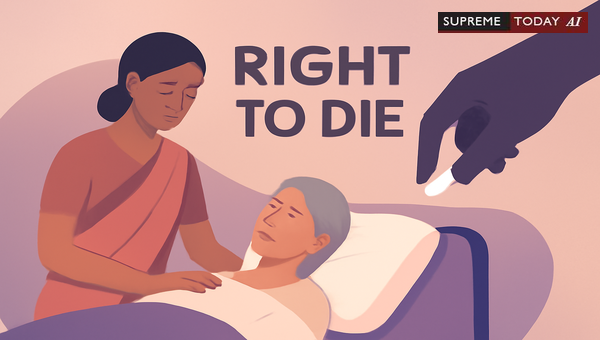
Is Right to Die Legal in India? Verdict
In an era where debates on , , and end-of-life choices dominate global discussions, many in India wonder: Whether Right to Die is Legal in India? The concept of the right to die—often linked to euthanasia—raises profound questions about the balance between individual dignity and the sanctity of life under the Indian Constitution. While the right to life is enshrined in Article 21, does it extend to a right to end it? This blog post delves into judgments, distinctions between active and , and the evolving interpretation of dignity, providing a comprehensive overview. Note: This is general information and not specific legal advice; consult a qualified lawyer for personal matters.
Understanding Article 21: Right to Life vs. Right to Die
guarantees the right to life and personal liberty, which the judiciary has expansively interpreted to include the 2023 0 Supreme(SC) 1046. However, the has consistently held that this does not encompass a fundamental right to die. In the landmark , a Constitution Bench clarified: the right to life under Article 21 does not include the right to die 2023 0 Supreme(SC) 1046. Suicide was deemed an unnatural termination of life incompatible with the right to life.
Yet, the Court nuanced this by recognizing that the may extend to the in limited scenarios—specifically, when death is natural, certain, and imminent 2023 0 Supreme(SC) 1046. As quoted: This may include the right of a dying man to also die with dignity when his life is ebbing out. But the ‘right to die’ with dignity at the end of life is not to be confused or equated with the ‘right to die’ an unnatural death curtailing the natural span of life 2023 0 Supreme(SC) 1046.
This distinction underscores that while active termination is off-limits, allowing a natural death to proceed aligns with dignity.
vs. : The Legal Divide
The draws a sharp line between active and :
- (e.g., administering lethal injections) remains illegal and cannot be judicially permitted 2023 0 Supreme(SC) 1046.
- (withholding or withdrawing life support for terminally ill patients where death is imminent) is allowable under strict guidelines2023 0 Supreme(SC) 1046.
The case was pivotal, upholding with procedural safeguards, such as court approval and medical board verification 2023 0 Supreme(SC) 1046. Later, in , the Court advanced this by recognizing the as an inseparable and inextricable facet of the right to life with dignity, particularly for those in a 2020 0 Supreme(Cal) 672.
These rulings emphasize that euthanasia requires legislation for broader legalization; courts provide interim guidelines but defer to 2023 0 Supreme(SC) 1046.
The Broader Canvas of Dignity Under Article 21
Dignity forms the core of Article 21, uniting fundamental rights 2021 Supreme(Online)(All) 188. The has repeatedly affirmed: Dignity is the core which unites the fundamental rights because the fundamental rights seek to achieve for each individual the dignity of existence 2021 Supreme(Online)(All) 188. This principle permeates diverse contexts:
- Reproductive autonomy: Women have a under Article 21 to terminate pregnancies in cases like rape, as it preserves dignity and 2025 0 Supreme(MP) 348 2023 0 Supreme(All) 2074. For instance, the right to dignity encapsulates the right of every individual to be treated as a self-governing entity having intrinsic value 2025 0 Supreme(MP) 348.
- Gender identity: Recognition of one's gender, including transgender as ',' lies at the heart of dignity 2021 0 Supreme(Bom) 12. Recognition of one’s gender identity lies at the heart of the to dignity 2021 0 Supreme(Bom) 12.
- Social justice: In caste atrocity cases, the right to live (and die) with dignity protects marginalized communities, with compensation for violations under Article 21 2020 0 Supreme(Bom) 459 2020 2 Supreme 291. There is and also 2020 2 Supreme 291.
- End-of-life rites: Even for the deceased, Article 21 extends dignity to mortal remains, as seen in COVID-19 disposal guidelines ensuring last rites 2020 0 Supreme(Cal) 672.
These cases illustrate how dignity evolves, indirectly bolstering arguments for compassionate end-of-life options without endorsing .
Key Cases: Milestones in the Debate
Here's a summary of pivotal judgments:
- : Right to die not part of Article 21; dignity limited to natural death 2023 0 Supreme(SC) 1046.
- : permitted with safeguards; active remains unlawful 2023 0 Supreme(SC) 1046.
- : Advanced living wills and right to refuse treatment, framing die-with-dignity as intrinsic to life 2020 0 Supreme(Cal) 672.
| Case | Key Holding | Implication ||------|-------------|-------------|| Gian Kaur 2023 0 Supreme(SC) 1046 | No right to die | Suicide decriminalized but not a right || Aruna Shanbaug 2023 0 Supreme(SC) 1046 | Passive OK, active no | Guidelines for withdrawal of support || Common Cause 2020 0 Supreme(Cal) 672 | Die with dignity facet of Article 21 | recognized |
Exceptions, Limitations, and the Path Forward
The is not absolute:- Limited to natural, imminent death where natural processes have begun 2023 0 Supreme(SC) 1046.- No judicial sanction for ; needs legislation2023 0 Supreme(SC) 1046.- Procedural hurdles: Medical boards, approval for passive cases.
Recommendations from judicial observations include:- Enacting laws for with safeguards.- Judiciary upholding refusal of extraordinary treatment as part of dignity, sans active measures 2023 0 Supreme(SC) 1046.
Recent contexts, like intersex rights and atrocity protections, reinforce dignity's primacy, potentially influencing future euthanasia reforms
SMT. PREMLATA PATHAK Vs DHARMENDRA VERMA
2020 0 Supreme(Bom) 593.Conclusion: Navigating Dignity and Life
In India, the right to die is not legal as a , but the finds tentative recognition in for terminal cases 2023 0 Supreme(SC) 1046. This reflects a cautious judiciary balancing life's sanctity with compassionate autonomy. As debates continue—fueled by global trends and domestic dignity jurisprudence—legislative action remains crucial.
Key Takeaways:- : Illegal.- : Permissible under guidelines.- Dignity under Article 21: Expansive, but bounded.
Stay informed on evolving laws. For personalized guidance, seek professional legal counsel.
#RightToDieIndia, #EuthanasiaLaw, #Article21















