


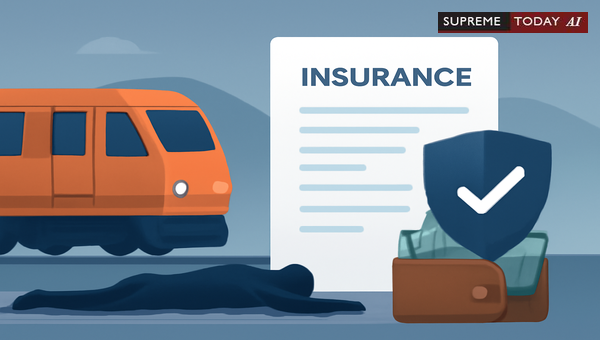
Train Death: Insurance Rejecting as ? Know Your Rights
Imagine losing a loved one in a tragic train accident, only for the insurance company to deny your personal accident claim, labeling it a '.' This is a common scenario where families face rejection despite evidence pointing to an accident. If you've filed—or are considering—a , understanding key legal points under the , can strengthen your case.
In this post, we explore: What constitutes an ''?Can trespass or criminal intent bar claims?How courts have ruled on similar cases. We'll draw from judicial precedents and statutes to provide clarity, while noting this is general information—not specific legal advice. Consult a lawyer for your situation.
The Core Issue: Accident or ?
A frequent question arises: Insured Person Died in Train Accident. Insurance Reject Complaint on the Ground that it is Case. We File . Need Law Points on it.
Insurers often reject claims citing , trespass, or breach of railway rules. However, courts have clarified that death from a train accident—even if the deceased was trespassing or acted with criminal intent—may qualify as an under of the . This entitles claimants to consideration under , barring explicit exclusions like proven .
Prithvi Singh vs Union of India - Delhi ()
The primary test? Was the death caused by an accident involving the train? Not the victim's legal status on railway property. 2022 0 Supreme(Del) 2139
Defining '' under
defines broadly, including the accidental falling of any passenger from a train carrying passengers and other acts like violence or robbery on premises. Courts extend this to deaths from being hit by a train in accidents, regardless of the victim's authorization or intent.
Prithvi Singh vs Union of India - Delhi ()
For instance, in cases where victims fell due to overcrowding, tribunals have ruled it an despite cryptic initial reports. One judgment noted: Reasons assigned to negative finding to issue of are cryptic, in sense, a short paragraph appears to have been extracted from ADRM’s report... observations are indeed cryptic and perverse. 2023 0 Supreme(Bom) 1302
This broad scope ensures compensation isn't denied lightly. under applies—no need to prove railway negligence. 2020 0 Supreme(Del) 170
Judicial Precedents: Trespassers and Criminal Intent Don't Automatically Bar Claims
Courts consistently protect claimants:
- Trespass or no ticket? Still compensable. In a case of unauthorized travel, death by train collision was held an . Liability persists unless is proven. 2010 0 Supreme(SC) 792
- Improper crossing? ruled that crossing tracks at non-designated spots doesn't negate status. Claims can't be dismissed solely on trespass. 2022 0 Supreme(Del) 2139
- Bona fide passenger burden on railways. Once an accident occurs (e.g., fall from train), railways must prove it wasn't untoward or due to passenger negligence. It is settled law that once an accident took place with the passenger while travelling in a train due to fall from the train or otherwise, Railway has to prove the incident as to whether the incident was due to negligence on the part of passenger. 2018 0 Supreme(Jhk) 160
In , favor claimants if evidence supports accident over . won't re-appreciate evidence: Where two interpretations of evidence are possible, based on evidence have to be accepted.
New India Assurance Co. Ltd. VS State Bank of India
Exceptions: When Claims May Be Rejected
Not all cases succeed. Key exclusions:
- Proven or self-inflicted injury: If conclusively established, rejection holds. 2010 0 Supreme(SC) 792
- Intoxication or insanity: Explicitly barred. 2010 0 Supreme(SC) 792
- Not involving train directly: E.g., falling on tracks before boarding isn't always untoward. 2016 0 Supreme(All) 3617
Mere breach of rules (e.g., overcrowding fall) doesn't qualify as exclusion. 2023 0 Supreme(Bom) 1302
Jurisdiction Note: For railway compensation, approach (RCT), not (MACT). MACT lacks jurisdiction over railways: lacks jurisdiction over compensation claims against Railways. 2025 0 Supreme(Gau) 842
But for insurance disputes (personal accident policy), are apt, especially if is alleged.
Building Your : Key Law Points
When filing under :
- Argue : Cite & 124A. Death by train hit = accident, not presumption.
Prithvi Singh vs Union of India - Delhi ()
- Shift Burden: Insurer/railways must prove —claimants needn't disprove it upfront. 2018 0 Supreme(Jhk) 160
- Precedents as Ammo: Reference cases like Gyasu for trespass irrelevance. 2022 0 Supreme(Del) 2139
- Evidence Focus: Post-mortem, eyewitnesses, FIR. Avoid dependency proof pitfalls. 2023 0 Supreme(Bom) 1302
- Policy Terms: Group often cover borrowers/insurants broadly.
New India Assurance Co. Ltd. VS State Bank of India
Courts award compensation (e.g., Rs. 4-8 lakhs + interest) if proven. 2020 0 Supreme(Del) 170 2018 0 Supreme(Jhk) 160
Practical Recommendations
- Gather Documents: Death certificate, policy, FIR, inquest report.
- Challenge Rejection: Demand reasons; if vague, it's perverse. 2023 0 Supreme(Bom) 1302
- Seek Enhanced Compensation: Post- rules boost amounts. 2018 0 Supreme(Jhk) 160
- Avoid Wrong Forum: RCT for railways; consumer court for insurer deficiency.
Conclusion: Don't Let Insurers Off the Hook Easily
Generally, train accident deaths qualify as untoward incidents under , entitling personal accident claims—trespass or alleged criminal intent notwithstanding, unless is irrefutably proven. Courts emphasize accident causation over victim fault. 2010 0 Supreme(SC) 792 2022 0 Supreme(Del) 2139
Key Takeaways:- Focus on 'train involvement' for untoward status.- Railways/insurers bear proof burden for exclusions.- Consumer complaints succeed with strong precedents.
This framework has helped many families. For tailored advice, contact a legal expert. Stay informed, claim your rights.
References:- 2010 0 Supreme(SC) 792: Trespass/criminal intent doesn't exclude .- 2022 0 Supreme(Del) 2139: Claims not dismissed solely on trespass.-
Prithvi Singh vs Union of India - Delhi ()
: Broad definition of .- Additional insights from 2023 0 Supreme(Bom) 1302, 2018 0 Supreme(Jhk) 160,New India Assurance Co. Ltd. VS State Bank of India
, etc. #TrainAccidentClaim, #RailwaysAct, #InsuranceDispute















