




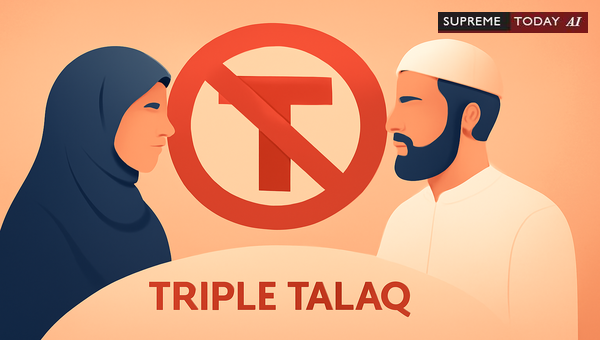
in India: and Criminalized – A Complete Legal Guide
In the evolving landscape of Indian family law, few issues have sparked as much debate as , also known as or Tripal Talak. This practice, once prevalent in certain Muslim communities, allowed a husband to pronounce 'talaq' three times instantly, dissolving the marriage without recourse. But is legal today? The short answer is no – it has been declared by the and criminalized by statute. This blog provides a legal analysis of Tripal Talak in India, drawing from landmark judgments and legislation to clarify its status, valid alternatives, and protections for women.
Note: This article offers general information based on established legal precedents and is not a substitute for professional legal advice. Consult a qualified lawyer for personalized guidance.
Historical Context of
Historically, was recognized under as a form of divorce, though considered sinful by some scholars. It involved pronouncing 'talaq' thrice in one sitting or over a short period, resulting in 2021 0 Supreme(Ker) 704. While effective under this school, other sects like Shia and Maliki did not recognize it as valid 2007 0 Supreme(Del) 2240.
This practice persisted in India despite its controversial nature, often leaving women vulnerable without maintenance or reconciliation opportunities. Courts have long scrutinized unsubstantiated claims of talaq, such as those merely in written statements without proper communication to the wife
. For instance, one ruling noted the absence of proof of talak, deprecating such pleas
.
Landmark Verdict:
The turning point came in with the 's decision in . A five-judge bench declared , illegal, and invalid, violating 2024 0 Supreme(Guj) 2230. The majority opinion described it as '' and 'antiquated', allowing unilateral dissolution without reconciliation, causing extreme hardship to women 2024 0 Supreme(Guj) 2230.
The Court emphasized that the practice is 'bad in theology, arbitrary, and ', incompatible with modern constitutional principles 2024 0 Supreme(Guj) 2230. This ruling set aside prior petitions relying on for divorce, as echoed in subsequent cases like one from the referencing
S.W.AABITH BASHA vs ZEENATHUNNISA - Supreme(Online)(MAD) 47961 - Supreme(Online)(MAD) 47961
.The
To enforce the verdict, enacted the . Section 3 explicitly states that any pronouncement of talaq – spoken, written, or electronic – with the effect of () is ''2022 0 Supreme(Ker) 396. This criminalizes the practice, making it punishable, and protects Muslim women's rights.
The Act aligns statutory law with constitutional mandates, ensuring holds no legal weight. High Courts have reinforced this; for example, in proceedings involving allegations of pronouncing , courts have declined to recognize it without further evidence
.
Valid Forms of Talaq Under Muslim Personal Law
Not all talaq forms are banned. The law recognizes and as lawful, provided they follow prescribed procedures 2025 0 Supreme(Raj) 1518.
- : The most approved form, involving a single pronouncement followed by a waiting period (iddat) for reconciliation.
- : Three pronouncements over three successive months (tuhr periods), with reconciliation attempts each time 2025 0 Supreme(Raj) 1518.
These differ from 's instant irrevocability. Other sources confirm (Ahsan and Hasan) as valid if executed properly, while talaq-ul-biddat is irregular and now criminalized 2021 Supreme(Online)(Ker) 59391 2021 Supreme(Online)(KER) 25466. Courts stress procedural adherence, rejecting mere oral or ex parte declarations S.W.AABITH BASHA vs ZEENATHUNNISA - Madras.
Legal Principles and Constitutional Safeguards
The rulings underscore that practices enabling unilateral and instant dissolution are arbitrary and unreasoned, clashing with equality and non-arbitrariness 2024 0 Supreme(Guj) 2230. Talaq must be substantiated with evidence and proper communication; unsubstantiated claims, like those in court filings without delivery to the wife, are invalid
.
In cases involving cruelty or other allegations alongside talaq claims, courts prioritize evidence and legal remedies for women
. The framework balances religious practices with constitutional rights, as seen in petitions like Akbari Talak, where broader transparency principles are invoked 2024 Supreme(Online)(Pat) 1950.
Exceptions, Limitations, and Courtroom Applications
- Valid and remain lawful with procedural compliance.
- The Act targets only instant ; other talaq forms are unaffected if proper.
- Pronouncements via electronic means (e.g., WhatsApp) are void if instant 2022 0 Supreme(Ker) 396.
Courts have deprecated talaq pleas without proof, ensuring women's legal representation and remedies 2021 Supreme(Online)(Ker) 59391. In one instance, despite talak allegations, proceedings continued due to lack of substantiation
.
Key Takeaways and Recommendations
- is prohibited: per 2024 0 Supreme(Guj) 2230 and criminal under Act 2022 0 Supreme(Ker) 396.
- Opt for valid alternatives: Use or Hasan for legitimacy 2025 0 Supreme(Raj) 1518.
- Seek reconciliation: Mandatory waiting periods protect families.
- Awareness is key: Educate on women's rights; unsubstantiated talaq claims fail in court
.
Muslim communities should adhere to lawful procedures, while legal practitioners must inform clients of these changes 2021 0 Supreme(Ker) 704. Ongoing judicial developments, like those in and Patna High Courts, reinforce this shift toward gender justice.
Conclusion
India's legal evolution on reflects a commitment to equality, rendering Tripal Talak a relic of the past. From Shayara Bano's bold challenge to the Act's enforcement, the focus is on protecting vulnerable women while respecting valid traditions. Stay informed, as family laws continue to adapt – but always consult experts for your situation.
References:1. judgment on unconstitutionality 2024 0 Supreme(Guj) 2230.2. Background on Talaq forms 2021 0 Supreme(Ker) 704.3. Muslim Women Act, 2022 0 Supreme(Ker) 396.4. Valid Talaq procedures 2025 0 Supreme(Raj) 1518.
#TripleTalaq #ShayaraBano #MuslimWomenRights















