



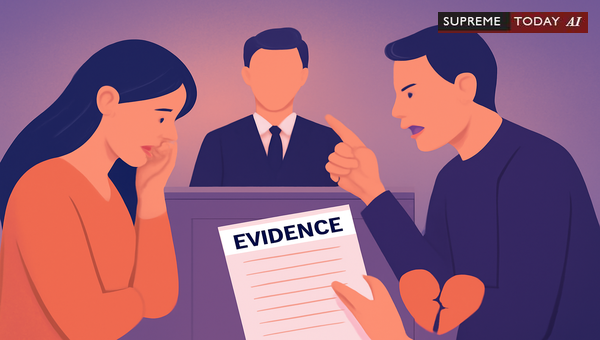
Unexamined Witnesses in Divorce Claims
In the emotionally charged arena of family law, claims of often form the cornerstone of under the . But what happens when a wife alleges by her husband, relying on witnesses like a neighborhood vegetable vendor or a working maid—only for those witnesses to refuse to appear in court? This scenario raises critical questions about and the robustness of matrimonial claims. This post delves into the legal ramifications, drawing from judicial precedents to explain why such unexamined testimonies typically fall short.
The Core Legal Question
Consider this common yet pivotal query: Wife claiming inflicted by husband and witness thereof are vegetable vendor and working maid but they will not come to court to depose consequence thereof.
At its heart, this involves proving —a ground for divorce under . encompasses conduct that causes grave mental suffering, but courts demand concrete, credible evidence. or unverified statements from peripheral witnesses rarely suffice.
Main Legal Finding: Credibility Through Court Examination
Courts consistently hold that evidence to establish must be credible, relevant, and admissible. Witnesses like vegetable vendors or maids, if not examined in court, cannot substantiate the claim. Their absence deprives the opposing party of , undermining the testimony's .
Key points include:- Witnesses must be examined in court for credible testimony on alleged cruelty 2015 0 Supreme(Cal) 184.- Unappearing witnesses, such as vendors or maids, cannot prove 2015 0 Supreme(Cal) 184.- Allegations based on unexamined witnesses lack legal admissibility 2000 0 Supreme(Cal) 289.
As one judgment clarifies: The letters written by the minor daughters to the respondent have been admitted into evidence, but the minor daughters have not come to the witness box to face the and as such the appellant/wife is deprived of the opportunity to elicit information from the minor daughters... 2015 0 Supreme(Cal) 184. This principle extends directly to everyday witnesses like vendors or domestic help.
Detailed Analysis: Why Court Examination is Essential
Requirement of Examination and
Indian courts prioritize subjected to to gauge truthfulness. Unexamined witnesses' statements are often treated as , carrying little weight. In cruelty cases, where intent and context matter, this scrutiny is vital.
For instance: Even assuming for argument’s sake that the minor daughters who were in the custody of the appellant/mother at the relevant point of time were subjected to ill-treatment by the appellant being the working mother, the same can by no stretch of imagination be construed as cruelty of the appellant/wife towards the respondent/husband. 2015 0 Supreme(Cal) 184. Similarly, a vendor's or maid's unverified account of quarrels cannot equate to proven .
of Peripheral Witnesses
Witnesses from daily life, like vegetable vendors or maids, may observe interactions but their reluctance to testify signals unreliability or lack of substance. Courts view this as a failure to meet the . The judgment in 2000 0 Supreme(Cal) 289 reinforces: The minor daughters who had written the letters have not come to the witness box to face the and as such the appellant/wife is deprived of the opportunity to elicit information... 2000 0 Supreme(Cal) 289.
Insights from Related Case Law
Broader jurisprudence on cruelty claims underscores the need for robust evidence. In
, the court dismissed unsubstantiated allegations of adultery and cruelty, noting: Only two of the allegations in the petition of the husband deserve consideration. One, the wife propagated that the husband had illicit relationship with a maid aged 15 years and made the maid pregnant. Lack of proof led to rejection, highlighting that even maid-related claims require direct evidence.
Similarly, in 2023 0 Supreme(Cal) 1459, the wife failed to prove cruelty due to insufficient evidence: On the other hand, the husband adduced evidence as first witness and also brought a neighbour as second witness in support of his contention that there was no occasion to perpetrate mental or physical cruelty upon the wife/appellant. 2023 0 Supreme(Cal) 1459. This contrasts sharply with unproduced witnesses, emphasizing examined testimony's role.
False or exaggerated claims can boomerang. Multiple cases illustrate how unsubstantiated complaints cause cruelty to the other spouse. For example: By sending this complaint the respondent-wife has caused to the appellant-husband. It is well settled that such statements cause .
2019 0 Supreme(Del) 1539 2019 0 Supreme(Mad) 1400. In 2017 0 Supreme(Mad) 2093, a wife's false was deemed , leading to divorce for the husband.
In
, references to a maid accompanying the couple underscored the need for witnesses to depose about alleged cruelty, aligning with the core principle.
These precedents show courts demand concrete proof—documents, direct parties' testimony, or examined witnesses—over peripheral, untested accounts.
Exceptions and Limitations
While strict, exceptions exist:- Examined and cross-examined witnesses are credible.- from unproduced witnesses generally fails.- Documentary evidence or party admissions may sometimes suffice, but not unexamined third-party statements.
In 2017 0 Supreme(Mad) 3599, separation satisfying allowed divorce, but cruelty still needed evidence: It is well settled that such statements cause .
Practical Recommendations
To strengthen claims:- Produce willing, relevant witnesses for court examination.- Avoid sole reliance on from vendors or maids.- Corroborate with documents, medical records, or party testimony.- Consult a family lawyer early to build a solid case.
Remember, this is general information; outcomes vary by facts and jurisdiction. Seek professional legal advice for your situation.
Conclusion and Key Takeaways
Unexamined witnesses like vegetable vendors or working maids cannot reliably prove in divorce proceedings. Courts prioritize examined testimony to ensure fairness and truth 2015 0 Supreme(Cal) 184 2000 0 Supreme(Cal) 289. Relying on them risks claim dismissal, as seen in various judgments emphasizing evidence standards.
Key Takeaways:- is crucial for credibility.- Peripheral witnesses without testimony lack .- Build cases on examined evidence to succeed.- False claims can constitute cruelty against the accuser.
Understanding these nuances empowers informed decisions in matrimonial disputes. For personalized guidance, consult a qualified attorney.
#MentalCruelty #DivorceLaw #FamilyCourt










