


Union Government's on Subjects: A Constitutional Guide
In India's , the division of between the Union (central) government and state governments is a cornerstone of governance. A common question arises: – does it exemplify Union authority encroaching on state domains, or is it firmly within constitutional bounds? While the , primarily deals with registration and rights of trade unions (a subject), understanding broader is crucial, especially when Union laws touch state matters. This post demystifies the Union Government's powers over subjects, drawing from and 246 of the Constitution, judicial precedents, and key exceptions. Note: This is general information and not specific legal advice; consult a qualified lawyer for your situation.
Overview of India's Legislative Framework
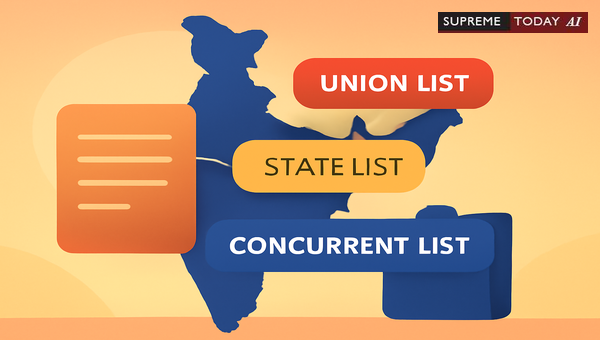
The Constitution of India, through and 246, clearly delineates legislative authority via the 's three lists: (List I), (List II), and (List III). Parliament holds over matters, such as defense and foreign affairs. State legislatures typically control items like public health and agriculture. Concurrent subjects, including trade unions (), allow both to legislate, with Union laws prevailing in conflicts. 2019 0 Supreme(Gau) 951 2019 0 Supreme(SC) 1343
As outlined: - (List I): Parliament legislates exclusively. 2019 0 Supreme(Gau) 951 2019 0 Supreme(SC) 1343- (List II): States have primary authority, subject to Union and Concurrent overrides. 2004 0 Supreme(AP) 87 2004 0 Supreme(Ker) 167- (List III): Shared powers, Union prevails on . 2004 1 Supreme 285 2019 0 Supreme(Gau) 951
This framework ensures federal balance but raises queries on Union overreach, particularly for acts like the Trade Union Act that regulate labor – a concurrent domain.
Can the Union Government Legislate on Subjects?
Generally, no – the Union cannot enact laws on explicitly enumerated matters for states. These are reserved for state legislatures. 2019 0 Supreme(SC) 1343 2022 0 Supreme(J&K) 105
Parliament's reach is limited: Parliament has to legislate on matters enumerated in the . 2019 0 Supreme(Gau) 951 2019 0 Supreme(SC) 1343. States hold sway over List II: State Legislatures have to make laws on matters enumerated in the , subject to the provisions of the and . 2004 0 Supreme(AP) 87 2004 0 Supreme(Ker) 167.
However, nuances exist:- Union Territories: The Union can legislate on matters for Union Territories (UTs), as they aren't 'states' under Article 246. 2022 0 Supreme(Ori) 466 2013 0 Supreme(Gau) 634.- : Parliament legislates for non-state territories on . 2023 0 Supreme(SC) 21 2021 0 Supreme(UK) 141.
In cases on Concurrent matters, Union law trumps: if there is a conflict, the law made by Parliament prevails. 2004 1 Supreme 285 2019 0 Supreme(Gau) 951 2015 0 Supreme(All) 1328.
Key Exceptions and Judicial Insights
Exceptions highlight Union's expanded role:- (): Covers any other matter not enumerated in List II or List III including any tax not mentioned in List II and List III. Parliament used this for Fringe Benefit Tax (FBT) under , upheld as constitutional. 2019 0 Supreme(Kar) 1378. The court affirmed: The Parliament has the to enact laws under Entry 97 of the . 2019 0 Supreme(Kar) 1378- National Capital Territory of Delhi (NCTD): Special provisions under . Once Parliament legislates on List II/III, NCTD Assembly loses competence. 2024 5 Supreme 688: (3)(c)) (iv) Once Parliament exercises its legislative power and makes a law on a subject in List II or List III, the Legislative Assembly of NCTD is denuded of its .
Recent cases reinforce distinctions. In Delhi Municipal Corporation matters, the Lt. Governor exercises nomination powers (e.g., Aldermen under ) as a statutory duty, not bound by Council of Ministers' aid under (4). 2024 5 Supreme 688: Lt. Governor is intended to act as per mandate of statute and not to be guided by aid and advice of Council of Ministers.
Taxation examples clarify state competence. ’s cess on cinema tickets was upheld under : The court upheld the constitutionality of the cess levied on cinema tickets, affirming the State's under Entry 62 of List II. 2025 0 Supreme(Ker) 128. Similarly, Parliament can exclusively make laws with respect to any of the matters enumerated in List I-... Subject to the above, the Legislature of any State has ... in List II-the . 2025 0 Supreme(Ker) 128
In healthcare sales tax disputes, courts applied the '' or '': Hospital supplies of medicines/implants are services, not sales, distinguishing from pure trade. 2022 0 Supreme(Raj) 391
Executive powers align: States' trade/business under Union matters must comply with parliamentary laws. 2017 0 Supreme(AP) 112
Relating to
, , prohibits agreements restraining trade union rights – a central law on Concurrent Entry 22 (trade unions). It exemplifies Union's primacy on shared subjects without invading pure domains. Challenges to such laws often fail if within constitutional bounds, mirroring FBT or entertainment tax validations. 2019 0 Supreme(Kar) 1378 2025 0 Supreme(Ker) 128
Practical Implications and Recommendations
For businesses or unions invoking Section 22:- Verify if the matter falls under ; engage state legislatures accordingly.- For UTs like Delhi, Union laws apply directly on State subjects.- In conflicts, Union prevails – plan compliance strategies.
Recommendations:- For any legislative initiative concerning subjects in the , it is advisable to engage with the respective State Legislature.- In cases involving Union Territories, the Union Government may proceed with legislation on matters, ensuring compliance with constitutional provisions.
Conclusion and Key Takeaways
The Union Government typically lacks authority to legislate on for states, preserving federalism. Exceptions for UTs, , and Concurrent supremacy maintain balance. Cases like Delhi nominations, cinema cess, and FBT underscore judicial deference to this scheme. 2024 5 Supreme 688 2025 0 Supreme(Ker) 128 2019 0 Supreme(Kar) 1378
Key Takeaways:- Exclusive Domains: (Parliament only), (states primarily), Concurrent (shared, Union overrides). 2019 0 Supreme(Gau) 951- UT Exception: Full Union power on . 2022 0 Supreme(Ori) 466- Seek Expert Advice: Always review specific facts against .
This framework, since , evolves via amendments and rulings, ensuring . Stay informed on updates!
#IndianConstitution #LegislativePowers #UnionVsState












