


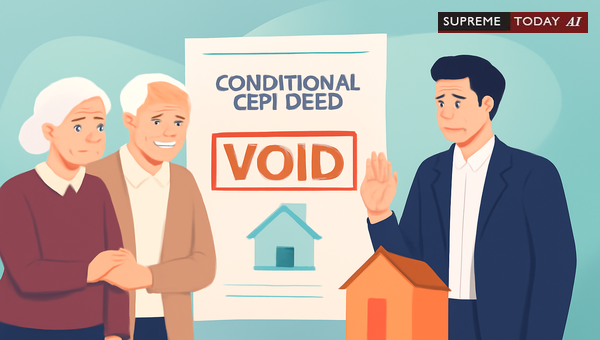
Can Senior Citizens Under ?
In an era where family dynamics are evolving and senior citizens often transfer property to loved ones, what happens when those conditions attached to the gift are ignored? Imagine gifting your home to a child or relative with the understanding they'd care for you, only for them—or even their —to refuse. Can you, as a senior citizen, turn to the law for relief?
This article dives deep into a pressing legal question: of the of a Conditional Gift Refuses to Comply with the Conditions. Can the Senior Citizen Invoke of the and Seek the Gift Deed as ? We'll explore the nuances of of the (the Act), backed by case laws and statutory insights. Note: This is general information, not specific legal advice. Consult a qualified lawyer for your situation.
Understanding : The Protective Shield for Seniors
(1) of the Act is a powerful provision designed to safeguard senior citizens' welfare. It states that where a senior citizen transfers property—whether by gift, sale, or otherwise—subject to the that the shall provide , and the to do so, the transfer can be by the 2025 1 Supreme 130.
Key takeaway: This applies only if the transfer was made with such a . As the emphasized in , the as required under (1) must be in the transfer document 2023 0 Supreme(Raj) 230. Without it, the provision typically doesn't apply.
When Does a '' Exist?
The law requires proof of the —either or in the deed. For instance:- : Clauses like the shall provide and basic amenities.- : Some courts have recognized implications from the deed's language. In one case, the reason mentioned in the settlement deed which is implied would be sufficient to comply with the conditions stipulated under (1) of the Act2025 Supreme(Online)(MAD) 13559 2025 0 Supreme(Mad) 2329.
However, gifts made purely out of without any stipulation generally cannot be challenged. The in Sudesh Chhikara held that when a gift is made out of without any stipulation of , cannot be invoked to annul the gift2024 0 Supreme(Kar) 404.
The Role of 's
The query specifically addresses scenarios where the of the refuse compliance. Here's the analysis:
- If the original breaches the , the senior citizen can seek to the deed. This extends post-transfer, as the transfer can be challenged even after the transfer, especially if the related to and amenities is not fulfilled2024 0 Supreme(Kar) 404 2025 0 Supreme(Mad) 4530.
- Regarding heirs: of the generally do not have the right to contest under if the original has passed away, unless they can demonstrate or other grounds like or 2025 Supreme(Online)(TEL) 4796. The obligation ties back to the original in the deed.
- Importantly, the senior citizen or their can invoke to seek if the refuses to maintain, even if conditions are implied 2025 0 Supreme(Mad) 4530 2025 0 Supreme(Mad) 2776. One source notes: where a senior citizen has transferred his property by way of a gift deed or otherwise, subject to the that the shall provide to the...2025 0 Supreme(Mad) 2475.
Courts have clarified that it is not necessary that to invoke , one has to seek under 2025 0 Supreme(Del) 506. stands alone for voiding transfers.
and
To succeed:1. Prove the : Show it's express or implied in the deed 2025 1 Supreme 130.2. Demonstrate refusal/failure: Evidence of neglected amenities or needs.3. Approach the Tribunal: File under ; no prior claim needed 2025 0 Supreme(Del) 506.
stipulates that if a senior citizen transfers property, whether as a gift or otherwise, with the that the will provide and the subsequently fails or refuses to fulfill these obligations, the senior citizen may request that the transfer be
2024 0 Supreme(Kar) 632.
Mere allegations aren't enough; solid proof is essential 2025 1 Supreme 130.
Landmark Case Laws: Lessons from the Judiciary
- Sudesh Chhikara (): Absence of an express meant inapplicable 2024 0 Supreme(Kar) 404.
- Subhashini (): Reiterated need for explicit inclusion2023 0 Supreme(Raj) 230.
- Other Insights: As per (1) of the Act, if a senior citizen has transferred a gift to the other on the that the should provide basic and if the fails to maintain the senior citizen, the transaction itself can be declared as by the 2021 0 Supreme(Mad) 3264.
- In Vikas Bahl reference, tribunals have set aside deeds for breaches 2024 0 Supreme(P&H) 869.
These cases underscore that while protective, isn't a blanket tool—conditions must be established.
Limitations and Exceptions
- ? No relief: Pure affection-based gifts are safe 2024 0 Supreme(Kar) 404.
- : If deed implies , it may qualify 2025 0 Supreme(Mad) 2180 2025 0 Supreme(Mad) 2776.
- : They step into the 's shoes; refusal by heirs can trigger action if proven 2025 0 Supreme(Mad) 4530.
- : States must publicize the Act for awareness 2019 0 Supreme(Kar) 276.
Key Takeaways for Senior Citizens
- Yes, potentially: Invoke if a conditional gift is breached by or heirs, with proof 2024 0 Supreme(Kar) 404 2025 0 Supreme(Mad) 4530.
- Always include clear conditions in deeds.
- Tribunals offer quick relief—act promptly.
In conclusion, while empowers seniors against non-compliant transferees and their heirs, success hinges on proving the . This provision balances generosity with protection, ensuring dignity in later years. For personalized guidance, reach out to a legal expert.
Word count: 1028. References are indicative of supporting documents; full texts should be reviewed.
#SeniorCitizensAct, #Section23, #GiftDeedVoid















