


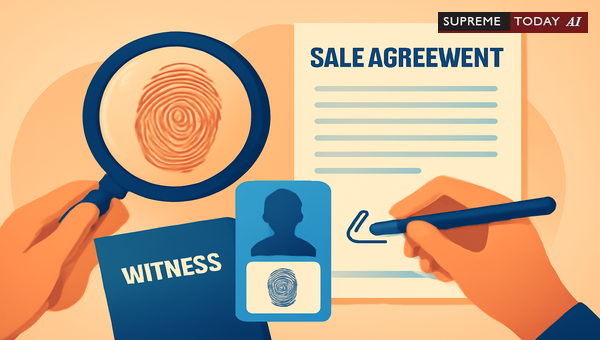
Can Witnesses Identify Signatures on Sale Agreements in Court?
In property transactions, registered agreements of sale often hinge on the authenticity of signatures or thumb impressions, commonly referred to as (). A critical question arises: whether sign of a person on Registered agreement of sale could be identified by the plaintiff and other witnesses and same can be marked during the course of cross examine? This issue is pivotal in disputes over , where witness testimony plays a starring role.
This blog post delves into the legal framework, drawing from established case law under the , and related judgments. While generally permissible, such identifications must meet specific . Note: This is general information, not legal advice; consult a qualified lawyer for your case.
Main Legal Finding: Yes, with Conditions
The sign of a person—be it a signature or —on a registered agreement of sale can be identified by witnesses, and this identification can be used during to test authenticity. Witnesses familiar with the mark, having seen it made, are key to proving genuineness. Courts recognize this as standard practice, provided the testimony is credible and consistent. 1999 3 Supreme 102
Key points include:- Witnesses who have seen the signature or can attest to it.- Such evidence is admissible and subject to .- Courts emphasize scrutinizing witness reliability to prevent fraud. 2019 0 Supreme(P&H) 2411
Significance of Witness Identification
Under the Indian Evidence Act, witness identification forms a cornerstone of proving document execution. For instance, in a case involving a vendor's thumb impressions, (PW1 and PW9) were coherent and consistent regarding the impressions and passage. This highlights how witnesses' familiarity establishes authenticity. 2019 0 Supreme(P&H) 2411
Similarly, principles from (for wills, analogous to sale deeds) require witnesses to have seen the signatory affix the mark. Failure to identify, as in one case where a witness has not identified the or signature of his father nor has he given evidence with reference to Ex.D1, weakens the case.
In , identifying the authenticate documents, reinforcing that proper identification supports validity. 2023 Supreme(Online)(KAR) 2001
Identification and Marking During
Courts permit marking documents via witness identification, even in . A judgment notes the lower court failed to consider the importance of witnesses' identification of signatures and the fact that can be used to test the genuineness of signatures. must review all evidence, including . 1990 0 Supreme(SC) 131 2011 0 Supreme(AP) 578
tests credibility: suggestions can challenge if the witness truly saw the mark. In one instance, a plaintiff could not have identified the Left Thumb Impression found in Exhibit-D12, since no person can identify his or her own Left Thumb Impression found in a document when confronted in evidence, illustrating limits but affirming general permissibility for others. 2017 0 Supreme(Kar) 763
During trials, plaintiffs often examine themselves and to prove execution, with documents marked as exhibits (e.g., Ex.P1). Unchallenged statements bolster claims.
SHANKAR IRABASAPPA DODDAMANI vs BASAVANAGOUDA SHIVARAYAPPA GILAGERI
2023 Supreme(Online)(KAR) 10486Legal Principles from the Indian Evidence Act
Sections like 45-47 allow opinion evidence on handwriting/signatures, but witness testimony who saw the act is primary and non-expert. arise if signatures lack corroboration by independent witnesses. 1999 3 Supreme 102
Related laws, such as , mirror this for wills: witnesses must see the mark. Analogously, for sale agreements, each of the witnesses shall sign the will in the presence of the principles apply to ensure attestation.
In suits, plaintiffs prove execution by self and , marking agreements without objection if stamped properly. 2021 0 Supreme(Mad) 796
Practical Application in Court Proceedings
Typically:1. Plaintiff tenders the document.2. Witnesses identify the /signature.3. Defense cross-examines to probe familiarity (e.g., did you see the person affix the mark?).4. Courts mark exhibits if genuine, later testing via experts if disputed.
In a sale deed fraud case, endorsements with LTMs proved consideration receipt, marked during evidence. 2013 0 Supreme(Kar) 1274
However, photocopies or unstamped documents face admissibility hurdles under the , . requires originals' proof. 2016 0 Supreme(MP) 1023
Power of attorney holders cannot always bind principals on personal knowledge matters, emphasizing direct witness need. 2017 0 Supreme(Kar) 763
Exceptions and Limitations
Not all identifications succeed:- Witness must have seen the mark made; mere familiarity insufficient.
- Inconsistent testimony invites rejection, as in cases relying on inadmissible photocopies. 2024 0 Supreme(P&H) 769- Own identification by the person is improbable without aids. 2017 0 Supreme(Kar) 763- Expert opinions supplement but don't replace witness evidence.- Fraud pleas require rebuttal beyond oral evidence, per . 2017 0 Supreme(Kar) 763
In rent control or , of common witnesses is allowed, but evidence must be case-specific. 2014 0 Supreme(Ker) 693
Recommendations for Litigants
- Examine key witnesses early: Attesting ones who saw execution.
- Prepare for : Anticipate challenges on sighting and consistency.
- Secure originals/stamps: Avoid admissibility issues. 2018 0 Supreme(MP) 46
- Use experts if disputed: For ink age or matching. 2017 0 Supreme(Kar) 763
- Courts should scrutinize circumstances to rely on credible evidence only.
Insights from Broader Case Law
In appeals, due execution via witnesses defeats time-bar claims, as silence infers refusal. 2021 0 Supreme(Mad) 796
Wills upheld when witnesses authenticate amid undue influence doubts, reversing misappreciations. 2023 Supreme(Online)(KAR) 2001
Fraud vitiates deeds if proven, but solid witness ID upholds them. 2013 0 Supreme(Kar) 1274
Conclusion and Key Takeaways
Witnesses generally can identify LTMs/signatures on registered sale agreements, marking them during to affirm authenticity. Backed by cases like 2019 0 Supreme(P&H) 2411 and 1990 0 Supreme(SC) 131, this upholds evidentiary integrity while allowing scrutiny.
Key takeaways:- Prioritize witnesses who saw the mark.- Leverage for/against.- Combine with documents/experts for robustness.
Property disputes turn on such proofs—stay informed, but seek professional counsel. For more on evidence law, explore our blog.
References:1. 1999 3 Supreme 102: Witness sighting for ID.2. 2019 0 Supreme(P&H) 2411: Consistent thumb ID.3. 1990 0 Supreme(SC) 131, 2011 0 Supreme(AP) 578: Cross-exam role.4. Others integrated as noted.
#EvidenceLaw #SignatureIdentification #LegalWitness












