


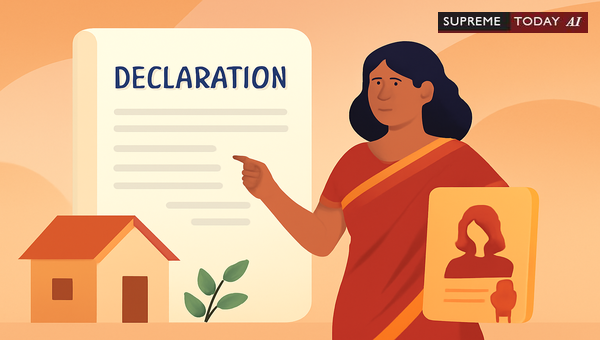
Does a Woman Need a to Claim Her Property Share?
In India, property disputes often arise within families, especially concerning women's rights to . A common question is: A Woman Would have to First File a to Get a Share in her Property. This query touches on key aspects of the and civil procedure, balancing inheritance rights with procedural requirements. While women's rights to property have strengthened post- amendments, the path to claiming a share isn't always straightforward.
This article breaks down when a is necessary, contrasts it with partition suits, and draws from judicial precedents. Note: This is general information, not legal advice. Consult a qualified lawyer for your specific case.
Understanding Declaration and Partition Suits
A seeks a court declaration affirming one's title or ownership rights to property, especially when disputed. It's crucial when there's a ''—doubts or challenges to ownership. In contrast, a divides jointly owned property among co-owners, presupposing established rights.
Legal documents highlight this distinction: The suit was valued based on the share sought for partition, not on the entire property, indicating it was not a 2023 0 Supreme(SC) 585. Courts emphasize that partition suits divide assets, while declaration suits establish foundational rights 2008 0 Supreme(SC) 1176.
When Can a Woman Claim Property Share Without a ?
Not always. If a woman's rights are clear—via inheritance, co-ownership, or intestate succession—she may proceed directly to a . For instance:
- As a , she can claim shares without prior declaration if unchallenged. Plaintiffs have succeeded based on heir status 2016 7 Supreme 713 2023 7 Supreme 401.
- Courts uphold direct partition when title is undisputed: If a woman has a clear title or right to a share in the property, she may pursue a directly 2008 0 Supreme(SC) 1176.
Under the , property devolves automatically to heirs in , allowing partition claims without declaration 2023 7 Supreme 401.
When Is a Necessary?
Declaration becomes essential if title is contested, third parties claim rights, or possession is unclear. Additional sources reinforce this:
- In disputes, women file declarations to affirm shares: The plaintiff got issued Ex.A1 claiming her share in the subject property, whereas through Ex.A3, the 1st defendant stated that the plaintiff would not get any share 2023 0 Supreme(AP) 1514.
- A widow filed to preserve her share amid family conflicts: She has filed a suit to preserve her share in the suit property 2019 0 Supreme(Mad) 736.
- Courts grant both declaration and partition: The plaintiff is entitled to get a declaration and get partition of her share in all the suit properties 2018 0 Supreme(Mad) 3814.
Other cases stress declaration for contested titles:
- That was a suit of declaration of share in the property. The plaintiff was not in exclusive possession 2015 0 Supreme(Ori) 416.
- Widows or mothers may need suits to enforce shares: such a right must be given to the woman or widow or mother, enabling her to file a suit as her right to get share in the suit property 2014 0 Supreme(Bom) 2447.
- When denied rights: When she was not given her legitimate right in the property, she filed a suit for declaration that she is entitled to 1/5th share 2010 0 Supreme(Kar) 326.
Summary insights confirm: Declaration suits establish rights, especially in contested scenarios 2025 0 Supreme(Mad) 3103 2025 0 Supreme(Mad) 2968 2024 2 Supreme 271 2023 0 Supreme(Mad) 2926 2024 0 Supreme(Mad) 2130 2023 0 Supreme(Mad) 937 2024 0 Supreme(Mad) 252 2025 Supreme(Online)(Kar) 41570 2022 0 Supreme(Guj) 1136. Possession alone doesn't confer ownership; suits formalize claims 2024 0 Supreme(Mad) 2130 2025 0 Supreme(Mad) 3103.
Key Exceptions and Challenges
- : Declarations assert rights in personal assets 2025 0 Supreme(Mad) 3103.
- Proof Requirements: Claimants must evidence family arrangements or partitions; lack thereof leads to rejection 2023 0 Supreme(Mad) 937 2024 0 Supreme(Mad) 252 2022 0 Supreme(Guj) 1136.
- Partition Limitations: Declaration clarifies ownership, but partition is needed for division 2023 0 Supreme(Mad) 2926 2024 0 Supreme(Mad) 2130.
Judicial Precedents and Women's Rights
Courts protect women's shares but require procedural steps:
- Heirs succeed without declaration if rights are evident 2016 7 Supreme 713.
- Challenges necessitate clearance: Serious defendant claims trigger declarations 2008 0 Supreme(SC) 1176.
Broader trends show women filing declarations alongside partitions for security, particularly in joint family or ancestral properties.
Practical Recommendations
- Assess Title Clarity: Clear inheritance? Opt for partition. Disputes? File declaration first 2008 0 Supreme(SC) 1176.
- Gather Evidence: Birth certificates, death records, family settlements prove heirship.
- Consider Costs and Time: Declarations add steps but prevent future litigation.
- Seek Partition Post-Declaration: Secure division and possession.
- Professional Guidance: Engage lawyers early; limitations apply under the .
Conclusion and Key Takeaways
A woman does not necessarily have to first file a if her property rights are undisputed via inheritance or co-ownership. Partition suits often suffice 2023 0 Supreme(SC) 585 2016 7 Supreme 713 2023 7 Supreme 401. However, typically, a is advisable or required when title is clouded, as seen in numerous precedents 2023 0 Supreme(AP) 1514 2018 0 Supreme(Mad) 3814 2015 0 Supreme(Ori) 416 2010 0 Supreme(Kar) 326.
Key Takeaways:- Clear rights → .- Disputed title → Declaration first.- Always prove entitlement with documents.- Women's rights are robust, but proactive suits enforce them.
Disclaimer: Laws evolve; outcomes depend on facts. This overview draws from cases like 2023 0 Supreme(SC) 585 2016 7 Supreme 713 2023 7 Supreme 401 2008 0 Supreme(SC) 1176 2023 0 Supreme(AP) 1514 2019 0 Supreme(Mad) 736 2018 0 Supreme(Mad) 3814 2015 0 Supreme(Ori) 416 2014 0 Supreme(Bom) 2447 2010 0 Supreme(Kar) 326. Consult legal experts for tailored advice.
#PropertyLawIndia, #WomensRights, #DeclarationSuit












