
 Back
Back





IN THE HIGH COURT OF KARNATAKA
C.M. Joshi, J.
Mahboob Sab – Appellant
Versus
Peersab – Respondent
Regular Second Appeal No. 7384 of 2011
Decided On : 07-07-2023
POSSESSION - Transfer of Property Act - Sections 106, 111(h) - The court analyzed the requirements of notice under Section 106 of the Transfer of Property Act, emphasizing that the intention to terminate the tenancy need not explicitly use the word 'termination.' The court interpreted Section 111(h) to support that a notice indicating an intention to quit suffices for lease determination. This interpretation influenced the court's decision to overturn the lower courts' dismissals of the plaintiff's suit for possession.
Fact of the Case:
The plaintiff filed a suit for possession of property based on a Gift Deed from his adoptive father. The defendants, who were residing in a portion of the property, denied the plaintiff's ownership and claimed a partition of the property. The trial court dismissed the suit, citing improper notice of termination of tenancy.
Finding of the Court:
The appellate court upheld the trial court's dismissal, stating that the notice issued by the plaintiff did not comply with the requirements of Section 106 of the Transfer of Property Act. The courts below failed to recognize the plaintiff's ownership and the nature of the tenancy.
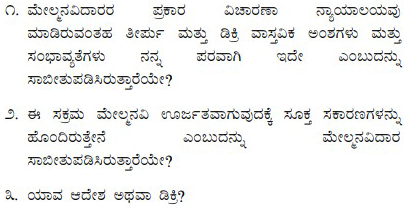
Issues: Whether the notice issued by the plaintiff was sufficient to terminate the tenancy under Section 106 of the Transfer of Property Act, and whether the plaintiff had established his ownership of the property.
Ratio Decidendi: The court concluded that the intention to terminate the tenancy was adequately expressed in the notice, despite the absence of the word 'termination.' The court emphasized that the interpretation of the notice should focus on the intention of the parties rather than strict adherence to wording.
Final Decision: The appeal was allowed, the judgments of the lower courts were set aside, and the defendants were ordered to vacate the property within four months.
JUDGMENT
1. This second appeal is directed against the concurrent findings by the learned Principal Civil Judge (Jr.Dn), Sindhanur, in OS No.89/2008 dtd. 7/4/2010 and the learned Senior Civil Judge and JMFC, Lingasugur, in RA No.5/2010 dtd. 30/6/2011, whereby, the suit filed by the plaintiff came to be dismissed.
2. The parties would be referred to as per their ranks before the Trial Court for the sake of convenience.
3. Brief facts are as below:
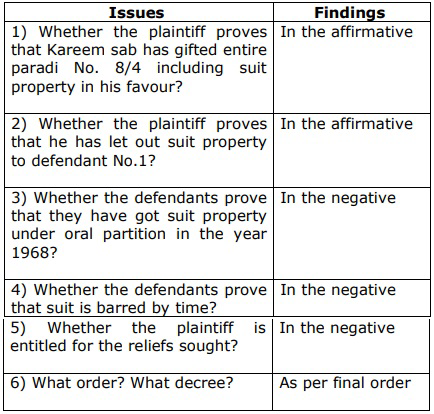
The appellant/plaintiff filed a suit for possession of the suit schedule property contending that the Paradi No.8/4 measuring 06 guntas at Ward No.6, Katebase Lane of Sindhanur, is the property belonging to him on the basis of a Gift Deed dtd. 3/9/1981. He contended that originally, the suit schedule property belonged to his maternal grand father Jalalsab and after his demise it devolved upon his son Abdul Karim Sab. He had no issues and therefore, he adopted the plaintiff as his son and the plaintiff was looking after him. Out of love and affection, Abdul Karim Sab, executed the Gift Deed on 3/9/1981 in favour of the plaintiff and since then he is the owner in title of the suit property. Accordingly, his name appears in the municipal records. In a portion of the said property measuring 06 guntas, he has put up a shed measuring 30 feet North-South and 30 feet EastWest for his residence. The defendant No.1 was residing at Javalagera and having no work at Javalagera village he returned to Sindhanur. He requested the plaintiff to help him and therefore, the plaintiff gave a portion of the said shed measuring East-West 30 feet and North-South 15 feet for his residence. The defendant No.1 had agreed to pay the rent for his residence in the said shed and agreed to vacate the same whenever the plaintiff demands. The plaintiff further contended that the defendant No.1 was staying in the said shed along with defendant Nos. 2 and 3 and defendants did not pay the rent and therefore, the plaintiff requested the defendants to pay the rent and to vacate the shed. When they did not heed to the request, a panchayat was held, who advised the defendants but it went in vain. Therefore, the plaintiff got issued a legal notice to the defendants on 11/2/2008 calling upon them to vacate the said shed which they did not comply despite receiving the notice. Therefore, it is contended that the defendants be directed to handover the possession of the suit property i.e. the shed occupied by the defendants.
4. In response to the summons, the defendants appeared through their counsel and filed the written statement contending that the suit of the plaintiff is misconceived and the suit is not maintainable. They contended that the entire Paradi No.8/4 is only in respect of the portion held by the plaintiff and not the entire 06 guntas of land. They admitted that the property held by Jalalsab had devolved upon his son Abdul Karim Sab. They also admitted that Abdul Kareem Sab had no issues and they pleaded ignorance about the alleged adoption of the plaintiff by Abdul Karim sab. They contended that the Abdul Karim Sab was also residing with the plaintiff as well as the defendant No.1 and denied that Abdul Karim Sab had executed the Gift Deed in favour of the plaintiff. They contended that if at all any such Gift Deed is executed, it is fraudulent and without the knowledge of the defendant No.1 and is intended to knock down the entire property by himself. Thus, they contended that the alleged Gift Deed is not binding on them. It is contended that TMC Number shown in the plaint pertains to the extent in possession and enjoyment of the plaintiff which is to the extent of 90 feet x 120 feet only and it do not include the portion in which the defendant Nos. 1 and 2 are in possession which is measuring 20 feet x 60 feet. They contended that a portion of the property occupied by the plaintiff was assigned in favour of his wife. It is contended that the defendant Nos. 1 and 2 were regularly paying tax over the extent of land h
AI

Acceptance of rent by a landlord after the issuance of a quit notice does not amount to a waiver of the notice or a renewal of the lease unless there is express or implied consent from the landlord.

The main legal point established in the judgment is the application of Section 106 of the Transfer of Property Act, 1882, to establish the existence of the oral tenancy and the bonafide requirement o....


A valid notice to quit under Section 106 of the Transfer of Property Act is mandatory to terminate a tenancy, regardless of original lease terms dispensing with such notice.


The main legal point established in the judgment is the validity of the quit notice issued under section 106 of the Transfer of Property Act and the jurisdiction of the Civil Court to try the suit.

Lease agreements with clauses allowing eviction can exempt parties from notice requirements under Section 106 of the T.P. Act.



An indispensable Tool for Legal Professionals, Endorsed by Various High Court and Judicial Officers
Please visit our Training & Support
Center or Contact Us for assistance

Scan Me!
India’s Legal research and Law Firm App, Download now!


For Daily Legal Updates, Join us on :



 Back to top


