
 Back
Back





IN THE HIGH COURT OF KARNATAKA
M. Nagaprasanna, J.
Mr. Aravinda – Appellant
Versus
State of Karnataka & Ors. – Respondents
Criminal Petition No.12056 of 2022
Decided On : 25-06-2024
EVIDENCE - CRIMINAL TRIAL - IPC SECTIONS: 114, 143, 147, 148, 149, 302, 307, 324, 447, 109, 120B; SC & ST (Prevention of Atrocities) Amendment Act, 2015 SECTIONS: 3(1)(r), 3(1)(s), 3(1)(w), 3(2)(v), 3(2)(va) - The court discussed the admissibility of electronic evidence under Section 65B of the Evidence Act, emphasizing the importance of allowing the accused to confront witnesses with relevant evidence. The court highlighted that withholding evidence could obstruct the truth-seeking process in a criminal trial, ultimately allowing the playing of video footage to ensure a fair trial.
Fact of the Case:
The petitioner, accused No.3, challenged an order from the 1st Additional District and Sessions Judge, which denied his request to confront a witness with video footage related to a murder case. The footage allegedly contradicted the prosecution's claim that the victim was brought dead to the hospital, which was central to the case against him.
Finding of the Court:
The court found that the denial of the request to play the video footage was unsustainable, as it could potentially lead to the discovery of truth in the trial. The court emphasized that every criminal trial is a journey towards discovering the truth and that the accused must be given a fair opportunity to defend themselves.
Issues: Whether the video footage could be admitted as evidence to confront the witness and whether the previous statements made in the presence of police could be considered relevant for the trial.
Ratio Decidendi: The court held that electronic evidence, such as video footage, is admissible if it is relevant to the matter in issue. The court distinguished the case from previous judgments by noting that the statements sought to be confronted were made at the scene of the crime, not after the filing of the charge sheet, thus warranting their admissibility.
Final Decision: The court allowed the criminal petition, set aside the previous order, and directed the trial court to permit the playing of the video footage for confrontation with the witness, ensuring that all legal parameters were followed.
ORDER
M. Nagaprasanna, J. - The petitioner/accused No.3 is knocking at the doors this Court calling in question an order dated 02-12-2022 passed by the 1st Additional District and Sessions Judge, Chikkaballapur in Spl.S.C.No.46 of 2021 arising out of crime in Crime No.43 of 2021 registered for offences punishable under Sections 114, 143, 147, 148, 149, 302, 307, 324, 447, 109 and 120B of the IPC and Section 3(1)(r), 3(1)(s), 3(1)(w), 3(2)(v), 3(2)(va) of the SC & ST (Prevention of Atrocities) Amendment Act, 2015 ('the Act' for short).
2. Heard Sri K.B.K. Swamy, learned counsel for the petitioner, Sri P. Thejesh, learned High Court Government Pleader for respondent No.1 and Sri S.R. Sreeprasad, learned counsel appearing for respondent No.2.
3. The facts, in brief, germane are as follows:-
A complaint comes to be registered on 22-03-2021 by the 2nd respondent/complainant alleging that she was a grantee of 2 acres 15 guntas of land in Sy.No.280 of Avalnagenahalli Village, Chikkaballapura Taluk and the adjoining area of 3 acres on the eastern side is said to be reserved for a graveyard. It is the allegation that the present petitioner has encroached upon the portion of the said grave yard and has fenced the same which is objected to by the husband of the complainant. In this regard a civil suit comes to be filed by the sons of one Girgi Venkata Reddy in O.S.No.6 of 2011 and the said suit is pending consideration. On 22-03-2021 at about 5.30 p.m. there appears to be an assault by several persons upon the husband of the complainant who succumbed to the injuries. This forms the fulcrum of crime including murder and attempt to murder with all other allegations, as well as offences punishable under the Act.
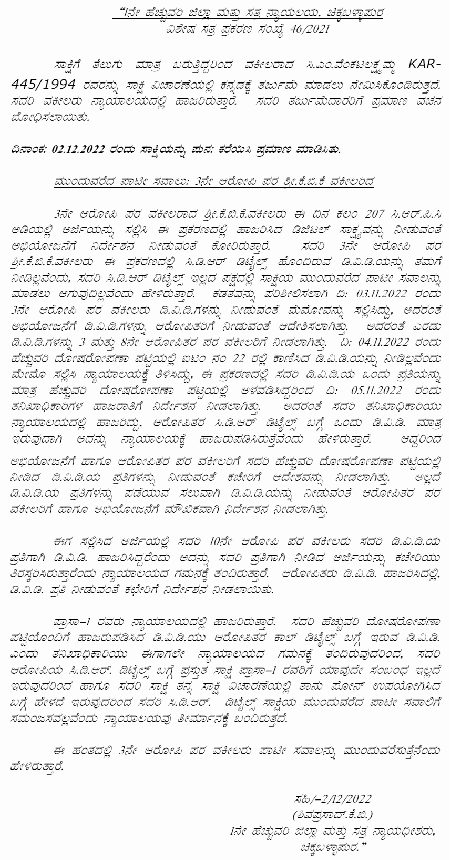
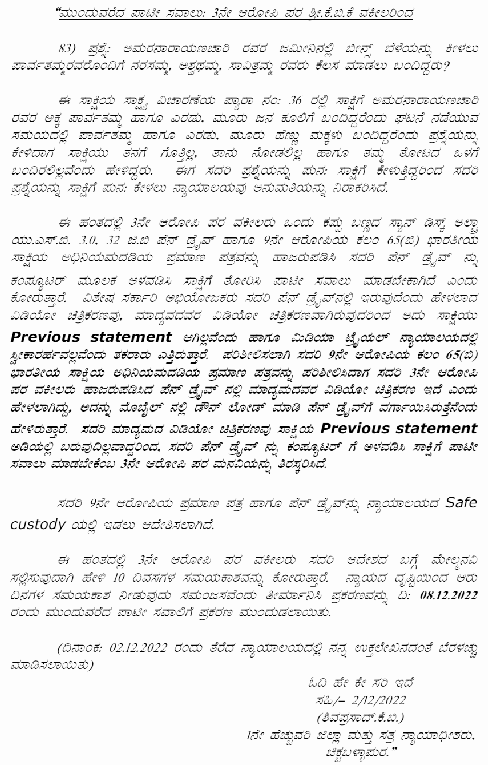
4. The Police conduct investigation and file a charge against 11 persons and dropped 3 persons from the array of accused, on the score that their presence in the scene of crime was not proved. The trial then commenced. The prosecution examined CW-1 to CW-7 as PW-1 to PW-7. The de-facto complainant was also examined as PW-1 and about 15 documents were marked as Exs.P1 to P15. PW-1 was subjected to cross-examination by the accused. During the course of cross-examination, accused No.3, the present petitioner places a request to the concerned Court to permit him to confront PW-1 by playing a video footage. Accordingly a certificate under Section 65B of the Evidence Act was also submitted to the Court with regard to the genuinity of the video footage. It is the case of the petitioner that the prosecution had drawn up the charge that the injured was brought to the hospital from the scene of crime on 22-03-2021. The contention of the prosecution is that the husband of the complainant was brought dead to the hospital. The video footage, according to the petitioner, had something different which would completely demolish the case of the prosecution, as he was not brought dead. It is the further case of the petitioner that certain statements in the presence of the Police Officers were recorded by the media who were present there, to cover the news of the alleged incident. The aforesaid video containing the statement of the injured was widely circulated in various social media platforms including whatsapp. In that background the accused intended to confront the injured witness PW-1 by playing the said video footage. It is, therefore, the request was placed before the concerned Court. That having been turned down is what has driven the petitioner to this Ccourt in the subject petition.
5. The learned counsel appearing for the petitioner Sri K.B.K.Swamy would vehemently contend that in a criminal trial the accused must be provided all opportunity to defend his case. It is his case that complete set of Call Detail Records (CDR) which was filed with the supplementary charge sheet is not provided to the accused in its entirety and the examination of the video footage in confrontation with PW-1 would demolish the case of the prosecution in its entirety. I
AI


The main legal principle established in the judgment is the importance of confronting witnesses with their previous statements to ensure a fair trial, as mandated by Section 145 of the Evidence Act a....




The court confirmed video conferencing for evidence recording aligns with modern judicial practices despite legal challenges on witness presence.

Accused have the right to access a transcript of the victim's Audio/Video Recorded Statement to ensure a fair trial and effective defense.


The certificate under Section 65-B of the Evidence Act must accompany the electronic record when it is produced in evidence, and the prosecution is obligated to supply all documents upon which relian....

Proof of demand and acceptance of bribe is essential for conviction under the Prevention of Corruption Act; mere identification in recordings is insufficient without corroborative evidence.



An indispensable Tool for Legal Professionals, Endorsed by Various High Court and Judicial Officers
Please visit our Training & Support
Center or Contact Us for assistance

Scan Me!
India’s Legal research and Law Firm App, Download now!


For Daily Legal Updates, Join us on :



 Back to top


