
 Back
Back





IN THE HIGH COURT OF KARNATAKA
M. Nagaprasanna, J.
Sri. Xxxx – Appellant
Versus
State of Karnataka & Ors. – Respondents
Criminal Petition No.7704 of 2022
Decided On : 28-06-2024
RAPE - CONSENSUAL RELATIONSHIP - IPC Sections 376, 417, 493, 506 - The court analyzed the definitions and interpretations of Sections 375 and 376 of the IPC, emphasizing that consensual relationships, even if based on a promise of marriage, do not constitute rape unless there is clear evidence of deceit or lack of consent. The court referenced precedents that distinguish between consensual sex and rape, concluding that the relationship between the petitioner and the complainant was consensual and did not meet the criteria for rape under the IPC. The court quashed the proceedings against the petitioner, asserting that allowing the trial would be an abuse of the legal process.
Fact of the Case:
The petitioner, who ran a mobile service shop, developed a consensual relationship with the complainant over six years. After the petitioner informed the complainant of his engagement to another woman, she filed a complaint alleging rape and other offenses, leading to the petitioner’s arrest and subsequent charge sheet by the police.
Finding of the Court:
The court found that the relationship was consensual and that the allegations of rape did not meet the legal definitions required under Section 375 of the IPC. The court emphasized that the complainant's own admissions indicated a consensual relationship, and thus, the charges were not sustainable.
Issues: Whether the relationship between the petitioner and the complainant constituted rape under Section 376 of the IPC, and whether the other charges under Sections 417, 493, and 506 were valid.
Ratio Decidendi: The court held that consensual sexual relationships, even if based on a promise of marriage, do not amount to rape unless there is clear evidence of deceit or lack of consent. The court reiterated that the burden of proof lies with the prosecution to establish the elements of the offense, which were not met in this case.
Final Decision: The court allowed the petition, quashed the proceedings in S.C.No.1383 of 2021, and stated that the observations made would not influence any other proceedings between the parties.
ORDER
M. Nagaprasanna, J.
The petitioner is before this Court calling in question proceedings in S.C.No.1383 of 2021 pending before LIII Additional City Civil and Sessions Judge, Bengaluru arising out of crime in Crime No.171 of 2018 registered for offences punishable under Sections 376 and 417 of the IPC.
2. Facts, in brief, adumbrated are as follows:-
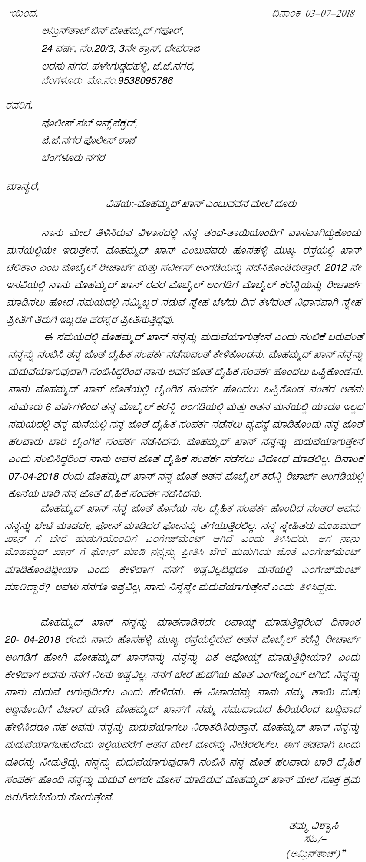
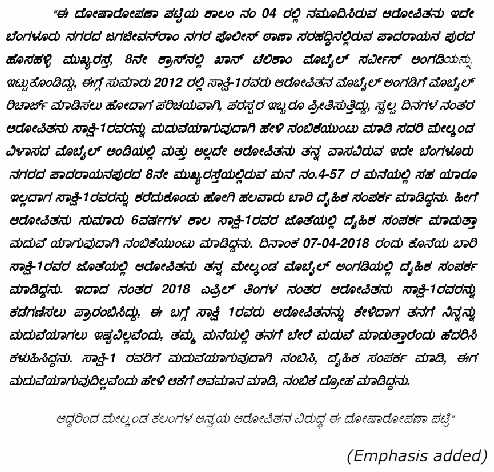
The 2nd respondent is the complainant. It is the case of the prosecution that the complainant is a resident of Hosahalli Main Road, Padarayanapura, Bengaluru. The petitioner who was also a resident of the same area was running a mobile service and re-charge centre. The complainant comes in contact with the petitioner, as every now and then the complainant used to visit the shop of the petitioner to get her pre-paid sim re-charged. The story begins in the year 2012. It is the case of the prosecution that the complainant and the petitioner developed friendship which then get into physical relationship and all the escapades used to happen in the shop itself. A crime then comes to be registered on 03-07-2018 on the ground that the petitioner had last of the incident of sexual intercourse with the complainant on 07-04-2018 and thereafter he began to avoid answering calls of the complainant and the complainant comes to know that he got engaged with some other girl. Therefore, the complaint comes to be registered for the aforesaid offences. On registration of the complaint, the petitioner was arrested and interrogated, at which point in time, he is said to have confessed that he has indulged in physical relationship with the complainant on the pretext of marriage. All these happen after registration of crime in Crime No.171 of 2018 for the afore-said offences. The Police, after investigation, file a charge sheet against the petitioner for the aforesaid offences along with the offences punishable under Sections 493 and 506 of the IPC. The learned Magistrate takes cognizance of the offences against the petitioner on 04-04-2019 and issues process. Since the offences alleged were exclusively triable by the Court of Sessions, the case was committed to the Court of Sessions and is presently pending before the Court of Sessions as S.C.No.1383 of 2021. Aggrieved by the same, the petitioner is before this Court calling in question the proceedings before the Court of Sessions.
3. Heard Sri N.Tejas, learned counsel appearing for the petitioner, Sri Harish Ganapathi, learned High Court Government Pleader appearing for respondent No.1 and Sri H. Sunil Kumar, learned counsel appearing for respondent No.2.
4. The learned counsel appearing for the petitioner submits that in the year 2012 the petitioner was running a mobile re-charge and service shop. Complainant used to visit the shop frequently to get her mobile re-charged. Since she became a regular customer, the 2nd respondent herself developed friendship with the petitioner and the friendship turned into relationship. On 20-04-2018 the complainant visits the shop and asks the petitioner why he is evading her, to which the petitioner appears to have informed that he was no more interested in her and that he got engaged to another girl and requested not to disturb his personal life. This is projected to be a rape in the complaint by blackmailing for extortion of money and all other instances including the complainant trying to commit suicide by consuming phenol.
4.1. The learned counsel would submit that none of the above factors are true. The relationship was completely consensual and whatever happened has happened not for a day, but for over six years. Further he has made it clear that always there was no promise of marriage between the two; it was only consensual relationship. It is his further submission that the complainant herself began to harass the petitioner and demanded Rs.10/- lakhs and alleging extortion the petitioner himself has registered a crime in Crime No.172 of 2018 which is also on 03-07-2018 and the Police after investigation have fil
AI
The court established that consensual sexual relationships do not constitute rape under Section 376 of the IPC unless there is clear evidence of deceit or lack of consent, emphasizing the importance ....
Section 375 of IPC states that a man is said to commit rape if he has had any form of sexual intercourse without consent of a woman.
An offence is punishable under Section 376 of IPC if offence of rape is established in terms of Section 375 which sets out ingredients of offence.

Consent obtained under a false promise of marriage does not constitute rape if the accused had no intention to deceive at the time of the promise.
Consent in consensual relationships invalidates allegations of rape; merely non-fulfilling marriage promises does not constitute a crime when prior consent for sexual interactions is established.
A breach of promise to marry does not constitute rape unless it can be proven that the promise was made with intent to deceive from the outset.
Consensual sexual relationships do not constitute rape even if they are based on a promise of marriage that was not fulfilled, unless there is evidence of fraudulent intent.
Consent given under a misconception of fact does not constitute valid consent for rape; a distinction exists between a false promise of marriage and a breach of promise.



An indispensable Tool for Legal Professionals, Endorsed by Various High Court and Judicial Officers
Please visit our Training & Support
Center or Contact Us for assistance

Scan Me!
India’s Legal research and Law Firm App, Download now!


For Daily Legal Updates, Join us on :



 Back to top


