
 Back
Back





IN THE HIGH COURT OF KARNATAKA AT BENGALURU
M. NAGAPRASANNA, J.
SHIVADHANUSH T.G. @ BEERAPPA S/O SHRI GIRISH T.K. – Petitioner
Versus
STATE OF KARNATAKA – Respondent
Criminal Petition No. 9120 of 2024
Decided On : 05-11-2024
Indian Penal Code, 1860 - Sections 375, 376, 417, and 504 - Allegations of rape and cheating based on a false promise of marriage - The relationship between the parties was consensual, lasting over seven years, with an engagement that did not culminate in marriage - The court emphasized that consent obtained under a false promise does not constitute rape if the accused had no intention to deceive at the time of the promise - The FIR and charge sheet did not establish the essential ingredients of rape as defined under Section 375 IPC. (Paras 1-18)
Facts of the case:
The petitioners challenged the FIR and charge sheet for offences under IPC sections, alleging that the first petitioner had a consensual relationship with the complainant, which included physical intimacy based on a promise of marriage that was not fulfilled.
Findings of Court:
The court found that the allegations did not prima facie constitute an offence under Section 376 IPC, as the relationship was consensual and the promise of marriage was not proven to be false from inception.
Issues: The main issue was whether the allegations indicated a case of rape or merely a breach of promise to marry.
Ratio Decidendi: The court ruled that the relationship was consensual and that the promise of marriage did not amount to a misconception of fact that would vitiate consent under Section 375 IPC.
Result: The FIR and charge sheet were quashed, and the proceedings against the petitioners were dismissed.
ORDER :
1. The petitioners are before this Court calling in question the crime registered in Crime No. 140 of 2023 and charge sheet bearing No. 13 of 2024 for offences punishable under Sections 376, 417 and 504 of the IPC.
2. Facts in brief, germane, are as follows:
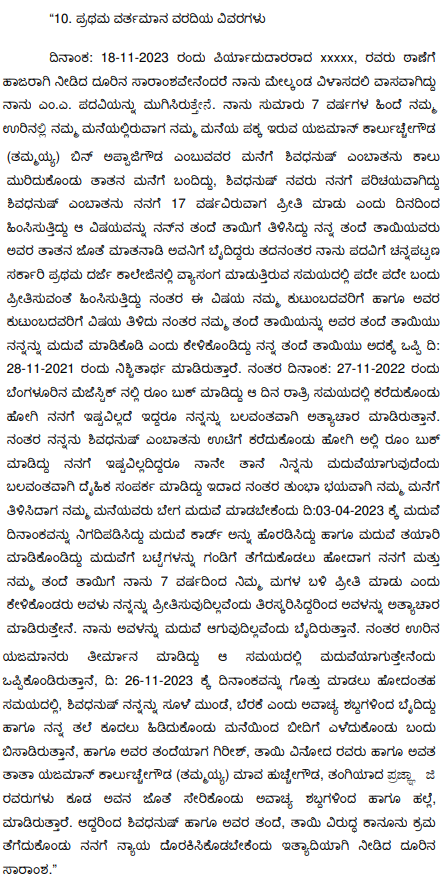
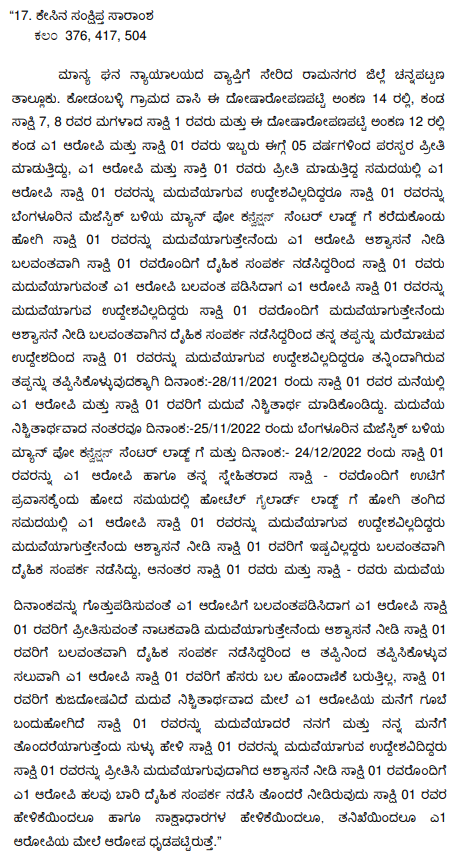
Before embarking upon consideration of the issue on its merit, I deem it appropriate to notice the relationship between the protagonists in the alleged episode of crime. The 1st petitioner and the 2nd respondent are said to be in a relationship. Petitioners 2, 3, 4, 5, and 6 are accused 2 to 6, they are the family members of the 1st petitioner/accused No. 1. The 2nd respondent is the complainant. The 1st petitioner is an employee working in the office of the sub-registrar at Indiranagar, Bangalore. He gets embroiled in a crime in Crime No. 140 of 2023 for it having been registered by the 2nd respondent. The gist of the complaint is that, the 1st petitioner and the complainant were known to each other for 7 years and they were also said to be in love. The friendship blossomed into relationship and the relationship led to engagement of the 1st petitioner with the 2nd respondent/complainant on 28-11-2021. Before and after the engagement, it is the averment in the complaint that they have had physical relationship as well. The engagement did not result in marriage.
3. On the score that the 1st petitioner has had physical relationship with the complainant on the promise of marriage and the relationship was for over 7 years, the 1st petitioner has breached the promise of marriage, as the engagement did not result in marriage, crime comes to be registered for offence of rape and cheating in Crime No. 140 of 2023. The police, after investigation, file a charge sheet against all the petitioners, the 1st petitioner and other members of the family. They are arraigned as accused Nos.1 to 6. Filing of the charge sheet is what has driven these petitioners to this Court in the subject petition.
4. Heard Smt Sadhana S. Desai, learned counsel appearing for petitioners, Sri B N Jagadeesha, learned Additional State Public Prosecutor appearing for respondent No. 1 and Sri Avishkar, learned counsel appearing for respondent No. 2.
5. The learned counsel for the petitioner would vehemently contend that the relationship between the 1st petitioner and the 2nd respondent was consensual, it was not for one year, but they knew each other for 7 years, got engaged on 28-11-2021 and due to skirmishes between the members of the family of the complainant and the 1st petitioner, the engagement broke. But between the date of engagement and its break, the complainant and the petitioner have gone around to several places and have had physical relationship. Therefore, the learned counsel would submit that the consent of the complainant for a consensual act is implicit throughout. It is her submission that the consent cannot be dubbed as, misconception of fact or forcibly taken. She would contend that such acts would not amount to an offence of rape and the offence of cheating also cannot be laid on breach of promise of marriage. She has placed reliance upon several judgments of the Apex Court and that of High Court of Kerala, all of which would bear consideration qua their relevance in the course of the order.
6. Per-contra, the learned counsel appearing for the 1st respondent/State and the 2nd respondent/complainant in unison would contend that consent is taken of the complainant to have physical relationship on promise of marriage, which was never the intention of the 1st petitioner. Therefore, the two would submit that it is a false promise of marriage and would submit that the charge sheet is filed after investigation and it is for the petitioners to come out clean in a full blown trial.
7. I have given my anxious consideration to the submissions made by the respective learned counsel and have perused the material on record.
8. The afore-narrated facts are not in dispute. The 1st petitioner and the 2nd resp
AI
Consent obtained under a false promise of marriage does not constitute rape if the accused had no intention to deceive at the time of the promise.

Consensual sexual relationships do not constitute rape even if they are based on a promise of marriage that was not fulfilled, unless there is evidence of fraudulent intent.
Section 375 of IPC states that a man is said to commit rape if he has had any form of sexual intercourse without consent of a woman.
A breach of promise to marry does not constitute rape unless it can be proven that the promise was made with intent to deceive from the outset.

Consensual relationships cannot be classified as rape simply due to a breach of promise to marry; criminal liability requires clear evidence of bad faith or deceit by the accused.
Consent given under a misconception of fact does not constitute valid consent for rape; a distinction exists between a false promise of marriage and a breach of promise.
Consent in consensual relationships invalidates allegations of rape; merely non-fulfilling marriage promises does not constitute a crime when prior consent for sexual interactions is established.
The court established that consensual sexual relationships do not constitute rape under Section 376 of the IPC unless there is clear evidence of deceit or lack of consent, emphasizing the importance ....



An indispensable Tool for Legal Professionals, Endorsed by Various High Court and Judicial Officers
Please visit our Training & Support
Center or Contact Us for assistance

Scan Me!
India’s Legal research and Law Firm App, Download now!


For Daily Legal Updates, Join us on :



 Back to top


