
 Back
Back





IN THE HIGH COURT OF KARNATAKA AT BENGALURU
M. NAGAPRASANNA, J.
Mr. Santhosh Shetty, S/o. Anand Shetty and Ors. – Petitioners
Versus
State Of Karnataka, By Sub Inspector Of Police, Kundapura Police Station, Bengaluru, Represented By Its State Public Prosecutor High Court Of Karnataka and Anr. – Respondents
Criminal Petition No.13912 Of 2023
Decided On : 07-06-2024
ORDER :
(M. Nagaprasanna, J.) :
The petitioners are before this Court calling in question proceedings in C.C.No.1926 of 2023 pending before the Additional Civil Judge & JMFC, Kundapura registered for offences punishable under Sections 376, 471, 420, 109, 504 r/w 34 of the IPC.
2. Heard Sri S. Mahesh Kiran Shetty, learned counsel appearing for the petitioners, Sri P. Thejesh, learned High Court Government Pleader appearing respondent No.1 and Sri P.B. Umesh, learned counsel appearing for respondent No.2.
3. Sans details, facts germane are as follows:-
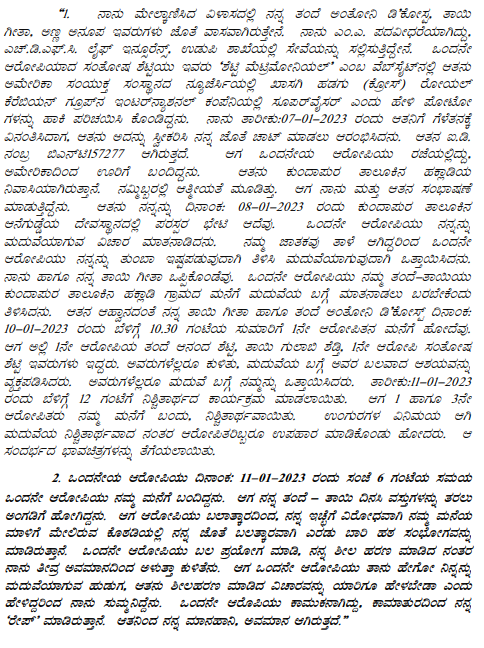
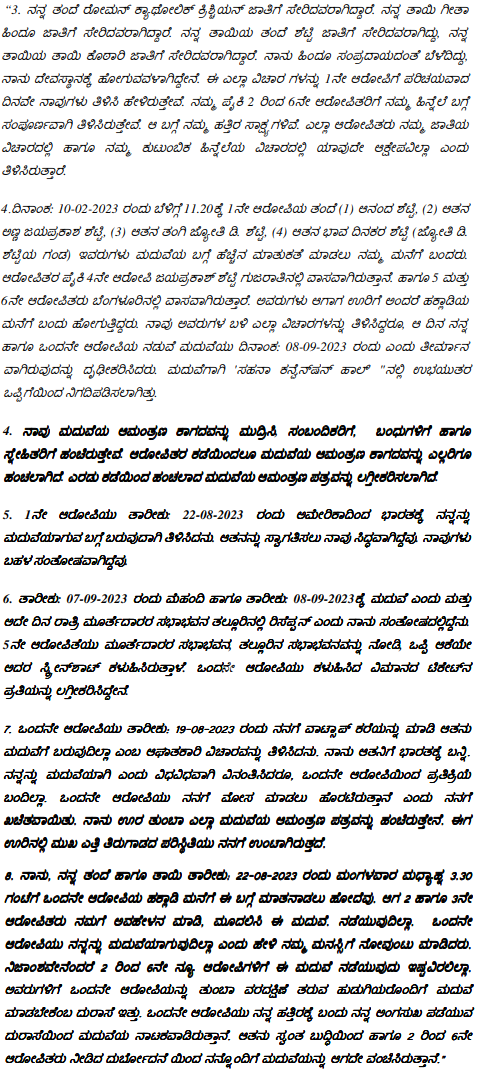
The 2nd respondent is the complainant. The 1st petitioner, in terms of the averments in the petition, is said to be working as a Supervisor in Royal Kerabiam Group International Shipping Company at New Jersey, United States of America, and was looking for a girl to get married. Owing to the said desire, he posted his profile, on matrimonial website called ‘Shetty Matrimonial’. After posting his profile, the 1st petitioner comes in contact with the 2nd respondent. Both began talks. This happens up to 07-01-2023. The 1st petitioner was in India at that point in time. On 08-01-2023, the 1st petitioner and the complainant met at a temple in Haklady and are said to have exchanged their opinions, which led to negotiations between the members of the families of both the 1st petitioner and the complainant. The proposal for marriage is said to have been accepted by the family members of both the families. Engagement of the 1st petitioner and the complainant is held on 11-01-2023.
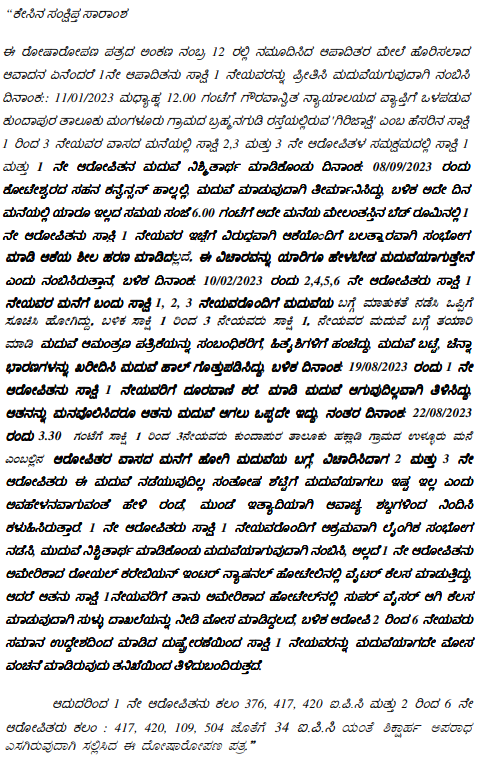
4. On 11-01-2023, it is the averment that the complainant asked the petitioner to transfer Rs.4/- lakhs to invest in some money earning fund. It is immediately done. On the morning of 12-01-2023 the 1st petitioner flies back to New Jersey. Communications between the two, including the families, galore. About seven months later emerges a complaint. Narration in the complaint is that on 11-01-2023 the 1st petitioner at about 6.00 p.m. noticing the fact that no one was in the house, forced the complainant to indulge in sexual intercourse, on the ground that the marriage of the 1st petitioner with the complainant had been agreed to be held on 08-09-2023. It is the further averment that believing the words of the family members of the 1st petitioner, invitations were also printed about the marriage. For manifold reasons which are narrated in the complaint, the engagement breaks and the marriage fails. It is then the aforesaid complaint emerges. All the family members including accused No.1, would be husband of the complainant are arrayed as accused in the complaint. The Police conduct investigation upon the complaint and file a charge sheet against all the petitioners. Filing of charge sheet is what has driven the petitioners to this Court in the subject petition.
5. The learned counsel appearing for the petitioners would vehemently contend that the incident narrated in the entire complaint is highly improbable. After the engagement, it is the case of the petitioners that all the family members never went away and there was no occasion at 6.00 p.m. on that day for the 1st petitioner to take the complainant to a room and indulge in sexual intercourse. It is the case of the 1st petitioner that throughout 7 months, the complainant goes on demanding money and, therefore, the family members doubting bona fides of the complainant decided to call off the marriage. The decision to call off the marriage cannot amount to cheating. Spending time with the complainant along with members of the family of the complainant cannot amount to rape under Section 376 of the IPC. It is his submission that there can be no better illustration of abuse of the process of law.
6. Per contra, the learned High Court Government Pleader appearing for the 1st respondent/State and the learned counsel appearing for the 2nd respondent/complainant would in unison submit that the Police after investigation have filed a charge sheet. Since the charge sheet is filed
AI
Consent given under a misconception of fact does not constitute valid consent for rape; a distinction exists between a false promise of marriage and a breach of promise.
Consent obtained under a false promise of marriage does not constitute rape if the accused had no intention to deceive at the time of the promise.

Section 375 of IPC states that a man is said to commit rape if he has had any form of sexual intercourse without consent of a woman.

Consensual relationships cannot be classified as rape simply due to a breach of promise to marry; criminal liability requires clear evidence of bad faith or deceit by the accused.
The court established that consensual sexual relationships do not constitute rape under Section 376 of the IPC unless there is clear evidence of deceit or lack of consent, emphasizing the importance ....
Consent in consensual relationships invalidates allegations of rape; merely non-fulfilling marriage promises does not constitute a crime when prior consent for sexual interactions is established.
A breach of promise to marry does not constitute rape unless it can be proven that the promise was made with intent to deceive from the outset.
Consensual sexual relationships do not constitute rape even if they are based on a promise of marriage that was not fulfilled, unless there is evidence of fraudulent intent.



An indispensable Tool for Legal Professionals, Endorsed by Various High Court and Judicial Officers
Please visit our Training & Support
Center or Contact Us for assistance

Scan Me!
India’s Legal research and Law Firm App, Download now!


For Daily Legal Updates, Join us on :



 Back to top


