
 Back
Back





IN THE HIGH COURT OF KARNATAKA (DHARWAD BENCH)
ANANT RAMANATH HEGDE, J.
Smt. Rukmini @ Rukmawwa and Ors. - Appellants
Versus
Maruti and Ors. - Respondents
Regular First Appeal No. 100208 of 2019 (DEC/PAR-)
Decided on : 04-10-2023
| Table of Content |
|---|
| 1. existence of ancestral properties and roles of parties. (Para 1 , 2 , 3 , 4 , 5 , 6) |
| 2. arguments regarding the validity of property sales. (Para 7 , 8) |
| 3. legal necessity and evidence in property cases. (Para 9 , 10 , 11) |
| 4. final ruling on ownership shares in properties. (Para 12 , 13) |
JUDGMENT :
Mr. Anant Ramanath Hegde, J. - The dismissal of the suit for partition in O.S.No.176/2017 on the file of the Principal Senior Civil Judge, Gokak, has given a cause of action to plaintiff No.1 to file this appeal.
2. The admitted genealogy of the parties is as under:-
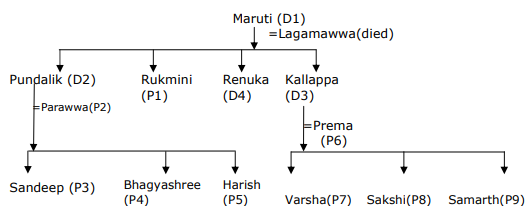
3. Maruti is the propositus and he is the first defendant. His wife Lagamawwa predeceased Maruti. The couple had two sons, Pundalik and Kallappa (second and third defendants) and two daughters, Rukmini and Renuka. Rukmani is the plaintiff and Renuka is defendant No.4. The children and wife of Pundalik have also joined Rukmini in filing the suit for partition. There are seven properties described in the plaint as the suit properties.
4. The suit is contested by 5th and 6th defendant. The said defendants are the purchasers of the property at Sl.No.5 under registered sale deed dated 22.11.2002 which is marked at Ex.P9. The said sale deed is executed by defendant No.1-Maruti. The wife of Maruti-Lagmawwa and the sons, Pundalik and Kallappa have also signed the sale deed as consenting parties.
5. On 28.01.2011, item Nos.1 to 4 properties are sold by defendant No.1 in favour of defendant No.7. Defendants No.2 to 4 have consented for the sale. The consenting parties to the sale did not contest the suit.
6. The trial Court has taken a view that sale is for the legal necessity and consequently, dismissed the suit. Aggrieved by the aforementioned judgment and decree, plaintiff No.1 is in appeal.
7. The learned counsel for appellant-plaintiff No.1 submits that the trial Court committed an error in holding that defendant No.1 has sold the property for legal necessity, in the absence of plea and evidence in this regard. It is also his contention that the properties are admittedly ancestral properties and this being the position, the sale transaction dated 28.01.2011 in respect of item Nos.1 to 4 properties could not have been held to be valid sale as the plaintiffs had acquired right in the property by reason of the birth in the family.
8. The learned counsel for defendants No.5 and 6- the purchasers would urge that the sale transaction in respect of item No.5 property took place on 22.11.2002 and assuming that the properties are the ancestral properties, the sale transaction effected before 20.12.2006 are saved in terms of the Amendment to section 6 of the HINDU SUCCESSION ACT , 1956, and if the properties are held to be the separate properties of Maruti, then also the sale transactions are valid transactions as the plaintiffs cannot question the sale effected by Maruti during his life time. Thus, he would defend the judgment and decree dismissing the suit in respect of item No.5 property.
9. This Court has considered the contentions raised at the Bar. The following point arises for consideration:-
"Whether the trial Court is justified in holding that the alienation of item Nos.1 to 4 properties are for legal necessity"
10. It is to be noticed in paragraph No.3 that plaintiffs have raised the contention that the suit properties are the ancestral joint family properties and item No.5 property was purchased from the income from item Nos.1 to 4 properties. To this plea, there is no contest by the sons of Maruti. Ex.P3 would clearly reveal that the properties at Serial No.1 to 4 are inherited after the death of Dundappa-the father of Maruti. Thus, the plea that the properties are the ancestral properties is very much established. When that being the position, all the children of Maruti acquired right in the properties at Serial No.1 to 4 by reason of birth in the family. Though the trial Court has taken a view that the sale of the year 2001 is for the legal necessity, the evidenc
AI
Sales of ancestral property require evidence of legal necessity, and the burden lies on the purchaser; lack of evidence invalidates claims of necessity.


In joint family property disputes, a guardian may transact on behalf of minors without court sanction, provided sales serve family interests.
The burden of proof lies with plaintiffs to demonstrate ownership rights, and valid alienation of property by family members for legal necessity cannot be contested without sufficient evidence.
Sale of ancestral property is valid if executed for legal necessity, including debt repayment, especially when plaintiffs fail to prove ownership claims.

The burden of proving legal necessity for the alienation of ancestral property lies on the alienee, and the transaction must be for the family's benefit, binding all undivided family members.

The Kartha of a joint family must prove legal necessity for alienation of family property; failure to demonstrate necessity invalidates alienation for coparceners' shares.
The legal principle established is that in cases involving the sale of joint family property, the burden of proving legal necessity lies with the purchaser only if the plaintiffs have properly pleade....
The burden of proof for legal necessity in property sales involving minors lies with the seller, and failure to provide evidence invalidates such sales.



An indispensable Tool for Legal Professionals, Endorsed by Various High Court and Judicial Officers
Please visit our Training & Support
Center or Contact Us for assistance

Scan Me!
India’s Legal research and Law Firm App, Download now!


For Daily Legal Updates, Join us on :



 Back to top


